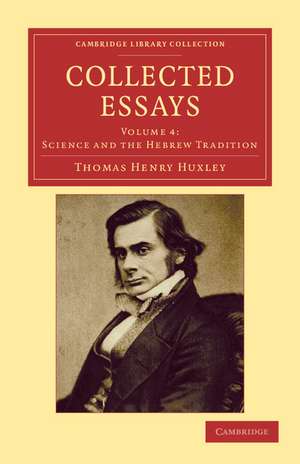
Collected Essays
Autor Thomas Henry Huxleyen Limba Engleză Paperback – 4 noi 2011
Preț: 386.69 lei
Puncte Express: 580
Carte tipărită la comandă
Livrare economică 27 noiembrie-11 decembrie
Livrare prin curier în România Termenul estimat este afișat lângă disponibilitate.
Transport gratuit de la 400.00 lei Plată online sau ramburs, în funcție de opțiunile comenzii.
Retur gratuit în 14 zile Comandă securizată și suport în română.
Specificații
ISBN-13: 9781108040549
ISBN-10: 1108040543
Pagini: 394
Dimensiuni: 140 x 216 x 23 mm
Greutate: 0.55 kg
Editura: Cambridge University Press
Locul publicării:Cambridge, United Kingdom
ISBN-10: 1108040543
Pagini: 394
Dimensiuni: 140 x 216 x 23 mm
Greutate: 0.55 kg
Editura: Cambridge University Press
Locul publicării:Cambridge, United Kingdom
V-ar putea interesa
-
 Great Ideas On the Suffering of the WorldArthur Schopenhauer-30%Preț: 39.92 lei56.67 lei
 -
 Hobbes: A Very Short IntroductionRichard Tuck-19%Preț: 57.65 lei71.42 lei
 -
 Descartes: An Intellectual BiographyStephen Gaukroger-28%Preț: 419.68 lei579.82 lei
 -
 Nietzsche and Rée: A Star FriendshipRobin Small-24%Preț: 208.57 lei273.75 lei
 -
 -28%Preț: 371.71 lei519.15 lei
 -
 -11%Preț: 360.73 lei406.39 lei
 -
 Kant's Theory of ActionRichard McCarty-31%Preț: 679.30 lei984.78 lei
 -
 Beyond Selflessness: Reading Nietzsche's GenealogyChristopher Janaway-12%Preț: 352.98 lei399.24 lei
 -
 A Commentary on Hegel's Philosophy of MindMichael Inwood-12%Preț: 260.68 lei295.15 lei
 -
 Taming the LeviathanJon ParkinPreț: 375.93 lei
 -
 Newton as PhilosopherJaniak AndrewPreț: 351.23 lei
 -
 Introductions to NietzscheRobert PippinPreț: 199.12 lei
 -
 The Cambridge Companion to Hegel and Nineteenth-Century PhilosophyFrederick C. BeiserPreț: 253.76 lei
 -
 KantRobert B. LoudenPreț: 296.71 lei
 -
 BerkeleyDesmond M. ClarkePreț: 287.55 lei
 -
 LockeRoger WoolhousePreț: 257.00 lei
 -
 -17%Preț: 170.72 lei205.06 lei
 -
 Hume: A Guide for the PerplexedAngela M. Coventry-17%Preț: 177.30 lei213.32 lei
 -
 Preț: 137.87 lei
Cuprins
Preface; 1. On the method of Zadig [1880]; 2. The rise and progress of palaeontology [1881]; 3. Lectures on evolution [1876]; 4. The interpreters of Genesis and the interpreters of nature [1885]; 5. Mr. Gladstone and Genesis [1886]; 6. The lights of the church and the light of science [1890]; 7. Hasisadra's adventure [1891]; 8. The evolution of theology: an anthropological study [1886].
Descriere
A nine-volume collection of essays and lectures published in 1893–4 by one of Victorian England's most influential biologists.