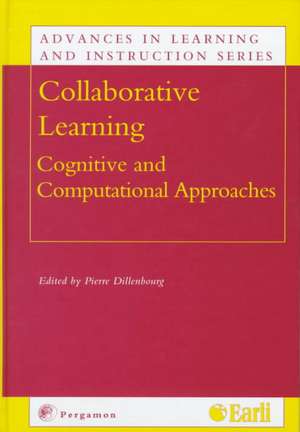
Collaborative Learning
Editat de P. Dillenbourgen Limba Engleză Hardback – 17 feb 1999
Preț: 956.35 lei
Preț vechi: 1242.02 lei
-23%
Puncte Express: 1435
Carte tipărită la comandă
Livrare economică 08-22 decembrie
Livrare prin curier în România Termenul estimat este afișat lângă disponibilitate.
Transport gratuit pentru acest produs Plată online sau ramburs, în funcție de opțiunile comenzii.
Retur gratuit în 14 zile Comandă securizată și suport în română.
Specificații
ISBN-13: 9780080430737
ISBN-10: 0080430732
Pagini: 260
Dimensiuni: 161 x 240 x 19 mm
Greutate: 0.51 kg
Ediția:Revised
Editura: Pergamon Press
ISBN-10: 0080430732
Pagini: 260
Dimensiuni: 161 x 240 x 19 mm
Greutate: 0.51 kg
Ediția:Revised
Editura: Pergamon Press
V-ar putea interesa
-
 The International Student HandbookDr Hayo Reinders-24%Preț: 202.41 lei267.67 lei
 -
 The Teaching for Understanding GuideTina BlythePreț: 232.64 lei
 -
 In a Class of Your OwnBill Gribble-44%Preț: 77.98 lei139.12 lei
 -
 Learning to Teach with a HangoverJon Barbuti-42%Preț: 76.95 lei133.61 lei
 -
 Drawing with ChildrenMona BrookesPreț: 142.48 lei
 -
 What Makes a Good School Now?Tim Brighouse-20%Preț: 248.09 lei310.59 lei
 -
 -42%Preț: 82.40 lei142.36 lei
Cuprins
Acknowledgement. Contributors. Introduction: what do you mean by 'collaborative learning'? (P. Dillenbourg). Learning together: understanding the processes of computer-based collaborative learning (K. Littleton, P. Häkkinen). The role of grounding in collaborative learning tasks (M. Baker et al.). What is "multi" in multi-agent learning? (G. Weiss, P. Dillenbourg). Comparing human-human and robot-robot interactions (R. Joiner et al.). Learning by explaining to oneself and to others (R. Ploetzner et al.). Knowledge transformations in agents and interactions: a comparison of machine learning and dialogue operators (E. Mephu Nguifo et al.). Can analytic models support learning in groups? (H.U. Hoppe, R. Ploetzner). Using telematics for collaborative knowledge construction (T. Hansen et al.). The productive agency that drives collaborative learning (D. Schwatrtz). References. Index.
Recenzii
Ann Jones, The Open University, Milton Keynes
There is no doubt that collaborative learning will continue to be an important area of research for a number of reasons: learning is now viewed as a lifelong activity and increasingly takes place in contexts where learning from interactions with others, whether around technology or through technology, is a vital part of that process. This book plays an important role in documenting and continuing the debate among scientists in two key fields.
Computers and Education
There is no doubt that collaborative learning will continue to be an important area of research for a number of reasons: learning is now viewed as a lifelong activity and increasingly takes place in contexts where learning from interactions with others, whether around technology or through technology, is a vital part of that process. This book plays an important role in documenting and continuing the debate among scientists in two key fields.
Computers and Education