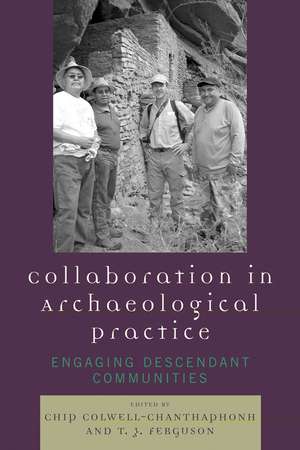
Collaboration in Archaeological Practice: Engaging Descendant Communities: Archaeology in Society
Editat de Chip Colwell-Chanthaphonh, T. J. Fergusonen Limba Engleză Paperback – 28 noi 2007

Preț: 352.34 lei
Preț vechi: 509.60 lei
-31%
Puncte Express: 529
Carte tipărită la comandă
Livrare economică 27 noiembrie-11 decembrie
Livrare prin curier în România Termenul estimat este afișat lângă disponibilitate.
Transport gratuit de la 400.00 lei Plată online sau ramburs, în funcție de opțiunile comenzii.
Retur gratuit în 14 zile Comandă securizată și suport în română.
Specificații
ISBN-13: 9780759110540
ISBN-10: 0759110549
Pagini: 317
Dimensiuni: 153 x 238 x 22 mm
Greutate: 0.53 kg
Editura: Bloomsbury Publishing
Colecția AltaMira Press
Seria Archaeology in Society
Locul publicării:New York, United States
ISBN-10: 0759110549
Pagini: 317
Dimensiuni: 153 x 238 x 22 mm
Greutate: 0.53 kg
Editura: Bloomsbury Publishing
Colecția AltaMira Press
Seria Archaeology in Society
Locul publicării:New York, United States
V-ar putea interesa
-
 -32%Preț: 1124.60 lei1657.71 lei
 -
 Archaeology: A Very Short IntroductionPaul Bahn-20%Preț: 56.62 lei70.82 lei
 -
 The Art and Archaeology of PashashTerence GriederPreț: 302.61 lei
 -
 Museum Objects: Experiencing the Properties of ThingsSandra H. Dudley-8%Preț: 517.25 lei562.23 lei
 -
 Heritage: Critical ApproachesRodney HarrisonPreț: 382.03 lei
 -
 -18%Preț: 1250.64 lei1525.16 lei
 -
 Preț: 147.04 lei
 -
 Pottery in ArchaeologyClive OrtonPreț: 298.97 lei
 -
 A Consumer's Guide to Archaeological ScienceMary E Malainey-15%Preț: 733.68 lei863.15 lei
 -
 ArchaeologyJoe FlatmanPreț: 71.03 lei
 -
 Conservation of Archaeological Ships and BoatsPer Hoffmann-23%Preț: 770.35 lei1000.45 lei
 -
 Climate and Ancient SocietiesSusanne Kerner-8%Preț: 366.41 lei398.27 lei
Cuprins
Chapter 1 Foreword
Chapter 2 The Collaborative Continuum
Chapter 3 Navigating the Fluidity of Social Identity: Collaborative Research into Cultural Affiliation in the American Southwest
Chapter 4 Unusual of "Extreme" Beliefs About the Past: Community Identity and Dealing with the Fringe
Chapter 5 Things Are Not Always What They Seem: Indigenous Knowledge and Pattern Recognition in Archaeological Analysis
Chapter 6 Not the End, Not the Middle, But the Beginning: Repatriation as a Transformative Mechanism for Archaeologists and Indigenous Peoples
Chapter 7 Heritage Ethics and Descendant Communities
Chapter 8 Collaboration Means Equality, Respect, and Reciprocity: A Conversation About Archaeology and the Hopi Tribe
Chapter 9 The Ethics of Collaboration: Whose Culture? Whose Intellectual Property? Who Benefits?
Chapter 10 New Africa: Understanding the Americanization of African Descent Groups Through Archaeology
Chapter 11 "I Wish for Paradise": Memory and Class in Hampden, Baltimore
Chapter 12 Entering the Agora: Archaeology, Conservation, and Indigenous Peoples in the Amazon
Chapter 13 Collaborative Encounters
Chapter 2 The Collaborative Continuum
Chapter 3 Navigating the Fluidity of Social Identity: Collaborative Research into Cultural Affiliation in the American Southwest
Chapter 4 Unusual of "Extreme" Beliefs About the Past: Community Identity and Dealing with the Fringe
Chapter 5 Things Are Not Always What They Seem: Indigenous Knowledge and Pattern Recognition in Archaeological Analysis
Chapter 6 Not the End, Not the Middle, But the Beginning: Repatriation as a Transformative Mechanism for Archaeologists and Indigenous Peoples
Chapter 7 Heritage Ethics and Descendant Communities
Chapter 8 Collaboration Means Equality, Respect, and Reciprocity: A Conversation About Archaeology and the Hopi Tribe
Chapter 9 The Ethics of Collaboration: Whose Culture? Whose Intellectual Property? Who Benefits?
Chapter 10 New Africa: Understanding the Americanization of African Descent Groups Through Archaeology
Chapter 11 "I Wish for Paradise": Memory and Class in Hampden, Baltimore
Chapter 12 Entering the Agora: Archaeology, Conservation, and Indigenous Peoples in the Amazon
Chapter 13 Collaborative Encounters
Recenzii
Colwell-Chanthaphonh and Ferguson have produced a provocative, insightful, and forward-looking book of international scope that has tremendous relevance for indigenous peoples and the archaeologists who work with and for them. In an era when archaeologists still struggle with the relevance of the past for the present, with making their work both responsive and responsible, this volume reveals just how important and successful that process can be. Its impact will be palpable, inspiring current and future researchers and community members to create mutually beneficial collaborative archaeologies.
This book deals explicitly with a topic that archaeologists have long avoided or dealt with implicitly. The relationships between archaeologists and the communities with whom they work are here discussed in refreshing ways by an exciting set of distinguished authors. They demonstrate the wider changes in the discipline resulting from an explicit approach that takes collaboration seriously.
Recommended.
The volume successfully fulfills the editors' aims set out in the introduction: 'to fill a gap in the current literature...[by providing] a theoretical perspective and broad interrogation of collaboration's multiplex applications.'
Collaboration in Archaeological Practice is a particularly relevant and important collection of essays. Indigenous voices are prominent throughout the book, in the selection of authors as well as the discussions concerning the participation of local representatives, which are integral to any truly collaborative research project. There is a great deal of useful and thought-provoking information relevant to any researcher engaged in archaeological and/or ethnographic fieldwork, no matter the location. Collaboration in Archaeological Practice is reflective of the recent sea-change in research across disciplinary boundaries that recognizes the importance and agency of indigenous voices. The book is a welcome and useful addition for anyone involved in, or even considering, field research.
This book is precisely what is needed in archaeology at this juncture. As interest in collaborative research grows, there are few tangible examples out there that provide ideas to someone unfamiliar with collaboration in archaeology, even fewer that are appropriately theoretically engaged. This book helps to bridge that gap. It offers a global view that includes both indigenous and non-indigenous communities from a range of temporal and geographic contexts. For anyone interested in exploring collaborative research-academics, professional archaeologists, students, and communities-this book should be at the top of your reading list.
Collaboration in Archaeological Practice is a particularly relevant and important colelction of essays that describes the major theoretical, methodological, ethical, and practical issues surrounding the emergent field of collaborative archaeology. There is a great deal of useful and thought-provoking information relevant to any researcher engaged in archaeological and/or ethnographic fieldwork, no matter the location.
Chip Colwell-Chanthaphonh and T. J. Ferguson's book adds to the literature on collaboration in the field of archaeology. It contributes directly to what is currently a very critical aspect of scholarship and teaching in archaeology as it focuses centrally on collaborative experiences from a range of temporal and geographic contexts. Discussions within archaeology about the need for collaboration abound, but few books discuss the range of positive and negative experiences of working with both indigenous and non-indigenous groups that are presented in this volume.
Cowell-Chanthaphonh and Ferguson have produced a well-organized edited volume that is enjoyable to read, and covers critical topics in the right amount of detail. It is appropraite for multiple audiences, including academic and non-academic readers.
This book deals explicitly with a topic that archaeologists have long avoided or dealt with implicitly. The relationships between archaeologists and the communities with whom they work are here discussed in refreshing ways by an exciting set of distinguished authors. They demonstrate the wider changes in the discipline resulting from an explicit approach that takes collaboration seriously.
Recommended.
The volume successfully fulfills the editors' aims set out in the introduction: 'to fill a gap in the current literature...[by providing] a theoretical perspective and broad interrogation of collaboration's multiplex applications.'
Collaboration in Archaeological Practice is a particularly relevant and important collection of essays. Indigenous voices are prominent throughout the book, in the selection of authors as well as the discussions concerning the participation of local representatives, which are integral to any truly collaborative research project. There is a great deal of useful and thought-provoking information relevant to any researcher engaged in archaeological and/or ethnographic fieldwork, no matter the location. Collaboration in Archaeological Practice is reflective of the recent sea-change in research across disciplinary boundaries that recognizes the importance and agency of indigenous voices. The book is a welcome and useful addition for anyone involved in, or even considering, field research.
This book is precisely what is needed in archaeology at this juncture. As interest in collaborative research grows, there are few tangible examples out there that provide ideas to someone unfamiliar with collaboration in archaeology, even fewer that are appropriately theoretically engaged. This book helps to bridge that gap. It offers a global view that includes both indigenous and non-indigenous communities from a range of temporal and geographic contexts. For anyone interested in exploring collaborative research-academics, professional archaeologists, students, and communities-this book should be at the top of your reading list.
Collaboration in Archaeological Practice is a particularly relevant and important colelction of essays that describes the major theoretical, methodological, ethical, and practical issues surrounding the emergent field of collaborative archaeology. There is a great deal of useful and thought-provoking information relevant to any researcher engaged in archaeological and/or ethnographic fieldwork, no matter the location.
Chip Colwell-Chanthaphonh and T. J. Ferguson's book adds to the literature on collaboration in the field of archaeology. It contributes directly to what is currently a very critical aspect of scholarship and teaching in archaeology as it focuses centrally on collaborative experiences from a range of temporal and geographic contexts. Discussions within archaeology about the need for collaboration abound, but few books discuss the range of positive and negative experiences of working with both indigenous and non-indigenous groups that are presented in this volume.
Cowell-Chanthaphonh and Ferguson have produced a well-organized edited volume that is enjoyable to read, and covers critical topics in the right amount of detail. It is appropraite for multiple audiences, including academic and non-academic readers.