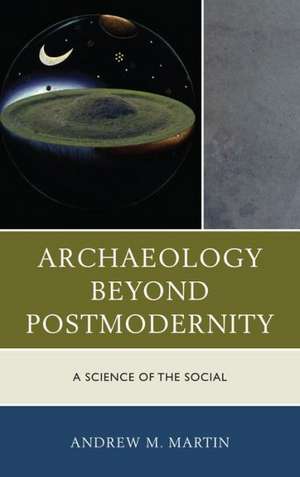
Archaeology beyond Postmodernity: A Science of the Social
Autor Andrew M. Martinen Limba Engleză Hardback – 19 iul 2013
Preț: 722.60 lei
Preț vechi: 1148.39 lei
-37%
Puncte Express: 1084
Carte tipărită la comandă
Livrare economică 03-17 decembrie
Livrare prin curier în România Termenul estimat este afișat lângă disponibilitate.
Transport gratuit pentru acest produs Plată online sau ramburs, în funcție de opțiunile comenzii.
Retur gratuit în 14 zile Comandă securizată și suport în română.
Specificații
ISBN-13: 9780759123571
ISBN-10: 0759123578
Pagini: 247
Ilustrații: 6 b/w illustrations; 5 tables
Dimensiuni: 160 x 237 x 25 mm
Greutate: 0.54 kg
Editura: Bloomsbury Publishing
Colecția AltaMira Press
Locul publicării:New York, United States
ISBN-10: 0759123578
Pagini: 247
Ilustrații: 6 b/w illustrations; 5 tables
Dimensiuni: 160 x 237 x 25 mm
Greutate: 0.54 kg
Editura: Bloomsbury Publishing
Colecția AltaMira Press
Locul publicării:New York, United States
Cuprins
Introduction
Chapter 1: Entangled by Modernism
Chapter 2. Archaeological Use of Theories
Chapter 3. Object Science
Chapter 4. Group Formation, Dissent, and Change
Chapter 5. A Method for Analyzing Cultural Action
Chapter 6. Fragmenting the Bronze Age
Chapter 7. Contestation in the Hopewell
Chapter 8. Conclusion
Appendix 1. Structural Similarities Between Mounds in Barrow Groups
Appendix 2. Correlation of Inhumations and Cremations with Barrow Types
Appendix 3. Proximity of Wessex Anomalies to Beaker Barrows
Appendix 4. Context of Beaker Barrows
Appendix 5. Comparison of Size Between Last Beaker and Wessex Barrows
Appendix 6. Context of Secondary Cremations
Appendix 7. Secondary Inhumations in Cremation Mounds
Appendix 8. Characteristics of Type 1, Type 2, and Type 3 Mounds
Bibliography
About the Author
Chapter 1: Entangled by Modernism
Chapter 2. Archaeological Use of Theories
Chapter 3. Object Science
Chapter 4. Group Formation, Dissent, and Change
Chapter 5. A Method for Analyzing Cultural Action
Chapter 6. Fragmenting the Bronze Age
Chapter 7. Contestation in the Hopewell
Chapter 8. Conclusion
Appendix 1. Structural Similarities Between Mounds in Barrow Groups
Appendix 2. Correlation of Inhumations and Cremations with Barrow Types
Appendix 3. Proximity of Wessex Anomalies to Beaker Barrows
Appendix 4. Context of Beaker Barrows
Appendix 5. Comparison of Size Between Last Beaker and Wessex Barrows
Appendix 6. Context of Secondary Cremations
Appendix 7. Secondary Inhumations in Cremation Mounds
Appendix 8. Characteristics of Type 1, Type 2, and Type 3 Mounds
Bibliography
About the Author
Recenzii
Martin has written a provocative and stimulating book that deserves a wide audience. . . .[I]t is fair to say that Martin's work offers one of the most in-depth and sustained attempts to grapple with the implications of a Latourian understanding of the social. . . .Still, Martin's book is a significant contribution, and whether one agrees with the particular route he chooses to take beyond postmodernity, anyone seeking to understand contemporary approaches in archaeological theory will find themselves embarrassed not to have read it.
This book is a proposal for and a stout defense of an archaeology based the ideas of Bruno Latour and Actor Network Theory. Martin not only lays out the central ideas of a Latourian archaeology but he also situates the ideas in relation to other approaches in theoretical archaeology. The book also provides two sustained archaeological examples which will be of interest to both American and British audiences: the prehistoric mounds of Hopewell in North America, and the Bronze Age of lowland Britain. The end result is an important book that explains and substantiates a new approach in archaeology and provides an exciting challenge for existing perspectives in the discipline.
This book is a proposal for and a stout defense of an archaeology based the ideas of Bruno Latour and Actor Network Theory. Martin not only lays out the central ideas of a Latourian archaeology but he also situates the ideas in relation to other approaches in theoretical archaeology. The book also provides two sustained archaeological examples which will be of interest to both American and British audiences: the prehistoric mounds of Hopewell in North America, and the Bronze Age of lowland Britain. The end result is an important book that explains and substantiates a new approach in archaeology and provides an exciting challenge for existing perspectives in the discipline.