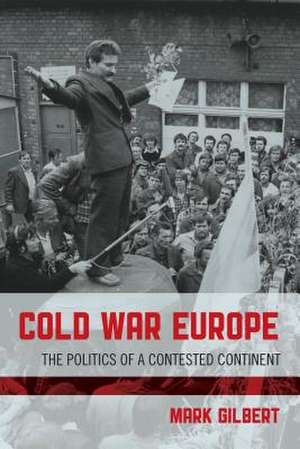
Cold War Europe: The Politics of a Contested Continent: Rowman & Littlefield Publishers
Autor Mark Gilberten Limba Engleză Paperback – 18 dec 2014
Din seria Rowman & Littlefield Publishers
-
 Preț: 113.82 lei
 - 13%
 Preț: 155.38 lei
 -
 Preț: 109.93 lei
 - 20%
 Preț: 370.93 lei
 - 19%
 Preț: 323.76 lei
 - 26%
 Preț: 223.03 lei
 - 19%
 Preț: 321.01 lei
 - 21%
 Preț: 307.35 lei
 - 20%
 Preț: 190.98 lei
 - 24%
 Preț: 255.02 lei
 - 16%
 Preț: 109.26 lei
 - 31%
 Preț: 351.69 lei
 - 15%
 Preț: 127.13 lei
 - 23%
 Preț: 320.61 lei
 - 19%
 Preț: 324.21 lei
 - 30%
 Preț: 355.24 lei
 - 23%
 Preț: 258.39 lei
 -
 Preț: 400.51 lei
 - 23%
 Preț: 275.97 lei
 - 24%
 Preț: 275.28 lei
 - 31%
 Preț: 351.50 lei
 - 22%
 Preț: 323.28 lei
 - 32%
 Preț: 373.39 lei
 - 34%
 Preț: 842.33 lei
 - 19%
 Preț: 314.30 lei
 - 23%
 Preț: 354.68 lei
 - 21%
 Preț: 128.84 lei
 - 30%
 Preț: 774.75 lei
 - 23%
 Preț: 278.65 lei
 - 23%
 Preț: 259.97 lei
 - 19%
 Preț: 344.02 lei
 - 32%
 Preț: 594.45 lei
 - 31%
 Preț: 566.85 lei
 - 22%
 Preț: 358.54 lei
 - 19%
 Preț: 322.03 lei
 - 16%
 Preț: 148.06 lei
 - 22%
 Preț: 360.79 lei
 - 19%
 Preț: 323.37 lei
 - 31%
 Preț: 414.61 lei
 - 25%
 Preț: 344.18 lei
 - 30%
 Preț: 703.64 lei
 - 14%
 Preț: 152.49 lei
 - 30%
 Preț: 827.47 lei
 - 19%
 Preț: 316.66 lei
 - 23%
 Preț: 276.77 lei
 - 29%
 Preț: 709.89 lei
 - 23%
 Preț: 262.16 lei
 - 19%
 Preț: 335.82 lei
Preț: 367.22 lei
Preț vechi: 461.94 lei
-21%
Puncte Express: 551
Carte tipărită la comandă
Livrare economică 23 noiembrie-07 decembrie
Livrare prin curier în România Termenul estimat este afișat lângă disponibilitate.
Transport gratuit de la 400.00 lei Plată online sau ramburs, în funcție de opțiunile comenzii.
Retur gratuit în 14 zile Comandă securizată și suport în română.
Specificații
ISBN-13: 9781442219854
ISBN-10: 1442219858
Pagini: 338
Ilustrații: 2 b/w illustrations; 2 maps
Dimensiuni: 150 x 226 x 22 mm
Greutate: 0.41 kg
Editura: Bloomsbury Publishing
Colecția Rowman & Littlefield
Seria Rowman & Littlefield Publishers
Locul publicării:New York, United States
ISBN-10: 1442219858
Pagini: 338
Ilustrații: 2 b/w illustrations; 2 maps
Dimensiuni: 150 x 226 x 22 mm
Greutate: 0.41 kg
Editura: Bloomsbury Publishing
Colecția Rowman & Littlefield
Seria Rowman & Littlefield Publishers
Locul publicării:New York, United States
Descriere
This compelling history of Europe's Cold War follows the dramatic arc of the conflict that shaped the development of the continent and defined world politics in the second half of the twentieth century. Focusing on European actors and events, Mark Gilbert traces the onset of the Cold War, the process of Stalinization in the Soviet bloc, and the difficulties of legitimation experienced by communist regimes in Hungary, Poland, and East Germany even after Stalin's death. He also shows how Washington's leadership and worldview was contested in Western Europe, especially by Great Britain and French president Charles de Gaulle. The book charts the growing weakness of the communist system in Eastern Europe and the economic and moral reasons for the system's eventual collapse. It highlights the central role of European leaders in the process of détente and in the diplomatic endgame that concluded the Cold War in 1990. Rather than simply a strategic standoff between the superpowers, Gilbert argues, the Cold War was a social and ideological conflict that transformed Europe from Lisbon to Riga. Fast-paced and readable, this political, intellectual, and social history illuminates a conflict that continues to resonate today.
Cuprins
Chapter 1: Introduction
Chapter 2: From War to Cold War
Chapter 3: Stalinization
Chapter 4: Creating the West
Chapter 5: 1956: Communism in Turmoil
Chapter 6: The Berlin Crisis
Chapter 7: Really Existing Socialism
Chapter 8: The Reluctant Ally
Chapter 9: Détente and Solidarity
Chapter 10: Reluctant Allies
Chapter 11: 1989: The Year of Revolutions
Chapter 12: Unifications and Dissolutions
Chapter 2: From War to Cold War
Chapter 3: Stalinization
Chapter 4: Creating the West
Chapter 5: 1956: Communism in Turmoil
Chapter 6: The Berlin Crisis
Chapter 7: Really Existing Socialism
Chapter 8: The Reluctant Ally
Chapter 9: Détente and Solidarity
Chapter 10: Reluctant Allies
Chapter 11: 1989: The Year of Revolutions
Chapter 12: Unifications and Dissolutions
Recenzii
The inhabitants of the 'common European house' seem once again to be dividing into two camps: those who live in free, prosperous and secure societies, and those who are subject to manipulation, repression and, above all, neglect. In that context, Mark Gilbert's concise history of how Europe lived through the Cold War and its end from 1945 to 1992 provides a welcome opportunity to refresh recollections and reflect on parallels and differences. . . .Along the way, Gilbert skilfully develops a few major themes. . . with an eye for gripping detail.
The book illuminates an important and sometimes forgotten aspect of the conflict. . . . Gilbert's analysis demonstrates the centrality of European actors to a variety of Cold War events.
Mark Gilbert writes with clarity and verve, and the story he tells is a dramatic, Europe-wide one that embraces both Western and Eastern European countries. This allows him to reveal the deeper social and economic layers of the Cold War conflict as it played out across the continent, on both sides of the Iron Curtain.
In this valuable account of the Cold War as European history, Mark Gilbert provides a crisp introduction to the politics of European governments and parties- East and West-in a divided continent. Thus he retrieves, and reclaims, the Europeans' own agency in the Cold War-for good and bad. The paradoxical conclusion of this wide-ranging international history of politics is that the historic defeat of Soviet communism is ultimately premised on economics, on the superior efficacy of capitalism upon the socialist command economy.
This outstanding overview of the huge and complex history of the Cold War puts Europe back where it belongs, at its very center, as this was not a bipolar contest between two superpowers. With immense erudition, Mark Gilbert presents a beautiful narrative and well-balanced analysis, giving due importance to actors and developments on both sides of the Iron Curtain. Gilbert brings events to life in snapshots, with colorful references to films, novels, and art that capture the essence of this huge ideological conflict. A powerful evocation of an era.
The book illuminates an important and sometimes forgotten aspect of the conflict. . . . Gilbert's analysis demonstrates the centrality of European actors to a variety of Cold War events.
Mark Gilbert writes with clarity and verve, and the story he tells is a dramatic, Europe-wide one that embraces both Western and Eastern European countries. This allows him to reveal the deeper social and economic layers of the Cold War conflict as it played out across the continent, on both sides of the Iron Curtain.
In this valuable account of the Cold War as European history, Mark Gilbert provides a crisp introduction to the politics of European governments and parties- East and West-in a divided continent. Thus he retrieves, and reclaims, the Europeans' own agency in the Cold War-for good and bad. The paradoxical conclusion of this wide-ranging international history of politics is that the historic defeat of Soviet communism is ultimately premised on economics, on the superior efficacy of capitalism upon the socialist command economy.
This outstanding overview of the huge and complex history of the Cold War puts Europe back where it belongs, at its very center, as this was not a bipolar contest between two superpowers. With immense erudition, Mark Gilbert presents a beautiful narrative and well-balanced analysis, giving due importance to actors and developments on both sides of the Iron Curtain. Gilbert brings events to life in snapshots, with colorful references to films, novels, and art that capture the essence of this huge ideological conflict. A powerful evocation of an era.