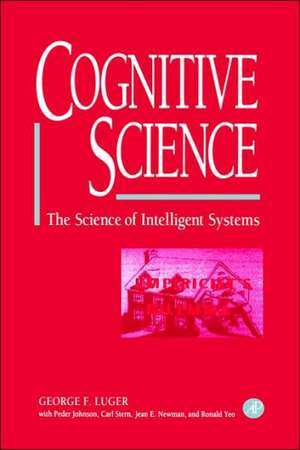
Cognitive Science: The Science of Intelligent Systems
Autor George F. Luger, Peder Johnson, Carl Stern, Jean E. Newman, Ronald Yeoen Limba Engleză Hardback – 6 iul 1994
Preț: 476.12 lei
Puncte Express: 714
Carte indisponibilă temporar
Livrare prin curier în România Termenul estimat este afișat lângă disponibilitate.
Transport gratuit pentru acest produs Plată online sau ramburs, în funcție de opțiunile comenzii.
Retur gratuit în 14 zile Comandă securizată și suport în română.
Specificații
ISBN-13: 9780124595705
ISBN-10: 0124595707
Pagini: 666
Dimensiuni: 152 x 229 x 35 mm
Greutate: 1.07 kg
Editura: ELSEVIER SCIENCE
ISBN-10: 0124595707
Pagini: 666
Dimensiuni: 152 x 229 x 35 mm
Greutate: 1.07 kg
Editura: ELSEVIER SCIENCE
V-ar putea interesa
-
 Happiness by DesignPaul Dolan-31%Preț: 63.80 lei92.70 lei
 -
 Cognitive Neuroscience: A Very Short IntroductionRichard Passingham-20%Preț: 57.12 lei71.12 lei
 -
 Flight from Wonder: An Investigation of Scientific CreativityAlbert Rothenberg-24%Preț: 353.60 lei466.32 lei
 -
 Body LanguageElizabeth KuhnkePreț: 93.73 lei
 -
 Critical FeelingRolf ReberPreț: 285.51 lei
 -
 Body Language for DummiesElizabeth KuhnkePreț: 152.41 lei
 -
 Does Your Family Make You Smarter?James R. FlynnPreț: 193.35 lei
 -
 Build Your Brain Power: The Art of Smart ThinkingSimon Wootton-26%Preț: 68.38 lei92.77 lei
 -
 The Little Mindfulness WorkbookGary Hennessey-28%Preț: 50.64 lei70.22 lei
 -
 -25%Preț: 221.98 lei295.28 lei
Public țintă
AUDIENCE: Upper-division students in cognitive science.Cuprins
Introduction to Cognitive Science:
Intelligence and the Roots of Cognitive Science.
Vocabularies for Describing Intelligence.
Representation Schemes.
Constraining the Architecture of Minds.
Natural Intelligence: Brain Function.
Symbol Based Representation and Search:
Network and Structured Representation Schemes.
Logic Based Representation and Reasoning.
Search Strategies for Weak Method Problem Solving.
Using Knowledge and Strong Method Problem Solving.
Machine Learning:
Explicit Symbol Based Learning Models.
Connectionist Networks: History, The Perception, and Backpropagation.
Competitive, Reinforcement, and Attractor Learning Models.
Language:
Language Representation and Processing.
Pragmatics and Discourse.
Building Cognitive Representations in PROLOG:
PROLOG as Representation and Language.
Creating Meta-Interpreters in PROLOG.
Epilogue:
Cognitive Science: Problems and Promise.
References.
Index.
Intelligence and the Roots of Cognitive Science.
Vocabularies for Describing Intelligence.
Representation Schemes.
Constraining the Architecture of Minds.
Natural Intelligence: Brain Function.
Symbol Based Representation and Search:
Network and Structured Representation Schemes.
Logic Based Representation and Reasoning.
Search Strategies for Weak Method Problem Solving.
Using Knowledge and Strong Method Problem Solving.
Machine Learning:
Explicit Symbol Based Learning Models.
Connectionist Networks: History, The Perception, and Backpropagation.
Competitive, Reinforcement, and Attractor Learning Models.
Language:
Language Representation and Processing.
Pragmatics and Discourse.
Building Cognitive Representations in PROLOG:
PROLOG as Representation and Language.
Creating Meta-Interpreters in PROLOG.
Epilogue:
Cognitive Science: Problems and Promise.
References.
Index.