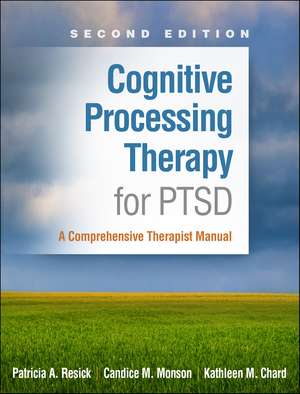
Cognitive Processing Therapy for PTSD, Second Edition: A Comprehensive Therapist Manual
Autor Patricia A. Resick, Candice M. Monson, Kathleen M. Charden Limba Engleză Hardback – 18 sep 2024
New to This Edition
- Each session now has its own chapter, printed with shaded tabs for easy reference.
- Reflects a wealth of new treatment research, conceptual refinements, and feedback from trainings of thousands of clinicians.
- Chapter on cognitive case conceptualization.
- Discusses additional treatment variations (telehealth, intensive CPT) and client populations (first responders).
See also Getting Unstuck from PTSD, by Patricia A. Resick, Shannon Wiltsey Stirman, and Stefanie T. LoSavio, which presents CPT in a guided self-help format for trauma survivors.
Preț: 591.86 lei
Preț vechi: 623.01 lei
-5%
Puncte Express: 888
Carte disponibilă
Livrare economică 17 noiembrie-01 decembrie
Livrare prin curier în România Termenul estimat este afișat lângă disponibilitate.
Transport gratuit pentru acest produs Plată online sau ramburs, în funcție de opțiunile comenzii.
Retur gratuit în 14 zile Comandă securizată și suport în română.
Specificații
ISBN-13: 9781462554300
ISBN-10: 146255430X
Pagini: 328
Dimensiuni: 213 x 281 x 25 mm
Greutate: 1.04 kg
Ediția:2nd edition
Editura: Guilford Publications
Colecția Guilford Press
ISBN-10: 146255430X
Pagini: 328
Dimensiuni: 213 x 281 x 25 mm
Greutate: 1.04 kg
Ediția:2nd edition
Editura: Guilford Publications
Colecția Guilford Press
V-ar putea interesa
-
 -21%Preț: 277.80 lei351.97 lei
 -
 Preț: 438.68 lei
 -
 Treatment of Complex Trauma: A Sequenced, Relationship-Based ApproachChristine A. Courtois-5%Preț: 320.89 lei337.77 lei
 -
 -5%Preț: 274.06 lei288.48 lei
 -
 -15%Preț: 542.15 lei637.82 lei
 -
 -5%Preț: 247.75 lei260.79 lei
 -
 -5%Preț: 469.85 lei494.58 lei
 -
 -5%Preț: 495.80 lei521.90 lei
 -
 Cognitive Behavior Therapy, Third Edition: Basics and BeyondJudith S. Beck-5%Preț: 498.29 lei524.52 lei
 -
 Handbook of PTSD, Third Edition: Science and PracticeMatthew J. Friedman-5%Preț: 875.61 lei921.70 lei
 -
 Handbook of Cognitive-Behavioral Therapies, Fourth EditionKeith S. Dobson-5%Preț: 420.89 lei443.05 lei
 -
 Handbook of PTSD, Third Edition: Science and PracticeMatthew J. Friedman-5%Preț: 588.17 lei619.12 lei
 -
 -30%Preț: 75.25 lei107.17 lei
 -
 Seeking Safety: A Treatment Manual for PTSD and Substance AbuseLisa M. Najavits-15%Preț: 469.35 lei552.18 lei
 -
 -30%Preț: 90.40 lei128.23 lei
 -
 -26%Preț: 279.71 lei379.22 lei
 -
 Cognitive Therapy of Anxiety Disorders: Science and PracticeDavid A. Clark-5%Preț: 530.52 lei558.44 lei
 -
 -32%Preț: 132.07 lei193.42 lei
Cuprins
Preface
I. Background on Posttraumatic Stress Disorder and Cognitive Processing Therapy
1. The Origins of Cognitive Processing Therapy
2. Research on CPT
3. Pretreatment Assessment
4. Cognitive Case Conceptualization
5. Preparing to Deliver CPT
II. CPT Manual
6. Session 1: Overview of PTSD and CPT
7. Session 2: Impact Statement
8. Session 3: ABC Worksheets
9. Session 4: Processing the Index Event
10. Session 5: Exploring Questions
11. Session 6: Thinking Patterns
12. Session 7: Alternative Thoughts Worksheets
13. Session 8: Trauma Themes--Safety
14. Session 9: Trauma Themes--Trust
15. Session 10: Trauma Themes--Power/Control
16. Session 11: Esteem
17. Session 12--Intimacy and Facing the Future
III. Alternatives in Delivery and Special Considerations
18. Variations in CPT
19. Group CPT
20. Individual Variation in Client Presentations
Appendix A: Materials for Therapists
Appendix B: Simplified Worksheets
References
Index
I. Background on Posttraumatic Stress Disorder and Cognitive Processing Therapy
1. The Origins of Cognitive Processing Therapy
2. Research on CPT
3. Pretreatment Assessment
4. Cognitive Case Conceptualization
5. Preparing to Deliver CPT
II. CPT Manual
6. Session 1: Overview of PTSD and CPT
7. Session 2: Impact Statement
8. Session 3: ABC Worksheets
9. Session 4: Processing the Index Event
10. Session 5: Exploring Questions
11. Session 6: Thinking Patterns
12. Session 7: Alternative Thoughts Worksheets
13. Session 8: Trauma Themes--Safety
14. Session 9: Trauma Themes--Trust
15. Session 10: Trauma Themes--Power/Control
16. Session 11: Esteem
17. Session 12--Intimacy and Facing the Future
III. Alternatives in Delivery and Special Considerations
18. Variations in CPT
19. Group CPT
20. Individual Variation in Client Presentations
Appendix A: Materials for Therapists
Appendix B: Simplified Worksheets
References
Index
Notă biografică
Patricia A. Resick, PhD, ABPP, is Professor Emeritus of Psychiatry and Behavioral Sciences at Duke University School of Medicine. She developed cognitive processing therapy (CPT) in 1988 at the University of Missouri–St. Louis, where she founded the Center for Trauma Recovery and was an Endowed Professor. For a decade, she was Director of the Women’s Health Sciences Division of the National Center for PTSD. She has conducted numerous randomized controlled trials of CPT with civilians and active-duty military. Dr. Resick has served as president of the International Society for Traumatic Stress Studies (ISTSS) and the Association for Behavioral and Cognitive Therapies (ABCT). She is the recipient of numerous research and mentoring awards, including Lifetime Achievement Awards from Division 56 (Trauma Psychology) of the American Psychological Association, ISTSS, and ABCT.
Candice M. Monson, PhD, is Professor of Psychology at Toronto Metropolitan University in Toronto, Ontario, Canada. A Fellow of the American and Canadian Psychological Associations and the Royal Society of Canada, she is a recipient of the Traumatic Stress Psychologist of the Year Award from the Canadian Psychological Association and the Distinguished Mentorship Award from the International Society for Traumatic Stress Studies. Dr. Monson is well known for her research on interpersonal factors in traumatization and the development, testing, and dissemination of treatments for posttraumatic stress disorder (PTSD), including cognitive processing therapy and cognitive-behavioral conjoint therapy for PTSD.
Kathleen M. Chard, PhD, is Associate Chief of Staff for Research at the Cincinnati Veterans Affairs (VA) Medical Center and Professor of Psychiatry and Behavioral Neuroscience at the University of Cincinnati. She oversees the dissemination of cognitive processing therapy (CPT) to VA clinicians across the United States and is President of the CPT Training Institute. Dr. Chard is a recipient of the Mark Wolcott Award for Excellence in Clinical Care Leadership from the VA and the Heroes of Military Medicine Award from the United Service Organization. She is known for her research on dissemination and clinical implementation of evidence-based trauma treatments for civilians, first responders, and veterans, and she is the creator of the CPT for Sexual Abuse treatment manual.
Candice M. Monson, PhD, is Professor of Psychology at Toronto Metropolitan University in Toronto, Ontario, Canada. A Fellow of the American and Canadian Psychological Associations and the Royal Society of Canada, she is a recipient of the Traumatic Stress Psychologist of the Year Award from the Canadian Psychological Association and the Distinguished Mentorship Award from the International Society for Traumatic Stress Studies. Dr. Monson is well known for her research on interpersonal factors in traumatization and the development, testing, and dissemination of treatments for posttraumatic stress disorder (PTSD), including cognitive processing therapy and cognitive-behavioral conjoint therapy for PTSD.
Kathleen M. Chard, PhD, is Associate Chief of Staff for Research at the Cincinnati Veterans Affairs (VA) Medical Center and Professor of Psychiatry and Behavioral Neuroscience at the University of Cincinnati. She oversees the dissemination of cognitive processing therapy (CPT) to VA clinicians across the United States and is President of the CPT Training Institute. Dr. Chard is a recipient of the Mark Wolcott Award for Excellence in Clinical Care Leadership from the VA and the Heroes of Military Medicine Award from the United Service Organization. She is known for her research on dissemination and clinical implementation of evidence-based trauma treatments for civilians, first responders, and veterans, and she is the creator of the CPT for Sexual Abuse treatment manual.
Recenzii
"This book provides a comprehensive guide to treating the complexities of PTSD with CPT. Specific issues that arise when working with different client groups are handled with sensitivity and insight. No trauma therapist can fail to benefit from the exceptional levels of experience and wisdom to be found in the second edition of this manual."--Chris R. Brewin PhD, Department of Clinical, Educational, and Health Psychology (Emeritus), University College London, United Kingdom
"Look no further, therapists working with clients with PTSD--the second edition of the CPT manual is the definitive resource you need. CPT is a first-line treatment for PTSD, recommended by clinical practice guidelines, the Departments of Veterans Affairs and Defense and more. Resick, Monson, and Chard harness their collective wisdom--accumulated through the treatment of tens of thousands of clients with PTSD--to include sample dialogues, real-world examples, and answers to common questions. A terminological change I find significant in this edition is the shift from 'challenging' to 'exploring' clients' thinking processes and habits. While this change may seem minor, it carries significant impact, fostering stronger therapist–client rapport."--Katy Dondanville, PsyD, ABPP, Director, STRONG STAR Training Initiative, University of Texas Health Science Center at San Antonio
"This second edition builds on decades of extraordinary input from CPT clinicians, trainers, researchers, and clients. The authors have integrated the latest research with helpful materials and guidelines on how to apply CPT effectively with a variety of clients and in different practice settings. The book is engaging, empowering, practical, scientifically grounded, and replete with wisdom. It is well organized and written with a logical progression--from pretreatment considerations; to the structure, themes, and goals of each session; to adaptations and special considerations. A groundbreaking treatment has just become more easily and clearly accessible through this excellent second edition."--Patricia J. Watson, PhD, Senior Educational Specialist, National Center for PTSD
"The second edition of this manual makes it even more straightforward to use CPT effectively with even the most complicated cases."--Sonya B. Norman, PhD, National Center for PTSD; Department of Psychiatry, University of California, San Diego-
"Look no further, therapists working with clients with PTSD--the second edition of the CPT manual is the definitive resource you need. CPT is a first-line treatment for PTSD, recommended by clinical practice guidelines, the Departments of Veterans Affairs and Defense and more. Resick, Monson, and Chard harness their collective wisdom--accumulated through the treatment of tens of thousands of clients with PTSD--to include sample dialogues, real-world examples, and answers to common questions. A terminological change I find significant in this edition is the shift from 'challenging' to 'exploring' clients' thinking processes and habits. While this change may seem minor, it carries significant impact, fostering stronger therapist–client rapport."--Katy Dondanville, PsyD, ABPP, Director, STRONG STAR Training Initiative, University of Texas Health Science Center at San Antonio
"This second edition builds on decades of extraordinary input from CPT clinicians, trainers, researchers, and clients. The authors have integrated the latest research with helpful materials and guidelines on how to apply CPT effectively with a variety of clients and in different practice settings. The book is engaging, empowering, practical, scientifically grounded, and replete with wisdom. It is well organized and written with a logical progression--from pretreatment considerations; to the structure, themes, and goals of each session; to adaptations and special considerations. A groundbreaking treatment has just become more easily and clearly accessible through this excellent second edition."--Patricia J. Watson, PhD, Senior Educational Specialist, National Center for PTSD
"The second edition of this manual makes it even more straightforward to use CPT effectively with even the most complicated cases."--Sonya B. Norman, PhD, National Center for PTSD; Department of Psychiatry, University of California, San Diego-
Descriere
The authoritative presentation of cognitive processing therapy (CPT) for posttraumatic stress disorder (PTSD) is now in a revised and updated second edition, with an easier-to-use format and a new chapter on conceptualizing treatment.