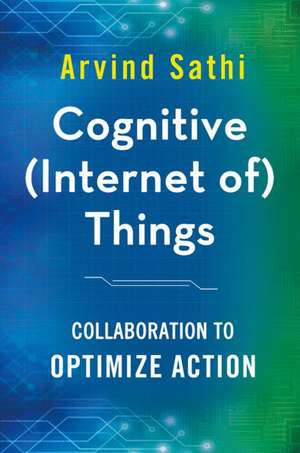
Cognitive (Internet Of) Things
Autor Arvind Sathien Limba Engleză Hardback – 23 sep 2016
Considerăm că punctul de plecare ideal pentru a înțelege viziunea lui Arvind Sathi este analiza modului în care un asistent personal sau un vehicul autonom trece de la simpla execuție a unor comenzi la comportament cognitiv autonom. Cognitive (Internet Of) Things nu se limitează la descrierea senzorilor, ci investighează mecanismele prin care obiectele învață, raționează și interacționează cu organizațiile. Volumul este structurat riguros în 12 capitole care urmăresc o progresie logică: de la definirea dispozitivului cognitiv și rolul său de asistent uman, până la arhitecturi complexe de rețea și impactul societal al balanței de putere între om și algoritm. Subliniem importanța capitolelor dedicate interfețelor man-to-machine și machine-to-machine, unde autorul explică procesele tehnice de autentificare și securizare a fluxurilor de date. Spre deosebire de era automatizării clasice, unde mașinile urmau reguli stricte, era cognitivă prezentată aici se bazează pe observații inteligente și organizarea cunoștințelor pentru rezolvarea proactivă a problemelor. Cititorul care a aplicat ideile din Cognitive Computing for Big Data Systems Over IoT de Arun Kumar Sangaiah va găsi aici puntea necesară către implementarea practică în business, deoarece Arvind Sathi pune un accent deosebit pe reutilizarea și monetizarea datelor în cadrul structurilor organizaționale. Abordarea este una pragmatică, orientată către manageri operaționali și profesioniști IT, oferind răspunsuri concrete despre proprietatea datelor și integrarea dispozitivelor în infrastructuri critice. Textul reușește să demistifice conceptul de „Internet of Everything”, oferind un cadru tehnic solid pentru ceea ce urmează în evoluția rețelelor de calculatoare.
Preț: 174.79 lei
Preț vechi: 218.49 lei
-20%
Carte disponibilă
Livrare economică 16-30 mai
Specificații
ISBN-10: 1137594659
Pagini: 178
Ilustrații: XVII, 178 p. 17 illus.
Dimensiuni: 156 x 241 x 20 mm
Greutate: 0.43 kg
Ediția:2016 edition
Editura: Palgrave Macmillan US
Locul publicării:New York, United States
V-ar putea interesa
-
 These Strange New MindsChristopher SummerfieldPreț: 118.08 lei
 -
 You Already KnowLaura HuangPreț: 116.55 lei
 -
 Don't Burn Anyone at the Stake TodayNaomi AldermanPreț: 115.45 lei
 -
 The Internet of Things, Revised and Updated EditionSamuel Greengard-17%Preț: 86.42 lei104.62 lei
 -
 The Connectivity of ThingsSebastian Giessmann-16%Preț: 576.61 lei686.45 lei
 -
 Hacking HumanityLara LewingtonPreț: 117.95 lei
 -
 Artificial WisdomThomas R. WeaverPreț: 120.25 lei
 -
 Smartphone NationKaitlyn RegehrPreț: 116.36 lei
 -
 AI First, Human AlwaysSandy CarterPreț: 150.73 lei
 -
 Age of Invisible MachinesRobb WilsonPreț: 137.18 lei
 -
 Communicative AIDavid J. GunkelPreț: 133.49 lei
 -
 -21%Preț: 182.92 lei231.61 lei
 -
 -21%Preț: 81.40 lei102.41 lei
 -
 The Atomic HumanNeil D. LawrencePreț: 89.93 lei
 -
 Cognitive Behavioural Therapy (Cbt)Elaine Iljon ForemanPreț: 68.54 lei
 -
 The AI ConEmily M. BenderPreț: 116.72 lei
 -
 Challenges in the IoT and Smart EnvironmentsReza Montasari-20%Preț: 1009.35 lei1261.68 lei
 -
 Concise Guide to the Internet of ThingsMichael Mccarthy-20%Preț: 423.91 lei529.89 lei
 -
 -20%Preț: 676.33 lei845.42 lei
 -
 Empire of AIKaren HaoPreț: 138.04 lei
De ce să citești această carte
Recomandăm această carte profesioniștilor IT și executivilor care doresc să depășească stadiul de simplă automatizare. Veți câștiga o înțelegere clară a modului în care dispozitivele cognitive pot fi integrate în fluxurile de lucru pentru a accelera rezolvarea problemelor complexe. Este un ghid esențial pentru a înțelege securitatea, monetizarea și arhitectura sistemelor IoT de generație următoare, oferind un avantaj competitiv în era procesării inteligente a datelor.
Despre autor
Arvind Sathi este un expert recunoscut în domeniul soluțiilor cognitive și al analizei datelor, având o experiență vastă în arhitecturi IT complexe. Prin lucrarea de față, publicată la Palgrave Macmillan US, el își folosește expertiza pentru a mapa intersecția dintre Internet of Things și inteligența artificială aplicată. Autorul se concentrează pe transformarea tehnologiei în valoare de business, fiind un promotor al integrării sistemelor inteligente în structurile organizaționale moderne pentru eficientizarea proceselor decizionale.
Descriere scurtă
This book examines the Cognitive Things covering a number of important questions:
• What are Cognitive Things?
• What applications can be driven from Cognitive Things – today and tomorrow?
• How will these Cognitive Things collaborate with each and other, with individuals and with organizations?
• What is the cognitive era? How is it different from the automation era? • How will the Cognitive Things support or accelerate human problem solving?
• Which technical components make up cognitive behavior?
• How does it redistribute the work-load between humans and machines?
• What types of data can be collected from them and shared with external organizations?
• How do they recognize and authenticate authorized users? How is the data safeguarded from potential theft? Who owns the data and how are the data ownership rights enforced?
Overall, Sathi explores ways in which Cognitive Things bring value to individuals as well as organizations and how to integrate the use of the devices into changing organizational structures. Case studies are used throughout to illustrate how innovators are already benefiting from the initial explosion of devices and data. Business executives, operational managers, and IT professionals will understand the fundamental changes required to fully benefit from cognitive technologies and howto utilize them for their own success.