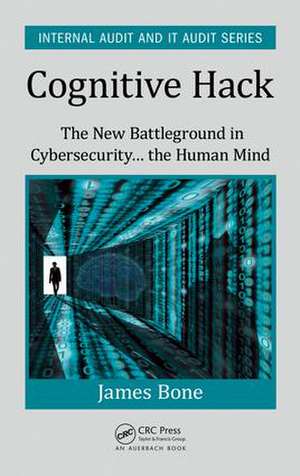
Cognitive Hack: The New Battleground in Cybersecurity ... the Human Mind: Security, Audit and Leadership Series
Autor James Boneen Limba Engleză Hardback – 31 ian 2017
Din seria Security, Audit and Leadership Series
- 20%
 Preț: 1197.18 lei
 - 8%
 Preț: 445.74 lei
 - 20%
 Preț: 386.37 lei
 -
 Preț: 418.53 lei
 -
 Preț: 326.44 lei
 - 11%
 Preț: 635.66 lei
 -
 Preț: 415.48 lei
 - 20%
 Preț: 379.78 lei
 - 20%
 Preț: 685.25 lei
 - 20%
 Preț: 506.49 lei
 - 20%
 Preț: 1629.80 lei
 -
 Preț: 345.94 lei
 - 20%
 Preț: 418.05 lei
 - 15%
 Preț: 472.42 lei
 - 20%
 Preț: 535.60 lei
 - 20%
 Preț: 299.76 lei
 - 20%
 Preț: 526.36 lei
 -
 Preț: 384.37 lei
 -
 Preț: 219.16 lei
 - 20%
 Preț: 492.86 lei
 - 20%
 Preț: 326.72 lei
 - 20%
 Preț: 1308.63 lei
 - 20%
 Preț: 354.29 lei
 - 20%
 Preț: 374.75 lei
 - 20%
 Preț: 316.61 lei
 -
 Preț: 424.04 lei
 -
 Preț: 346.21 lei
 - 20%
 Preț: 1030.95 lei
 - 20%
 Preț: 530.01 lei
 - 20%
 Preț: 573.71 lei
 - 20%
 Preț: 349.28 lei
 -
 Preț: 350.55 lei
 - 20%
 Preț: 311.00 lei
 - 20%
 Preț: 715.46 lei
 - 20%
 Preț: 488.00 lei
 -
 Preț: 297.38 lei
 -
 Preț: 391.02 lei
 - 20%
 Preț: 327.92 lei
 - 20%
 Preț: 1112.87 lei
 - 20%
 Preț: 520.36 lei
 - 20%
 Preț: 364.17 lei
Preț: 676.81 lei
Preț vechi: 796.25 lei
-15%
Puncte Express: 1015
Carte tipărită la comandă
Livrare economică 03-17 decembrie
Livrare prin curier în România Termenul estimat este afișat lângă disponibilitate.
Transport gratuit pentru acest produs Plată online sau ramburs, în funcție de opțiunile comenzii.
Retur gratuit în 14 zile Comandă securizată și suport în română.
Specificații
ISBN-13: 9781498749817
ISBN-10: 149874981X
Pagini: 204
Ilustrații: 30 Illustrations, black and white
Dimensiuni: 156 x 234 x 16 mm
Greutate: 0.43 kg
Ediția:1
Editura: CRC Press
Colecția Auerbach Publications
Seria Security, Audit and Leadership Series
ISBN-10: 149874981X
Pagini: 204
Ilustrații: 30 Illustrations, black and white
Dimensiuni: 156 x 234 x 16 mm
Greutate: 0.43 kg
Ediția:1
Editura: CRC Press
Colecția Auerbach Publications
Seria Security, Audit and Leadership Series
V-ar putea interesa
-
 Computational Intelligence in Healthcare ApplicationsRajeev Agrawal-28%Preț: 839.26 lei1161.12 lei
 -
 Cloud Reliability Engineering: Technologies and ToolsRathnakar Achary-20%Preț: 477.53 lei596.91 lei
 -
 -20%Preț: 424.73 lei530.91 lei
 -
 -20%Preț: 424.11 lei530.14 lei
 -
 Cybersecurity Lessons from CoVID-19Robert Slade-20%Preț: 414.75 lei518.44 lei
 -
 Project Management Maturity ModelJ. Kent Crawford-15%Preț: 649.35 lei763.94 lei
 -
 -20%Preț: 532.98 lei666.22 lei
 -
 -20%Preț: 404.26 lei505.33 lei
 -
 Blockchain Chicken FarmXiaowei WangPreț: 93.56 lei
 -
 -20%Preț: 496.47 lei620.59 lei
 -
 -20%Preț: 1554.97 lei1943.71 lei
 -
 Prospective Payment SystemsDuane C. Abbey-20%Preț: 1423.67 lei1779.60 lei
 -
 Project Management Recipes for SuccessGuy L. De Furia-20%Preț: 1478.05 lei1847.57 lei
 -
 -20%Preț: 590.62 lei738.27 lei
Public țintă
Academic and Professional Practice & DevelopmentCuprins
Introduction: The Analytics of Data Breaches. Cyber-security: Understanding Vulnerabilities. Cognitive Behavior and Cyber-Security. Risk-weighted Exposures of System Applications. The Art and Science of Data Governance. Mapping the Digital Footprint of Data Breaches.
Recenzii
Review by Raman Narasimhan
Coverage & Scope
Cognitive Hack by James Bone offers a fresh perspective on cybersecurity by shifting the focus from technical solutions to the vulnerabilities of the human mind. It argues that the greatest weakness in cybersecurity is not weak passwords or outdated software but rather cognitive biases, decision-making patterns, and human behavior. The book explores how hackers exploit these vulnerabilities through deception, social engineering, and psychological manipulation rather than brute-force attacks on networks. By examining cybersecurity through a multidisciplinary lens that includes psychology, risk management, and information security, The author provides a comprehensive and practical framework for understanding and countering cyber threats. The book is particularly useful for cybersecurity professionals, IT auditors, and business leaders who want to move beyond conventional security measures and incorporate cognitive security into their risk management strategies.
Flow and Structure
The book is well-structured, with six chapters that build logically upon each other. The early sections lay the foundation for understanding the cyber paradox, where increased investments in cybersecurity do not necessarily translate into better protection. Subsequent chapters explore cognitive behaviors and how human perception influences security risks, leading to a discussion on deception and hacking psychology. The later chapters focus on the Cognitive Risk Framework, which provides a structured approach for integrating cognitive security into an organization’s defense strategy. The writing is clear and well-paced, with each chapter reinforcing the central thesis that cybersecurity must evolve beyond technical solutions to include behavioral analysis and deception-based security measures.
Practical Use and Applications
One of the book’s key strengths is its real-world applicability that provides practical insights into how organizations can defend themselves. The concept of deception-based security, which misleads attackers with false information and traps, making it harder for them to achieve their goals is an interesting thought to look for. It also emphasizes the role of situational awareness training in strengthening human defenses against phishing, fraud, and social engineering attacks. The book is particularly relevant for businesses looking to enhance their security posture, as it highlights best practices for risk management, governance, and cybersecurity intelligence. Case studies, including high-profile cyberattacks like the Ashley Madison breach, provide practical lessons that organizations can apply to improve their security frameworks.
Final Thoughts
Cognitive Hack is a well-researched and thought-provoking book that challenges conventional wisdom in cybersecurity. It successfully argues that human behavior is the weakest link and offers actionable strategies to mitigate cognitive vulnerabilities. By integrating insights from psychology, risk management, and security informatics, Cognitive Hack provides a multidisciplinary approach that is both innovative and practical. Its emphasis on best practices, practical applications, and forward-thinking security strategies makes it a must-read for those looking to stay ahead in the ever-evolving cybersecurity landscape.
Coverage & Scope
Cognitive Hack by James Bone offers a fresh perspective on cybersecurity by shifting the focus from technical solutions to the vulnerabilities of the human mind. It argues that the greatest weakness in cybersecurity is not weak passwords or outdated software but rather cognitive biases, decision-making patterns, and human behavior. The book explores how hackers exploit these vulnerabilities through deception, social engineering, and psychological manipulation rather than brute-force attacks on networks. By examining cybersecurity through a multidisciplinary lens that includes psychology, risk management, and information security, The author provides a comprehensive and practical framework for understanding and countering cyber threats. The book is particularly useful for cybersecurity professionals, IT auditors, and business leaders who want to move beyond conventional security measures and incorporate cognitive security into their risk management strategies.
Flow and Structure
The book is well-structured, with six chapters that build logically upon each other. The early sections lay the foundation for understanding the cyber paradox, where increased investments in cybersecurity do not necessarily translate into better protection. Subsequent chapters explore cognitive behaviors and how human perception influences security risks, leading to a discussion on deception and hacking psychology. The later chapters focus on the Cognitive Risk Framework, which provides a structured approach for integrating cognitive security into an organization’s defense strategy. The writing is clear and well-paced, with each chapter reinforcing the central thesis that cybersecurity must evolve beyond technical solutions to include behavioral analysis and deception-based security measures.
Practical Use and Applications
One of the book’s key strengths is its real-world applicability that provides practical insights into how organizations can defend themselves. The concept of deception-based security, which misleads attackers with false information and traps, making it harder for them to achieve their goals is an interesting thought to look for. It also emphasizes the role of situational awareness training in strengthening human defenses against phishing, fraud, and social engineering attacks. The book is particularly relevant for businesses looking to enhance their security posture, as it highlights best practices for risk management, governance, and cybersecurity intelligence. Case studies, including high-profile cyberattacks like the Ashley Madison breach, provide practical lessons that organizations can apply to improve their security frameworks.
Final Thoughts
Cognitive Hack is a well-researched and thought-provoking book that challenges conventional wisdom in cybersecurity. It successfully argues that human behavior is the weakest link and offers actionable strategies to mitigate cognitive vulnerabilities. By integrating insights from psychology, risk management, and security informatics, Cognitive Hack provides a multidisciplinary approach that is both innovative and practical. Its emphasis on best practices, practical applications, and forward-thinking security strategies makes it a must-read for those looking to stay ahead in the ever-evolving cybersecurity landscape.
Descriere
This book explores a broad cross section of research and actual case studies to draw out new insights that may be used to build a benchmark for IT security professionals. This research takes a deeper dive beneath the surface of the analysis to uncover novel ways to mitigate data security vulnerabilities, connect the dots and identify patterns in the data on breaches. This analysis will assist security professionals not only in benchmarking their risk management programs but also in identifying forward looking security measures to narrow the path of future vulnerabilities.