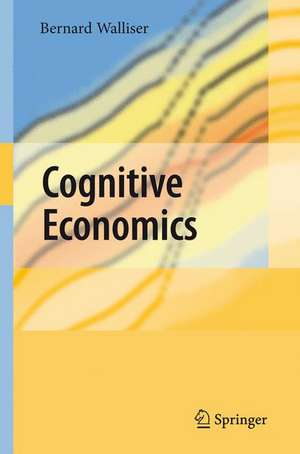
Cognitive Economics
Autor Bernard Walliseren Limba Engleză Hardback – 12 noi 2007
The book mainly aims at extending the framework of game theory in order to better fit the results of rapidly increasing laboratory experiments concerned with individual choices and collective interactions. It also seeks to better explain some original economic phenomena involving boundedly rational agents in an institutional setting such as financial bubbles, job search or technological innovation.
Written in an informal way, the book is addressed to philosophers or cognitive scientists curious of how economics deal with cognition, as well as graduate students in economics eager to discover how economic science evolves.
Preț: 644.11 lei
Preț vechi: 757.77 lei
-15%
Puncte Express: 966
Carte tipărită la comandă
Livrare economică 13-27 noiembrie
Livrare prin curier în România Termenul estimat este afișat lângă disponibilitate.
Transport gratuit pentru acest produs Plată online sau ramburs, în funcție de opțiunile comenzii.
Retur gratuit în 14 zile Comandă securizată și suport în română.
Specificații
ISBN-13: 9783540713463
ISBN-10: 3540713468
Pagini: 196
Ilustrații: VII, 185 p.
Dimensiuni: 160 x 241 x 17 mm
Greutate: 0.47 kg
Ediția:2008
Editura: Springer
Locul publicării:Berlin, Heidelberg, Germany
ISBN-10: 3540713468
Pagini: 196
Ilustrații: VII, 185 p.
Dimensiuni: 160 x 241 x 17 mm
Greutate: 0.47 kg
Ediția:2008
Editura: Springer
Locul publicării:Berlin, Heidelberg, Germany
V-ar putea interesa
-
 How Markets Fail: The Logic of Economic CalamitiesCassidy John-19%Preț: 75.16 lei92.53 lei
 -
 The Theory of Moral SentimentsAdam SmithPreț: 111.46 lei
 -
 Happiness 2/eRichard Layard-31%Preț: 64.36 lei92.64 lei
 -
 Economics EvolvingAgnar SandmoPreț: 254.97 lei
 -
 The Human EconomyKeith HartPreț: 254.27 lei
 -
 Law, the State & Other Political Writings, 1843-1850Frdric BastiatPreț: 122.57 leiNou
 -
 The Intelligent Woman's Guide to Socialism & CapitalismGeorge Bernard ShawPreț: 118.36 lei
 -
 Capitalism: A Structural GenocideGarry Leech-11%Preț: 122.43 lei137.36 lei
 -
 Wealth of NationsAdam SmithPreț: 50.01 lei
 -
 The Value Of NothingRaj PatelPreț: 63.83 lei
 -
 Introducing KeynesPeter PughPreț: 63.48 lei
 -
 The Skeptical Economist: Revealing the Ethics Inside EconomicsJonathan AldredPreț: 278.38 lei
 -
 What is Money?Joseph BeuysPreț: 90.44 lei
 -
 The End of GrowthRichard HeinbergPreț: 109.70 lei
 -
 The Reformation in EconomicsPhilip PilkingtonPreț: 359.55 lei
 -
 Handbook of New Institutional EconomicsClaude Ménard-18%Preț: 728.59 lei888.52 lei
 -
 Economic DynamicsGiancarlo Gandolfo-18%Preț: 977.31 lei1191.84 lei
Public țintă
ResearchCuprins
Structure of individual beliefs.- Change of individual beliefs.- Decision-making as reasoning.- Dynamic action and belief revision.- Coordination of players through beliefs.- Learning processes among players.- Communication and reasoning in an economic system.- Evolution of the economic system.
Textul de pe ultima copertă
As a manifestation of a 'cognitive turn' observable in all social sciences, Cognitive Economics is concerned with the beliefs and mental operations held by actors placed within a dynamical and strategic environment. It appears as a synthesis of an educative research program, dealing with crossed expectations of actors, and an evolutionist research program on collective learning processes.
The book mainly aims at extending the framework of game theory in order to better fit the results of rapidly increasing laboratory experiments concerned with individual choices and collective interactions. It also seeks to better explain some original economic phenomena involving boundedly rational agents in an institutional setting such as financial bubbles, job search or technological innovation.
Written in an informal way, the book is addressed to philosophers or cognitive scientists curious of how economics deal with cognition, as well as graduate students in economics eager to discover how economic science evolves.
The book mainly aims at extending the framework of game theory in order to better fit the results of rapidly increasing laboratory experiments concerned with individual choices and collective interactions. It also seeks to better explain some original economic phenomena involving boundedly rational agents in an institutional setting such as financial bubbles, job search or technological innovation.
Written in an informal way, the book is addressed to philosophers or cognitive scientists curious of how economics deal with cognition, as well as graduate students in economics eager to discover how economic science evolves.
Caracteristici
Insight in how an economist handles human cognition, by incorporating various concepts and schemes into game theory Insight in how relevant cognition is in classical economics (e.g. financial speculation, job search, technological innovation) Includes supplementary material: sn.pub/extras