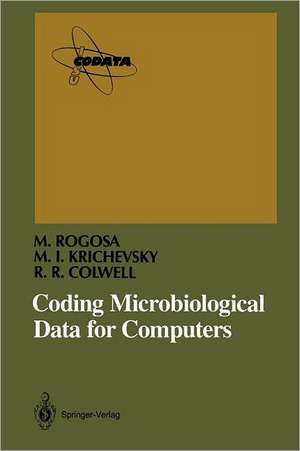
Coding Microbiological Data for Computers: Springer Series in Microbiology
Autor Morrison Rogosa, Micah I. Krichevsky, Rita R. Colwellen Limba Engleză Paperback – oct 2011
Preț: 644.73 lei
Preț vechi: 758.51 lei
-15%
Puncte Express: 967
Carte tipărită la comandă
Livrare economică 21 noiembrie-05 decembrie
Livrare prin curier în România Termenul estimat este afișat lângă disponibilitate.
Transport gratuit pentru acest produs Plată online sau ramburs, în funcție de opțiunile comenzii.
Retur gratuit în 14 zile Comandă securizată și suport în română.
Specificații
ISBN-13: 9781461293866
ISBN-10: 1461293863
Pagini: 316
Ilustrații: XI, 299 p.
Dimensiuni: 155 x 235 x 18 mm
Greutate: 0.48 kg
Ediția:Softcover reprint of the original 1st ed. 1986
Editura: Springer
Colecția Springer Series in Microbiology
Seria Springer Series in Microbiology
Locul publicării:New York, NY, United States
ISBN-10: 1461293863
Pagini: 316
Ilustrații: XI, 299 p.
Dimensiuni: 155 x 235 x 18 mm
Greutate: 0.48 kg
Ediția:Softcover reprint of the original 1st ed. 1986
Editura: Springer
Colecția Springer Series in Microbiology
Seria Springer Series in Microbiology
Locul publicării:New York, NY, United States
V-ar putea interesa
-
 On Natural SelectionCharles Darwin-20%Preț: 45.12 lei56.55 lei
 -
 The Blind WatchmakerRichard Dawkins-28%Preț: 77.77 lei108.42 lei
 -
 Frogs, Flies, and Dandelions: Speciation - The Evolution of New SpeciesMenno Schilthuizen-27%Preț: 352.84 lei484.02 lei
 -
 -32%Preț: 728.30 lei1078.94 lei
 -
 Origins of the Human BrainJean-Pierre Changeux-33%Preț: 759.48 lei1126.07 lei
 -
 The Origin and Early Evolution of LifeTom Fenchel-28%Preț: 377.94 lei528.22 lei
 -
 New Uses for New PhylogeniesPaul H. Harvey-30%Preț: 414.43 lei589.60 lei
 -
 The Evolution of Sibling RivalryDouglas W. Mock-28%Preț: 385.56 lei532.69 lei
 -
 Evolution in Health and DiseaseStephen C. Stearns-24%Preț: 588.20 lei768.95 lei
 -
 -31%Preț: 593.84 lei856.94 lei
 -
 Language EvolutionMorten H. Christiansen-28%Preț: 389.54 lei540.46 lei
 -
 Human Nature and the Limits of ScienceJohn Dupré-20%Preț: 364.38 lei453.29 lei
 -
 Mathematical Population Genetics 1Warren J. Ewens-18%Preț: 1161.93 lei1416.98 lei
 -
 On the Origin of SpeciesCharles Darwin-19%Preț: 71.42 lei88.32 lei
 -
 -28%Preț: 84.33 lei116.62 lei
 -
 What Evolution Is: From Theory to FactErnst Mayr-26%Preț: 68.68 lei92.82 lei
 -
 How Babies Think: The Science of ChildhoodAlison Gopnik-27%Preț: 67.57 lei91.97 lei
 -
 Preț: 426.40 lei
Public țintă
ResearchCuprins
Directions for Coding Data.- Coding Numerical Data.- Recording Specimen and Associated Microbial Data.- Directions for Coding Reference System Data.- Example Set of Code Sheets.- Section.- 1: General Information Code Sheet.- 2: Specific Strain Information.- 3: Individual Cell Morphology.- 4: Individual Vegetative Cell Size.- 5: Insoluble Intracellular And Extracellular Depositions.- 6: Endospores And Cysts.- 7: Myxospores, Sporocysts, Fruiting Bodies, Spores, Sporozoites, Trophozoites, And Gametocytes.- 8: Branching, Hyphae, and Production of Asexual Spores.- 9: Stalks.- 10: Sheaths.- 11: Capsules.- 12: Stain Reactions.- 13: Motility, Flagellation and External Organelles.- 14: Mode Of Cell Division.- 15: Arrangement.- 16: Cultural Conditions, Inhibitors, Nutrition, Growth, Life Cycles.- 17: Vegetative Cell Temperature Relations.- 18: Sodium Chloride & other Osmotic Agents - Tolerance and Requirements.- 19/40: Antibiotic Sensitivity.- 20: Pigments and Odors.- 21: Cell Contents.- 22: Lysis.- 23: Cell Surface (Wall or Membrane).- 24: Metabolic Reactions.- 25: Carbohydrate Metabolism.- 26: Alcohol Metabolism.- 27: Aldehyde Metabolism.- 28: Carboxylic Acid or Ester Metabolism.- 29: Amino Acid Metabolism.- 30: Amine, Amide, Lactam, Purine, Pyrimidine Metabolism.- 31: Hydrocarbon and Ketone Metabolism.- 32: Fat and Oil Metabolism.- 33: Preservation of Strains.- 34: Metabolic Pathways and Enzymes.- 35: Quantitative Antibiotic Sensitivity.- 36: Internal Organelles.- 37: Nucleus.- 38: Nucleic Acids.- Reference System.- 101: Salmonella.- 0 Antigens - Polyvalent Antisera - Bacto.- 0 Antigens - Polyvalent Antisera - CDC.- 0 Antigens - Polyvalent Antisera - Wellcome.- Spicer-Edwards Polyvalent H Antisera.- H Antigens - Wellcome.- List of Manufacturers1 Specific Antisera.- 0 Antigens.- H Antigens.- Pooled H Antigens.- 103: Streptococcus.- Neufeld Quellung Reaction.- Lancefield Groups.- 105: Staphylococcus.- Staphylococcal Toxin.- Immunodiffusion.- Phage Typing - Lytic Groups.- Phage Types.- 106: Escherichia.- 0 Antigens - Bacto.- H Antigens - Polyvalent Antisera - Bacto.- H Antigens - Single Factors - Bacto.- OK Antigens - Polyvalent Antisera - Bacto.- Specific OK Antigens - Bacto.- 107: Campylobacter.- Penner Method - Hemagglutination - CDC.- Lior Method - Polyvalent Antisera.- Lior Method - Single Factor Antisera.- Appendix - Synonyms of Compounds.- References.