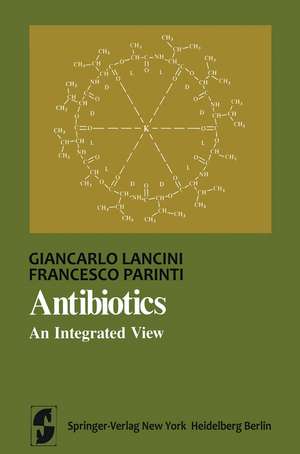
Antibiotics: Springer Series in Microbiology
Autor Giancarlo Lancini, Francesco Parenti Traducere de Betty Rubinen Limba Engleză Paperback – 9 noi 2011
Preț: 374.84 lei
Puncte Express: 562
Carte tipărită la comandă
Livrare economică 23 noiembrie-07 decembrie
Livrare prin curier în România Termenul estimat este afișat lângă disponibilitate.
Transport gratuit de la 400.00 lei Plată online sau ramburs, în funcție de opțiunile comenzii.
Retur gratuit în 14 zile Comandă securizată și suport în română.
Specificații
ISBN-13: 9781461256762
ISBN-10: 1461256763
Pagini: 272
Ilustrații: XII, 253 p. 14 illus.
Dimensiuni: 155 x 235 x 15 mm
Greutate: 0.42 kg
Ediția:Softcover reprint of the original 1st ed. 1982
Editura: Springer
Colecția Springer Series in Microbiology
Seria Springer Series in Microbiology
Locul publicării:New York, NY, United States
ISBN-10: 1461256763
Pagini: 272
Ilustrații: XII, 253 p. 14 illus.
Dimensiuni: 155 x 235 x 15 mm
Greutate: 0.42 kg
Ediția:Softcover reprint of the original 1st ed. 1982
Editura: Springer
Colecția Springer Series in Microbiology
Seria Springer Series in Microbiology
Locul publicării:New York, NY, United States
V-ar putea interesa
-
 -29%Preț: 449.07 lei631.97 lei
 -
 Phylogenetic SystematicsWilli HennigPreț: 297.75 lei
 -
 Mathematical Population Genetics 1Warren J. Ewens-18%Preț: 1161.93 lei1416.98 lei
 -
 Computational Genome AnalysisRichard C Deonier-15%Preț: 605.65 lei712.53 lei
 -
 Preț: 107.17 lei
 -
 Global BrainHoward BloomPreț: 114.96 lei
 -
 Probability Models for DNA Sequence EvolutionRichard Durrett-18%Preț: 735.90 lei897.44 lei
 -
 Statistical Methods for Microarray Data AnalysisAndrei Y. Yakovlev-5%Preț: 748.52 lei787.91 lei
 -
 -19%Preț: 76.47 lei93.87 lei
 -
 Live Cell AssaysChristophe Furger-9%Preț: 986.52 lei1084.09 lei
 -
 Ethics in MedicineShabih H. Zaidi-5%Preț: 356.57 lei375.34 lei
 -
 Equitable Access to Human Biological Resources in Developing CountriesRoger Scarlin Chennells-15%Preț: 665.43 lei782.86 lei
 -
 Systems BiologyEdda Klipp-11%Preț: 532.70 lei598.55 lei
 -
 Am anderen Ende des MikroskopsElmer W. KonemanPreț: 220.05 lei
 -
 Preț: 426.40 lei
Public țintă
ResearchCuprins
1 The Antibiotics: An Overview.- I. Definition.- II. Chemical Nature.- III. Producing Microorganisms.- IV. Biosynthesis.- V. Activity and Resistance.- VI. Mechanism of Action.- VII. Chemotherapy.- VIII. Chemical Modifications.- IX. Principal Classes of Antibiotics.- 2 Activity of the Antibiotics.- I. Definition.- II. Determination of the Minimal Inhibitory Concentration in Liquid Medium.- III. Determination of the Minimal Inhibitory Concentration in Solid Medium.- IV. Determination of Antibiotic Activity by the Agar Diffusion Test.- V. Factors Affecting the Determination of Antibiotic Activity.- VI. Determination of the Minimal Bactericidal Concentration.- VII. The Antibiogram (Bacterial Sensitivity Test).- VIII. Spectrum of Antibiotic Activity.- IX. Interaction of Antibiotics.- X. Recent Microbiological Techniques: Miniaturization and Automation.- 3 Mechanism of Action of the Antibiotics.- I. Relationship Between the Mechanism of Action and the Selectivity of the Antibiotics.- II. Methods for Study of the Mechanism of Action of Antibiotics.- III. Inhibitors of Cell Wall Synthesis.- IV. Inhibitors of Transcription and Replication of Genetic Material.- V. Inhibitors of Protein Synthesis.- VI. Inhibitors of Cell Membrane Functions.- VII. The Antimetabolites.- 4 Resistance of Microorganisms to Antibiotics.- I. General Aspects.- II. Biochemical Bases of Resistance.- III. Genetic Aspects.- 5 Activities of the Antibiotics in Relation to Their Structures.- I. Introduction.- II. ?-Lactam Antibiotics.- III. Tetracyclines.- TV. Aminoglycosides.- V. Macrolides.- VI. Ansamycins.- VII. Peptide Antibiotics.- VIII. Miscellaneous Antibiotics.- 6 Biosynthesis of Antibiotics.- I. Primary and Secondary Metabolites.- II. Methods of Study.- III. Antibiotics Derived from a Single PrimaryMetabolite.- IV. Antibiotics Derived by Condensation of Several Metabolites.- V. Antibiotics Derived by Oligomer or Polymer Formation.- 7 Search for and Development of New Antibiotics.- I. Search for New Antibiotics.- II. Development of an Antibiotic from the Laboratory to the Clinic.- III. Development: From the Laboratory to the Manufacturing Process.- 8 The Use of Antibiotics.- I. Chemotherapy of Infectious Diseases.- II. Uses Other than Human Pharmacology.- III. Antibiotics as Research Tools.- 9 Antibiotics and Producer Organisms.- I. Classes of Antibiotics and Taxonomic Positions of Producing Organisms.- II. Paradox: How to Avoid Suicide.- III. Hypotheses about the Function(s) of Antibiotics in Producing Organisms.- Further Readings.