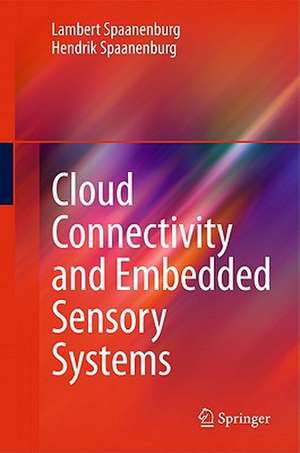
Cloud Connectivity and Embedded Sensory Systems
Autor Lambert Spaanenburg, Hendrik Spaanenburgen Limba Engleză Hardback – 2 dec 2010
Preț: 940.51 lei
Preț vechi: 1146.97 lei
-18%
Puncte Express: 1411
Carte tipărită la comandă
Livrare economică 01-15 decembrie
Livrare prin curier în România Termenul estimat este afișat lângă disponibilitate.
Transport gratuit pentru acest produs Plată online sau ramburs, în funcție de opțiunile comenzii.
Retur gratuit în 14 zile Comandă securizată și suport în română.
Specificații
ISBN-13: 9781441975447
ISBN-10: 1441975446
Pagini: 285
Ilustrații: XXIII, 285 p.
Dimensiuni: 164 x 245 x 27 mm
Greutate: 0.61 kg
Ediția:2011 edition
Editura: Springer
Locul publicării:New York, NY, United States
ISBN-10: 1441975446
Pagini: 285
Ilustrații: XXIII, 285 p.
Dimensiuni: 164 x 245 x 27 mm
Greutate: 0.61 kg
Ediția:2011 edition
Editura: Springer
Locul publicării:New York, NY, United States
V-ar putea interesa
-
 Advanced BDD OptimizationRudiger Ebendt-18%Preț: 930.89 lei1135.23 lei
 -
 -18%Preț: 986.77 lei1203.37 lei
 -
 -18%Preț: 1270.24 lei1549.07 lei
 -
 Compiling EsterelDumitru Potop-Butucaru-18%Preț: 936.02 lei1141.48 lei
 -
 Surface Mount Technology with Fine Pitch ComponentsH. Danielsson-18%Preț: 1265.16 lei1542.88 lei
 -
 Multirate and Multiphase Switched-capacitor CircuitsAdam Dabrowski-18%Preț: 985.70 lei1202.07 lei
 -
 -15%Preț: 691.94 lei814.05 lei
 -
 Integrated Circuit Test EngineeringIan A. Grout-15%Preț: 569.91 lei670.47 lei
 -
 -18%Preț: 783.75 lei955.79 lei
 -
 Handbook of Microwave and Radar EngineeringAnatoly Belous-18%Preț: 1585.30 lei1933.30 lei
 -
 Authentication of Embedded DevicesBasel HalakPreț: 485.17 lei
 -
 AC Electrical Circuit AnalysisMehdi Rahmani-AndebiliPreț: 392.73 lei
 -
 Integrated Hybrid Resonant DCDC ConvertersPeter Renz-15%Preț: 559.36 lei658.07 lei
 -
 Mixed-Signal Embedded Systems DesignEdward H. Currie-19%Preț: 638.47 lei788.23 lei
 -
 Advanced SPICE Model for GaN HEMTs (ASM-HEMT)Sourabh Khandelwal-23%Preț: 714.12 lei927.43 lei
 -
 -15%Preț: 604.71 lei711.42 lei
 -
 Electronic Circuit Design and ApplicationStephan J. G. Gift-19%Preț: 699.64 lei863.76 lei
 -
 -15%Preț: 607.56 lei714.77 lei
 -
 Tantalum and Niobium-Based CapacitorsYuri Freeman-15%Preț: 604.25 lei710.89 lei
 -
 Recurrent Neural NetworksFathi M. SalemPreț: 433.58 lei
 -
 Design Automation for Field-coupled NanotechnologiesMarcel Walter-15%Preț: 665.01 lei782.36 lei
 -
 Ultra-low Voltage Low Power Active-RC Filters and Amplifiers for Low Energy RF ReceiversLucas Compassi Severo-15%Preț: 603.17 lei709.61 lei
 -
 Design of Miniaturized Variable-Capacitance Electrostatic Energy HarvestersSeyed Hossein Daneshvar-15%Preț: 548.35 lei645.12 lei
 -
 Digital Logic Design Using VerilogVaibbhav Taraate-18%Preț: 776.70 lei947.20 lei
 -
 Recent Advances in PMOS Negative Bias Temperature InstabilitySouvik Mahapatra-24%Preț: 905.06 lei1190.86 lei
 -
 Gm-C Filter Synthesis for Modern RF SystemsVan¿o Litovski-18%Preț: 1043.99 lei1273.16 lei
 -
 ASIC Design and SynthesisVaibbhav Taraate-18%Preț: 896.82 lei1093.68 lei
Public țintă
Professional/practitionerCuprins
Introduction.- Ambient Intelligence Limitations.- Topological Considerations.- Software Infrastructure.- Network Safety and Security.- System Development.- Applications: Android-in-the-Cloud.- Wear-Free Transmission.- Body-Area Networks.- Patient Monitoring.- Environmental Monitoring.- Conclusion.
Textul de pe ultima copertă
Cloud Connectivity and Embedded Sensory Systemsby: Lambert SpaanenburgHendrik SpaanenburgSensory systems are meant to create awareness in space and time. They may be measuring the presence of an object or a condition, characterizing an object stream or a situational pattern, or even detect abnormalities that are to occur. This book provides new theory on the design of wireless sensor networks, based on concepts developed for large-scale, distributed computing environments known as “clouds.” It provides a single-source entry into the world of intelligent sensory systems, with a step-by-step discussion of building case studies that capture the requirements, taking into account practical limitations of creating ambient intelligence. The reader will not only achieve a better understanding of sensory clouds, but is also guided by examples of how to design such networks, taking the typical characteristics of diverse application areas into account.•Offers readers a single-source entry into the world of cloud-centric, embedded intelligent sensory systems;•Presents sensory networks in the context of “cloud computing”;•Promotes the notion of migrating software on virtualized hardware;•Emphasizes the role of redundant network communication and computation to optimize safety and security;•Distinguishes between cloud, swarm and flock computing, in order to make the extended network more intelligent and therefore less dependent on the quality of the individual sensors.
Caracteristici
Offers readers a single-source entry into the world of intelligent, embedded sensor networks Presents sensor networks in the context of “cloud computing”; Focuses on topological and communication constraints, while adding intelligence, security and safety to the overall desired system functionality Distinguishes between cloud, swarm and flock computing, in order to make the extended network more intelligent and therefore less dependent on the quality of the individual sensors