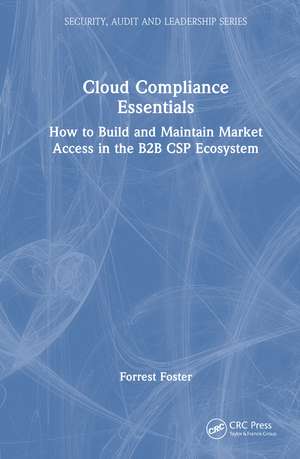
Cloud Compliance Essentials: Build and Maintain Market Access in the B2B CSP Ecosystem: Security, Audit and Leadership Series
Autor Forrest R. Fosteren Limba Engleză Hardback – 20 sep 2026
The Barrier to Entry: Every corporation, government organization, and market segment enforces unique, evolving requirements for market access. For CSPs, the cost of implementing the business processes necessary to satisfy these new customers is resource-intensive, expensive, and high-risk. Failing to manage this effectively means squandering precious capital with little hope of return.
The Solution: Cloud Compliance Essentials (CCE) operates as both a high-level business strategy guide and a practical handbook for navigating these hurdles. It rejects the notion of compliance as a one-time project, framing it instead as the 'long game' – a critical strategic operation where senior management must allocate resources wisely to balance opportunity against Operational Expense (OpEx).
Through a robust People, Process, & Technology perspective, this book guides readers on how to:
- Build Baselines: Construct an industry-accepted Information Security Management System (ISMS) that serves as a foundation for global market access.
- Scale Strategically: Make informed decisions on which markets to enter and when, ensuring that compliance costs do not outweigh potential revenue.
- Maintain Trust: Establish and operate effective internal control frameworks that bridge the gap between technical capability (including AI utilization) and customer confidence.
Din seria Security, Audit and Leadership Series
-
 Preț: 326.44 lei
- 8%
 Preț: 445.74 lei
- 11%
 Preț: 635.66 lei
-
 Preț: 415.48 lei
-
 Preț: 418.53 lei
- 8%
 Preț: 445.18 lei
- 20%
 Preț: 379.78 lei
- 20%
 Preț: 685.25 lei
- 20%
 Preț: 506.49 lei
- 20%
 Preț: 1629.80 lei
-
 Preț: 345.94 lei
- 20%
 Preț: 418.05 lei
- 15%
 Preț: 472.42 lei
- 20%
 Preț: 535.60 lei
- 20%
 Preț: 299.76 lei
-
 Preț: 391.12 lei
- 20%
 Preț: 526.36 lei
-
 Preț: 219.16 lei
- 20%
 Preț: 492.86 lei
- 20%
 Preț: 326.72 lei
- 20%
 Preț: 1308.63 lei
- 20%
 Preț: 354.29 lei
- 20%
 Preț: 374.75 lei
- 20%
 Preț: 316.61 lei
-
 Preț: 438.98 lei
-
 Preț: 346.21 lei
- 20%
 Preț: 1030.95 lei
- 20%
 Preț: 327.92 lei
- 20%
 Preț: 548.06 lei
- 20%
 Preț: 573.71 lei
- 20%
 Preț: 349.28 lei
-
 Preț: 350.55 lei
- 20%
 Preț: 315.27 lei
- 20%
 Preț: 715.46 lei
- 20%
 Preț: 488.00 lei
-
 Preț: 297.38 lei
-
 Preț: 391.02 lei
- 20%
 Preț: 1112.87 lei
- 20%
 Preț: 520.36 lei
- 20%
 Preț: 364.17 lei
- 20%
 Preț: 393.25 lei
Preț: 1013.33 lei
Preț vechi: 1266.67 lei
-20% Nou
Puncte Express: 1520
Carte tipărită la comandă
Livrare economică 09-23 decembrie
Livrare prin curier în România Termenul estimat este afișat lângă disponibilitate.
Transport gratuit pentru acest produs Plată online sau ramburs, în funcție de opțiunile comenzii.
Retur gratuit în 14 zile Comandă securizată și suport în română.
Specificații
ISBN-13: 9781032802299
ISBN-10: 1032802294
Pagini: 244
Ilustrații: 10
Dimensiuni: 156 x 234 mm
Greutate: 0.61 kg
Ediția:1
Editura: CRC Press
Colecția CRC Press
Seria Security, Audit and Leadership Series
ISBN-10: 1032802294
Pagini: 244
Ilustrații: 10
Dimensiuni: 156 x 234 mm
Greutate: 0.61 kg
Ediția:1
Editura: CRC Press
Colecția CRC Press
Seria Security, Audit and Leadership Series
Public țintă
Professional Practice & Development, Professional Reference, and Professional TrainingCuprins
PART 1: The Big Picture. Introduction. Chapter 1: B2B CSP Go-to-market Strategy. Chapter 2: Audit 101 for CSP Leaders: how to audit proof your business. Chapter 3: Governance and Stakeholder Management. Chapter 4: The Cloud Compliance Practitioner. PART 2: Standards - Methods - and Methodologies. Chapter 5: Cloud Certifications and Assurance Schemes. Chapter 6: Strategic Audit Vendor Management. Chapter 7: Web Marketing and Trust Portals. PART 3: Implementation and Operations. Chapter 8: Establishing the ISMS via ISO 27001 with ISO 42001 AI Governance. Chapter 9: Planning and Timelines. Chapter 10: Putting It All Together.
Notă biografică
Forrest R. Foster is a distinguished expert in Cybersecurity Governance, Risk, and Compliance (GRC), bringing over 35 years of experience as a servant leader to large-scale technology initiatives. Currently serving the Security & Trust Organization at Cisco Systems, Forrest bridges the gap between technical engineering teams and C-suite stakeholders. He combines rigorous architectural frameworks with deep security expertise to design systems and processes that are secure by design and aligned with corporate strategy.
His leadership extends to the broader industry, where he has served as President of the ISC² Silicon Valley Chapter and co-founder and President of the ISC² Austin Chapter. A dedicated mentor and lifelong learner, Forrest holds an Executive Certification from the National Society of Leadership and Success, alongside an MBA, an NSA-Validated and Designated BSIT in Information Security & Assurance, and core industry credentials including the CISA, CISSP, CNSS-I, CRISC and ISO 27001 Lead Auditor. Forrest is the author of the upcoming book Cloud Compliance Essentials (CRC Press, Taylor & Francis Group), a definitive guide to business strategies and methods for global market access.
His leadership extends to the broader industry, where he has served as President of the ISC² Silicon Valley Chapter and co-founder and President of the ISC² Austin Chapter. A dedicated mentor and lifelong learner, Forrest holds an Executive Certification from the National Society of Leadership and Success, alongside an MBA, an NSA-Validated and Designated BSIT in Information Security & Assurance, and core industry credentials including the CISA, CISSP, CNSS-I, CRISC and ISO 27001 Lead Auditor. Forrest is the author of the upcoming book Cloud Compliance Essentials (CRC Press, Taylor & Francis Group), a definitive guide to business strategies and methods for global market access.
Recenzii
Cloud Compliance Essentials reframes compliance from a defensive obligation into a core market-access strategy for business-to-business cloud service providers. Foster’s central argument is persuasive: certification, assurance, and governance directly affect whether a provider can enter regulated markets, close enterprise deals, and sustain customer trust.
Organized in three parts, the book moves logically from go-to-market strategy, audit fundamentals, and stakeholder governance through certification schemes, audit-vendor management, and trust portals, before turning to ISO 27001 and ISO 42001 implementation, planning, and continuous operations. This architecture serves both audiences the book seeks to unite—executives who need to understand the commercial rationale for compliance and practitioners who need to see how its many programs, controls, and decisions fit together.
The book’s greatest strength is its practical, experience-based treatment of a subject that is often presented as either abstract policy or dense technical instruction. Foster repeatedly uses the People, Process, and Technology lens to connect governance, control ownership, vendor selection, gap remediation, audit preparation, web marketing, and executive decision-making.
He also keeps the commercial stakes visible, linking security and assurance work to revenue, cost, customer confidence, and competitive differentiation. Checklists, maturity paths, sample planning considerations, and implementation guidance make the discussion actionable rather than merely descriptive. The result is especially useful for compliance leaders, CISOs, founders, and product or sales executives who need a shared language for turning assurance requirements into a scalable operating capability.
That breadth creates a few tradeoffs. The density of acronyms, frameworks, and certification choices may require slower reading from newcomers, and several core messages recur often enough to feel repetitive. Because regulatory requirements and assurance schemes evolve quickly, readers will also need to pair the book’s strategic guidance with current standards and authoritative jurisdiction-specific sources. Its deliberate focus on the B2B cloud-service-provider ecosystem further means that it is not a comprehensive guide to every form of enterprise assurance. These are limitations of scope rather than flaws in the book’s central thesis.
Overall, Cloud Compliance Essentials is a valuable field guide and reference work—best used as a strategic playbook that teams revisit during market planning, certification selection, audit preparation, and program maturation. It is strongly recommended for cloud leaders who want compliance to produce durable trust and commercial advantage rather than function as a last-minute exercise.
Ron Baklarz
One of the persistent challenges in cybersecurity is that compliance is too often treated as an administrative obligation rather than an essential component of effective governance, organisational resilience and long-term business success. In Cloud Compliance Essentials, Forrest R. Foster challenges this mindset, drawing on more than three decades of professional experience to demonstrate that meaningful assurance is not achieved through certifications or documentation alone, but through sustained leadership, accountable governance and the integration of security into everyday business operations. What makes this book particularly valuable is its recognition that compliance is not simply a technical discipline, but a strategic organisational capability that influences trust, commercial opportunity and the ability to operate successfully in increasingly complex regulatory environments.
Foster brings a refreshingly pragmatic perspective to a subject frequently dominated by frameworks, standards and procedural complexity. Rather than presenting compliance as an exercise in achieving perfection, he emphasises continuous improvement, proportionate risk management and the importance of demonstrating that controls are genuinely implemented and operating effectively. His examination of cloud assurance schemes, ISO 27001, emerging AI governance requirements, stakeholder management and the practical challenges of establishing and sustaining an Information Security Management System provides readers with a useful connection between regulatory expectations and operational reality. Particularly compelling is his discussion of the relationship between compliance investment, organisational maturity and customer trust, recognising that poorly considered compliance activities can consume considerable resources without necessarily delivering corresponding security or business value.
From my own experience working across government, Defence and critical security environments, I particularly appreciate the emphasis on evidence-based assurance, leadership accountability and the distinction between demonstrating compliance and actually managing risk. These are challenges that transcend individual industries, jurisdictions and technologies. Although the book is primarily directed towards business-to-business cloud service providers, its underlying lessons are equally relevant to security executives, governance and risk professionals, auditors, technology leaders and organisations seeking to build sustainable security capabilities. The practical examples and lessons drawn from real-world experience help bridge the often considerable distance between what frameworks prescribe and what organisations can realistically implement.
Cloud Compliance Essentials is a worthwhile addition to the professional literature precisely because it encourages readers to think beyond individual controls and certifications towards the broader systems of governance, decision-making and organisational behaviour that make assurance meaningful. I would particularly encourage emerging and experienced security professionals, CISOs, business leaders and those responsible for cloud governance to read it. Whether establishing a compliance program, navigating increasingly demanding customer and regulatory expectations, or reconsidering the effectiveness of an existing assurance function, readers will find valuable perspectives that challenge conventional thinking and encourage a more strategic, sustainable and mature approach to security and trust.
Jessamy Perkins EMBA, BA (Security, Terrorism & Counterterrorism)
Principal Cyber Security Adviser | Executive Security & Risk Leader
Most compliance books are written for people who already run audits. Forrest Foster’s Cloud Compliance Essentials: Build and Maintain Market Access in the B2B CSP Ecosystem is written for the people who pay for it. That shift matters. Foster treats compliance as a market access decision rather than a security checklist: which certifications to pursue, in what order, and at what operating cost. His point about “hidden losses” stayed with me. A bank’s third-party risk team screens 50 vendors, often with generative AI doing the first pass, and 43 of them drop out without ever learning they were considered. Anyone who has sat on the buying side of a federal or financial services procurement knows this is true, and it is rarely said this plainly to the founders and executives who need to hear it.
The book’s strength is that it's built on years of practice. Foster structures the certification landscape as a maturity ladder. It starts at a “Level Zero” for startups that need OWASP and the CSA’s free guidance more than they need consultants. It moves through ISO 27001 and SOC 2, then to CSA STAR, BSI C5 and ENS, and ends with the heavy lifts: FedRAMP 20x, IRAP and ISMAP. The chapter on audit vendor management is worth the price alone. It covers rotating assessors across the ISO three-year cycle to show impartiality, avoiding API lock-in with a single audit firm, and spotting the bait-and-switch where a senior auditor sells the engagement and a junior one shows up. The trust portal chapter backs its advice with a result: using CAIQ-based trust bundles behind a click-through NDA cut incoming customer questionnaires by more than 90 percent. The appendix also admits something few practitioners will say in print. With processes changing so often, a GRC tool can cost more to maintain than the spreadsheets it replaces.
The book has a few rough edges. Key themes recur often, and a few recur many times. The author says the repetition is intentional, but some readers will skim. The ISO 42001 integration section also reads more like a well-organized starting point than a full playbook, given how strongly the book frames AI governance as a new customer demand. Still, extending ISO 27001 clause by clause to cover AI, rather than standing up a separate management system, is the right approach, and it’s the advice I give clients. For CSP leaders weighing their first certification, compliance practitioners trying to explain the business case upward, and anyone selling cloud services into regulated markets, this is a grounded and honest guide. Foster’s core message is that compliance can’t be faked and that trust is earned on every renewal. It’s the right message right now.
Scott Andersen
Founder, Creative Technology and Innovation
Descriere
Cloud Compliance Essentials: A Strategic Guide to Market Access and Customer Trust
The Business-to-Business (B2B) Cloud Service Provider (CSP) market is on a trajectory of explosive growth, estimated at approximately $875 billion in 2026 and poised to reach well into the trillions by 2030.
The Business-to-Business (B2B) Cloud Service Provider (CSP) market is on a trajectory of explosive growth, estimated at approximately $875 billion in 2026 and poised to reach well into the trillions by 2030.