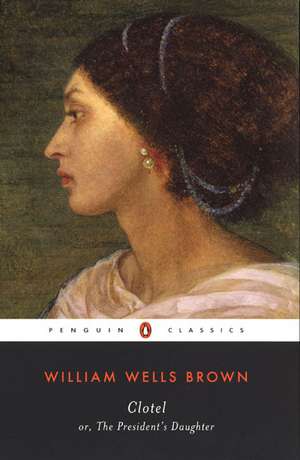
Clotel
Autor William Wells Brownen Limba Engleză Paperback – 30 dec 2003
First published in December 1853, Clotel was written amid then unconfirmed rumors that Thomas Jefferson had fathered children with one of his slaves. The story begins with the auction of his mistress, here called Currer, and their two daughters, Clotel and Althesa. The Virginian who buys Clotel falls in love with her, gets her pregnant, seems to promise marriage—then sells her. Escaping from the slave dealer, Clotel returns to Virginia disguised as a white man in order to rescue her daughter, Mary, a slave in her father’s house. A fast-paced and harrowing tale of slavery and freedom, of the hypocrisies of a nation founded on democratic principles, Clotel is more than a sensationalist novel. It is a founding text of the African American novelistic tradition, a brilliantly composed and richly detailed exploration of human relations in a new world in which race is a cultural construct.
- First time in Penguin Classics
- Published in time for African-American History Month
- Includes appendices that show the different endings Brown created for the various later versions of Clotel, along with the author's narrative of his "Life and Escape," Introduction, suggested readings, and comprehensive explanatory notes
Preț: 80.62 lei
Puncte Express: 121
Carte disponibilă
Livrare economică 07-21 noiembrie
Livrare prin curier în România Termenul estimat este afișat lângă disponibilitate.
Transport gratuit de la 400.00 lei Plată online sau ramburs, în funcție de opțiunile comenzii.
Retur gratuit în 14 zile Comandă securizată și suport în română.
Specificații
ISBN-13: 9780142437728
ISBN-10: 0142437727
Pagini: 320
Dimensiuni: 130 x 198 x 32 mm
Greutate: 0.25 kg
Editura: Penguin Publishing Group
ISBN-10: 0142437727
Pagini: 320
Dimensiuni: 130 x 198 x 32 mm
Greutate: 0.25 kg
Editura: Penguin Publishing Group
V-ar putea interesa
-
 Uncle Tom's CabinHarriet Beecher StowePreț: 28.01 lei
 -
 Searching for My Slave RootsMalik Al NasirPreț: 158.51 lei
 -
 Preț: 45.03 lei
 -
 Twelve Years a SlaveSolomon NorthupPreț: 187.39 lei
 -
 The Bondwoman's NarrativeHannah CraftsPreț: 118.38 lei
 -
 Narrative of the Life of Frederick DouglassFrederick Douglass-19%Preț: 23.42 lei28.76 lei
 -
 The Life of Olaudah EquianoOlaudah Equiano-42%Preț: 34.77 lei59.77 lei
 -
 Incidents in the Life of a Slave GirlHarriet Jacobs-32%Preț: 24.59 lei36.40 lei
 -
 The Marrow of TraditionCharles W. ChesnuttPreț: 46.64 lei
 -
 'I Was Transformed'Laurence FentonPreț: 84.85 lei
 -
 The Good Lord BirdJames McBride-24%Preț: 60.87 lei80.56 lei
 -
 Narrative of the Life of Frederick Douglass (Special Edition)Frederick Douglass-32%Preț: 92.56 lei136.46 lei
 -
 ClotelleWilliam Wells BrownPreț: 43.59 lei
 -
 Slaves in Algiers; or, A Struggle for FreedomSusanna Rowson-18%Preț: 119.86 lei146.88 lei
 -
 William Wells Brown: Clotel & Other WritingsWilliam Wells BrownPreț: 230.65 lei
 -
 12 Years a SlaveSolomon NorthupPreț: 58.20 lei
 -
 Escape; or, a Leap for FreedomWilliam Wells BrownPreț: 67.17 lei
Notă biografică
William Wells Brown (1814ߝ1884) was born a slave, escaped to the North and then to England, and became one of the most prominent abolitionists of his time. During his prolific literary career, Brown was a pioneer in several different genres, including travel writing, fiction, and drama.
M. Giulia Fabi is the author of Passing and the Rise of the African American Novel. She teaches American literature at the University of Ferrara, Italy.
M. Giulia Fabi is the author of Passing and the Rise of the African American Novel. She teaches American literature at the University of Ferrara, Italy.
Descriere
Descriere de la o altă ediție sau format:
As nearly all of its reviewers pointed out, Clotel was an audience-minded performance, an effort to capitalize on the post—Uncle Tom’s Cabin “mania” for abolitionist fiction in Great Britain, where William Wells Brown lived between 1849 and 1854. The novel tells the story of Clotel and Althesa, the fictional daughters of Thomas Jefferson and his mixed-race slave. Like the popular and entertaining public lectures that Brown gave in England and America, Clotel is a series of startling, attention-grabbing narrative “attractions.” Brown creates in this novel a delivery system for these attractions in an effort to draw as many readers as possible toward anti-slavery and anti-racist causes. Rough, studded with caricatures, and intimate with the racism it ironizes, Clotel is still capable of creating a potent mix of discomfort and delight.
This edition aims to make it possible to read Clotel in something like its original cultural context. Geoffrey Sanborn’s Introduction discusses Brown’s extensive plagiarism of other authors in composing Clotel, as well as his narrative strategies within the novel itself. Appendices include material on slave auctions, contemporary attractions and amusements, and the topic of plagiarism more broadly.
As nearly all of its reviewers pointed out, Clotel was an audience-minded performance, an effort to capitalize on the post—Uncle Tom’s Cabin “mania” for abolitionist fiction in Great Britain, where William Wells Brown lived between 1849 and 1854. The novel tells the story of Clotel and Althesa, the fictional daughters of Thomas Jefferson and his mixed-race slave. Like the popular and entertaining public lectures that Brown gave in England and America, Clotel is a series of startling, attention-grabbing narrative “attractions.” Brown creates in this novel a delivery system for these attractions in an effort to draw as many readers as possible toward anti-slavery and anti-racist causes. Rough, studded with caricatures, and intimate with the racism it ironizes, Clotel is still capable of creating a potent mix of discomfort and delight.
This edition aims to make it possible to read Clotel in something like its original cultural context. Geoffrey Sanborn’s Introduction discusses Brown’s extensive plagiarism of other authors in composing Clotel, as well as his narrative strategies within the novel itself. Appendices include material on slave auctions, contemporary attractions and amusements, and the topic of plagiarism more broadly.
Recenzii
As nearly all of its reviewers pointed out, Clotel was an audience-minded performance, an effort to capitalize on the post—Uncle Tom’s Cabin “mania” for abolitionist fiction in Great Britain, where William Wells Brown lived between 1849 and 1854. The novel tells the story of Clotel and Althesa, the fictional daughters of Thomas Jefferson and his mixed-race slave. Like the popular and entertaining public lectures that Brown gave in England and America, Clotel is a series of startling, attention-grabbing narrative “attractions.” Brown creates in this novel a delivery system for these attractions in an effort to draw as many readers as possible toward anti-slavery and anti-racist causes. Rough, studded with caricatures, and intimate with the racism it ironizes, Clotel is still capable of creating a potent mix of discomfort and delight.
This edition aims to make it possible to read Clotel in something like its original cultural context. Geoffrey Sanborn’s Introduction discusses Brown’s extensive plagiarism of other authors in composing Clotel, as well as his narrative strategies within the novel itself. Appendices include material on slave auctions, contemporary attractions and amusements, and the topic of plagiarism more broadly.
“Exquisitely curated with appropriate supporting documents and furnished with an expert introduction, Geoffrey Sanborn’s edition of William Wells Brown’s Clotel will prove to be a welcome text to students and generalists interested in the literature and history of chattel slavery in the US, as well as to specialists working in African-American Studies.” — Ivy Wilson, Northwestern University
“Geoffrey Sanborn’s edition of Clotel offers readers a clear understanding of its richness, complexity, and value to American literature. In a lucid introduction that allows us to understand Brown’s work in relation to his contemporaries, and in meticulously researched notes and appendices, Sanborn invites twenty-firstcentury audiences to experience the pleasure and power of Clotel.” — Tess Chakkalakal, Bowdoin College
This edition aims to make it possible to read Clotel in something like its original cultural context. Geoffrey Sanborn’s Introduction discusses Brown’s extensive plagiarism of other authors in composing Clotel, as well as his narrative strategies within the novel itself. Appendices include material on slave auctions, contemporary attractions and amusements, and the topic of plagiarism more broadly.
“Exquisitely curated with appropriate supporting documents and furnished with an expert introduction, Geoffrey Sanborn’s edition of William Wells Brown’s Clotel will prove to be a welcome text to students and generalists interested in the literature and history of chattel slavery in the US, as well as to specialists working in African-American Studies.” — Ivy Wilson, Northwestern University
“Geoffrey Sanborn’s edition of Clotel offers readers a clear understanding of its richness, complexity, and value to American literature. In a lucid introduction that allows us to understand Brown’s work in relation to his contemporaries, and in meticulously researched notes and appendices, Sanborn invites twenty-firstcentury audiences to experience the pleasure and power of Clotel.” — Tess Chakkalakal, Bowdoin College
Cuprins
Acknowledgements
Introduction
William Wells Brown: A Brief Chronology
A Note on the Text
Clotel; or, The President’s Daughter
Appendix A: Contemporary Reviews
Introduction
William Wells Brown: A Brief Chronology
A Note on the Text
Clotel; or, The President’s Daughter
Appendix A: Contemporary Reviews
- “Clotel,” Hereford Times (17 December 1853)
- “Clotel,” Pennsylvania Freeman (29 December 1853)
- “W.W. Brown’s New Work,” National Anti-Slavery Standard (31 December 1853)
- “Clotel,” Anti-Slavery Advocate (January 1854)
- “Clotel,” Tait’s Edinburgh Magazine 21 (January 1854)
- “Clotel,” Bristol Mercury (28 January 1854)
- [William Lloyd Garrison,] “New Work by William Wells Brown,” Liberator (3 February 1854)
- From [William Lloyd Garrison,] “A Scene at New Orleans,” Liberator (21 September 1838)
- H.S.D., “An Auction,” National Anti-Slavery Standard (20 March 1845)
- “Slave Auction Scene,” Anti-Slavery Reporter (1 December 1846)
- From “The Case of Two Slave Girls,” Christian Watchman (2 November 1848)
- From “Visit to a Slave Auction,” Frederick Douglass' Paper (2 February 1855)
- From [Gamaliel Bailey,] “Popular Amusements in New York” National Era (15 April 1847)
- “Mechanical Museum—Lafayette Bazaar,” New York Evening Post (22 December 1847)
- From “Banvard’s Panorama of the Mississippi and Missouri Rivers,” Illustrated London News (9 December 1848)
- From George Washington Bungay, Crayon Sketches and Off-Hand Takings (1852)
- From “The Anniversaries,” New York Herald (9 May 1849)
- From “Address from W.W. Brown, an Escaped Slave,” Norfolk News (4 May 1850)
- From “Third Anniversary of the New York Anti-Slavery Society,” National Anti-Slavery Standard (16 May 1856)
- From “Speech of William Wells Brown,” National Anti-Slavery Standard (26 May 1860)
- From [James Frederick Ferrier,] “The Plagiarisms of S.T. Coleridge,” Blackwood’s Magazine 47 (March 1840)
- From “Plagiarism,” New-York Mirror (15 January 1842)
- Untitled article, Caledonian Mercury (18 November 1852)
- From untitled article, London Times (22 November 1852)
- From “Stop Thief!” Fife Herald (25 November 1852)
- From William Wells Brown, “Letter from William W. Brown,” Frederick Douglass’ Paper (10 June 1853)
- From Thomas Montgomery, Literary Societies, Their Uses and Abuses (1853)
- From “Plagiarism: Especially That of Coleridge,” Eclectic Magazine 32 (August 1854)