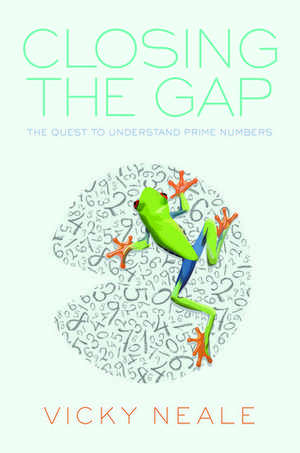
Closing the Gap: The Quest to Understand Prime Numbers
Autor Vicky Nealeen Limba Engleză Hardback – 12 oct 2017
Preț: 209.14 lei
Preț vechi: 249.38 lei
-16%
Puncte Express: 314
Carte tipărită la comandă
Livrare economică 27 noiembrie-08 decembrie
Livrare express 24-30 octombrie pentru 69.65 lei
Livrare prin curier în România Termenul estimat este afișat lângă disponibilitate.
Transport gratuit de la 400.00 lei Plată online sau ramburs, în funcție de opțiunile comenzii.
Retur gratuit în 14 zile Comandă securizată și suport în română.
Specificații
ISBN-13: 9780198788287
ISBN-10: 0198788282
Pagini: 172
Dimensiuni: 167 x 241 x 16 mm
Greutate: 0.45 kg
Editura: OUP OXFORD
Colecția OUP Oxford
Locul publicării:Oxford, United Kingdom
ISBN-10: 0198788282
Pagini: 172
Dimensiuni: 167 x 241 x 16 mm
Greutate: 0.45 kg
Editura: OUP OXFORD
Colecția OUP Oxford
Locul publicării:Oxford, United Kingdom
V-ar putea interesa
-
 Arithmetic and Algebra Again, 2/eBrita ImmergutPreț: 211.80 lei
 -
 Corrective Mathematics Addition, WorkbookN/A McGraw Hill-59%Preț: 89.63 lei220.81 lei
 -
 The Philosophy of Leibniz: Metaphysics and LanguageBenson Mates-28%Preț: 465.05 lei649.86 lei
 -
 -13%Preț: 173.49 lei198.60 lei
 -
 From Kant to Hilbert Volume 1: A Source Book in the Foundations of MathematicsWilliam Bragg Ewald-32%Preț: 828.76 lei1224.41 lei
 -
 A Basic Course in StatisticsClarkePreț: 566.22 lei
 -
 Constrained Statistical InferenceSilvapulle-9%Preț: 1103.41 lei1212.53 lei
 -
 Dr. Math Presents More GeometryThe Math ForumPreț: 96.59 lei
 -
 Preț: 473.77 lei
 -
 Extreme Value and Related ModelsCastillo-9%Preț: 1076.60 lei1183.08 lei
 -
 Accelerated TestingWayne B Nelson-9%Preț: 959.18 lei1054.04 lei
 -
 Markov Decision Processes - Discrete Stochastic Dynamic ProgrammingMartin L. Puterman-23%Preț: 932.73 lei1211.34 lei
 -
 Trigonometric Sums in Number Theory and AnalysisGennady I. Arkhipov-23%Preț: 2223.74 lei2887.98 lei
Recenzii
The way [Closing the Gap] explores mathematics and at the same time describes the work mathematicians do, is very interesting and it keeps the reader invested in the book. It is easy to read and precise. The book could be definitely recommended to mathematics students and teachers but also to younger people with an interest in higher-level mathematics.
The book features a creative structure that lends itself well to the subject matter. A curious undergraduate mathematics major should enjoy this book and learn a great deal. For mathematicians who do not specialize in number theory but who are curious about the flurry of recent activity in the field, this book provides an excellent entry point.
If you are looking for an introduction to the world of Polymath; if you are looking for the story of the Twin Primes Conjecture; if you are looking to show you friends and family what your life as a mathematician is; if you would like a bit of asymptotic mathematics explained to you plainly; if you would like a summary of Waring's problem; or if you just have a couple of hours and are looking for a nice diversion, then you have found it.
The book is clearly and enthusiastically written and beautifully presented.
For myself, I learned a lot, even about subjects I thought I knew before... it is clear from every page in the book that Neale is superb teacher. In sum, I recommend this book highly to anyone interested in mathematics, young people and teachers but also to researchers.
Written in an engaging and inclusive way, it makes a perfect read for beginners but it also picks up the pace fairly quickly, so even enthusiasts like myself are bound to enjoy it. Neale manages to take the readers on a journey to cutting edge research mathematics.
Neale writes in an inviting style that draws readers into this challenging subject, convincing them that, with a little effort, they too can follow along. An enjoyable book and journey, complemented by a helpful reading list and index... Recommended.
Closing the Gap is an excellent exposition of the study of prime numbers. Not only do we learn about the history of this area since the Greeks, but the book is the first aimed at a lay readership that provides insight into recent breakthroughs. Vicky Neale's passion in the subject is contagious and I enjoyed how she weaves together the mathematics with background on how mathematicians now work, as well as her reflections on what it is like to be a mathematician. This book would be ideal for a curious sixth former wanting to peek ahead at what might lie around the corner if they are considering studying mathematics at a higher level.
Her prose is clear but not patronizing, precise but accessible. The result is a very enjoyable book that can be read with profit not only by laypeople but also by mathematics students and the people who teach them.
Closing The Gap has gone straight into my top ten books to give to interested students... The book's introduction starts with an extended analogy comparing mathematics to climbing [and] Neale sets herself up as this guide, and succeeds brilliantly.
Closing the Gap is among the clearest popular accounts of maths I've read in a while. It's about prime numbers, as the title suggests, but it's also a master piece in the art of weaving. Apart from exploring the mathematics, the book gives an intimate description of the process of doing maths as experienced by those who do it every day, and an account of a particularly exciting, and recent, period when prime number theory made some great leaps forward. And it's a look at a completely new way of doing mathematics: in large online collaborations that anyone can join.
The book features a creative structure that lends itself well to the subject matter. A curious undergraduate mathematics major should enjoy this book and learn a great deal. For mathematicians who do not specialize in number theory but who are curious about the flurry of recent activity in the field, this book provides an excellent entry point.
If you are looking for an introduction to the world of Polymath; if you are looking for the story of the Twin Primes Conjecture; if you are looking to show you friends and family what your life as a mathematician is; if you would like a bit of asymptotic mathematics explained to you plainly; if you would like a summary of Waring's problem; or if you just have a couple of hours and are looking for a nice diversion, then you have found it.
The book is clearly and enthusiastically written and beautifully presented.
For myself, I learned a lot, even about subjects I thought I knew before... it is clear from every page in the book that Neale is superb teacher. In sum, I recommend this book highly to anyone interested in mathematics, young people and teachers but also to researchers.
Written in an engaging and inclusive way, it makes a perfect read for beginners but it also picks up the pace fairly quickly, so even enthusiasts like myself are bound to enjoy it. Neale manages to take the readers on a journey to cutting edge research mathematics.
Neale writes in an inviting style that draws readers into this challenging subject, convincing them that, with a little effort, they too can follow along. An enjoyable book and journey, complemented by a helpful reading list and index... Recommended.
Closing the Gap is an excellent exposition of the study of prime numbers. Not only do we learn about the history of this area since the Greeks, but the book is the first aimed at a lay readership that provides insight into recent breakthroughs. Vicky Neale's passion in the subject is contagious and I enjoyed how she weaves together the mathematics with background on how mathematicians now work, as well as her reflections on what it is like to be a mathematician. This book would be ideal for a curious sixth former wanting to peek ahead at what might lie around the corner if they are considering studying mathematics at a higher level.
Her prose is clear but not patronizing, precise but accessible. The result is a very enjoyable book that can be read with profit not only by laypeople but also by mathematics students and the people who teach them.
Closing The Gap has gone straight into my top ten books to give to interested students... The book's introduction starts with an extended analogy comparing mathematics to climbing [and] Neale sets herself up as this guide, and succeeds brilliantly.
Closing the Gap is among the clearest popular accounts of maths I've read in a while. It's about prime numbers, as the title suggests, but it's also a master piece in the art of weaving. Apart from exploring the mathematics, the book gives an intimate description of the process of doing maths as experienced by those who do it every day, and an account of a particularly exciting, and recent, period when prime number theory made some great leaps forward. And it's a look at a completely new way of doing mathematics: in large online collaborations that anyone can join.
Notă biografică
Vicky Neale is the Whitehead Lecturer at the Mathematical Institute and Balliol College, University of Oxford. A substantial part of her remit is public communication of mathematics. She has wide experience of working with students of all ages (school children to adults, via undergraduates), and of giving public lectures, and does various media work.
Cuprins
- 1: Introduction
- 2: What is a prime?
- 3: May 2013
- 4: It's easy to ask hard questions
- 5: May 2013
- 6: Making hard problems easier
- 7: June 2013
- 8: How many primes are there?
- 9: July 2013
- 10: What's so mathematical about my mathematical pencil?
- 11: August 2013
- 12: If primes are hard, let's try something else
- 13: November 2013
- 14: Generalise . . .
- 15: April 2014
- 16: Where next?