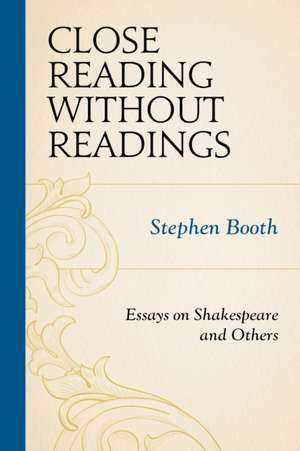
Close Reading without Readings: Essays on Shakespeare and Others
Autor Stephen Boothen Limba Engleză Paperback – 6 apr 2017
Preț: 328.04 lei
Preț vechi: 425.70 lei
-23%
Puncte Express: 492
Carte tipărită la comandă
Livrare economică 07-21 decembrie
Livrare prin curier în România Termenul estimat este afișat lângă disponibilitate.
Transport gratuit de la 400.00 lei Plată online sau ramburs, în funcție de opțiunile comenzii.
Retur gratuit în 14 zile Comandă securizată și suport în română.
Specificații
ISBN-13: 9781611478921
ISBN-10: 1611478928
Pagini: 200
Dimensiuni: 148 x 228 x 14 mm
Greutate: 0.3 kg
Editura: Bloomsbury Publishing
Colecția Fairleigh Dickinson University Press
Locul publicării:New York, United States
ISBN-10: 1611478928
Pagini: 200
Dimensiuni: 148 x 228 x 14 mm
Greutate: 0.3 kg
Editura: Bloomsbury Publishing
Colecția Fairleigh Dickinson University Press
Locul publicării:New York, United States
V-ar putea interesa
-
 BLOOD ON TONGUE PBStephen BoothPreț: 94.34 lei
 -
 One Last BreathStephen BoothPreț: 94.56 lei
 -
 Scared to LiveStephen BoothPreț: 94.27 lei
 -
 Dying to SinStephen BoothPreț: 121.63 lei
 -
 The Kill CallStephen BoothPreț: 95.57 lei
 -
 Lost RiverStephen BoothPreț: 78.22 lei
 -
 The Oxford Handbook of Shakespeare's PoetryJonathan Post-18%Preț: 326.30 lei396.92 lei
 -
 Shakespeare's SonnetsWilliam ShakespearePreț: 117.82 lei
 -
 The Evolution of English Prose, 1700 1800Carey McIntoshPreț: 302.71 lei
 -
 A History of Augustan FableMark LoveridgePreț: 359.47 lei
 -
 Britannia's Issue: The Rise of British Literature from Dryden to OssianHoward D. WeinbrotPreț: 423.01 lei
 -
 The Making of Jacobean CultureCurtis PerryPreț: 301.66 lei
 -
 Ben Jonson and Possessive AuthorshipJoseph Loewenstein-11%Preț: 414.17 lei465.37 lei
 -
 Sexuality and Gender in Early Modern EuropeJames Grantham TurnerPreț: 442.93 lei
 -
 Printing, Writers and Readers in Renaissance ItalyBrian RichardsonPreț: 373.99 lei
 -
 Authorship, Commerce, and Gender in Early Eighteenth-Century EnglandCatherine Ingrassia-11%Preț: 695.95 lei781.96 lei
 -
 Press Censorship in Jacobean EnglandCyndia Susan Clegg-11%Preț: 722.92 lei812.26 lei
 -
 -14%Preț: 733.89 lei853.36 lei
 -
 The epigram in England, 1590-1640James Doelman-23%Preț: 808.19 lei1049.60 lei
 -
 The Devil's EdgeStephen Booth-24%Preț: 61.04 lei80.32 lei
 -
 Dead And BuriedStephen Booth-24%Preț: 60.91 lei80.23 lei
 -
 The Ben Jonson EncyclopediaD. Heyward Brock-33%Preț: 969.77 lei1444.52 lei
 -
 Privacy in the Age of ShakespeareRonald Huebert-19%Preț: 488.09 lei602.59 lei
 -
 Mind, Body, Motion, MatterMary Helen Mcmurran-19%Preț: 549.73 lei678.68 lei
 -
 The Spanish TragedyThomas Kyd-18%Preț: 152.86 lei186.01 lei
 -
 Marriage and Land Law in Shakespeare and MiddletonNancy Mohrlock Bunker-23%Preț: 323.17 lei417.49 lei
 -
 -22%Preț: 324.50 lei418.19 lei
 -
 EssexAnnaliese ConnollyPreț: 288.67 lei
 -
 King Lear, Macbeth, Indefinition, and TragedyStephen BoothPreț: 114.13 lei
Cuprins
Foreword
1. Poetic Richness, A Preliminary Audit: Antony and Cleopatra 3.10
2. The Acquiescent Audience
3. Desdemona's Eyes and the Aesthetics of Blindness
4. 2 Henry IV and the Aesthetics of Failure
5. Faith in The Winter's Tale and Faith in The Winter's Tale
6. A Discourse on the Witty Partition of A Midsummer Night's Dream
7. Twelfth Night and Othello: Those Extraordinary Twins
8. Deviation, Variation, and Variety in Stanza One of Venus and Adonis
9. On the Eventfulness of Hero and Leander
10. Prelapsarian Eroticism: Paradise Lost
11. On the Aesthetic Significance of Non-Signifying Signification in Romeo and Juliet
12. Liking Julius Caesar
13. On the Value of Hamlet
Index
1. Poetic Richness, A Preliminary Audit: Antony and Cleopatra 3.10
2. The Acquiescent Audience
3. Desdemona's Eyes and the Aesthetics of Blindness
4. 2 Henry IV and the Aesthetics of Failure
5. Faith in The Winter's Tale and Faith in The Winter's Tale
6. A Discourse on the Witty Partition of A Midsummer Night's Dream
7. Twelfth Night and Othello: Those Extraordinary Twins
8. Deviation, Variation, and Variety in Stanza One of Venus and Adonis
9. On the Eventfulness of Hero and Leander
10. Prelapsarian Eroticism: Paradise Lost
11. On the Aesthetic Significance of Non-Signifying Signification in Romeo and Juliet
12. Liking Julius Caesar
13. On the Value of Hamlet
Index
Recenzii
This collection of 13 essays by influential scholar Stephen Booth includes some heretofore unpublished conference papers and some previously published works. As a deconstructionist pioneer, Booth discusses the unsettled meanings in literary works, some 'irritants,' and insists (as Prospero does with Miranda) that readers must be attentive to primary texts. Booth offers, for example, close readings of Julius Caesar-a play that 'makes fools of its audience'-and the 'editor-made text' of Hamlet. Booth also explores Marlowe's Hero and Leander, Milton's Paradise Lost,and Shakespeare's Antony and Cleopatra, Romeo and Juliet, The Winter's Tale, Twelfth Night,and Othello. In all of the essays, Booth's tone is humorous and vital, even visceral. As in every perfect piece of literature, form and content meet in this book as Booth uses stylistic practices similar to those he explores. For example, in 'Witty Partition of A Midsummer Night's Dream,' Booth uses a conversational, direct address challenging the audience to experience the beauty in literature. A demanding writer, Booth admits to offering 'painful exercises' in these readings and unapologetically commands readers to 'engage in some [them]selves.' Summing Up: Recommended. Upper-division undergraduates through faculty.
There is much to learn from this collection, especially for students new to the game. As ever, the lesson is simple: pay attention to the object of literary art-not just to its subject-and to the behavior of your mind as it pays attention. Read Booth's book, therefore, and again and again; and, this time, may the lesson take.
There is much to learn from this collection, especially for students new to the game. As ever, the lesson is simple: pay attention to the object of literary art-not just to its subject-and to the behavior of your mind as it pays attention. Read Booth's book, therefore, and again and again; and, this time, may the lesson take.