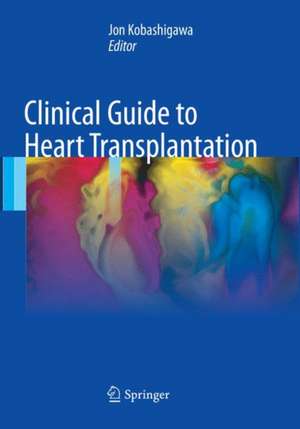
Clinical Guide to Heart Transplantation
Editat de Jon Kobashigawaen Limba Engleză Paperback – 20 iul 2018
Sub coordonarea editorială a lui Jon Kobashigawa, un expert recunoscut în domeniu, Clinical Guide to Heart Transplantation reunește expertiza clinică necesară gestionării unei patologii cu un impact major asupra sănătății publice globale. Notăm cu interes rigoarea cu care sunt prezentate datele epidemiologice, subliniind că riscul pe parcursul vieții de a dezvolta insuficiență cardiacă este de unu la cinci, o realitate care impune protocoale de intervenție precise. Considerăm că această lucrare, publicată de Springer, reușește să sintetizeze complexitatea transplantului cardiac într-un format accesibil, dar exhaustiv din punct de vedere academic. Structura volumului urmează o progresie logică, de la criteriile de înrolare pe lista de așteptare și testele de histocompatibilitate, până la tehnici chirurgicale și strategii de imunosupresie. Un element distinctiv este includerea unor capitole dedicate viitorului disciplinei, precum genomica și chimerismul, oferind o perspectivă care depășește simpla procedură chirurgicală. Manualul este o referință clinică solidă, comparabilă cu Contemporary Heart Transplantation de Linda Bogar, dar se distinge prin concizia sa, fiind axat pe ghidurile de bune practici esențiale în faza peri-operatorie și în monitorizarea rejectului în primul an. Credem că relevanța acestui ghid este amplificată de deficitul cronic de organe donatoare, ceea ce transformă evaluarea riguroasă a candidaților într-o necesitate critică. Analiza detaliată a complicațiilor pe termen lung și a opțiunilor de suport circulator mecanic, inclusiv inima artificială totală, oferă medicului cardiolog și chirurgului cardiovascular instrumentele necesare pentru a maximiza beneficiile clinice într-un domeniu unde marja de eroare este minimă.
Preț: 783.16 lei
Preț vechi: 824.37 lei
-5%
Carte tipărită la comandă
Livrare economică 03-09 iunie
Specificații
ISBN-10: 3319829076
Pagini: 272
Ilustrații: XII, 258 p. 50 illus., 25 illus. in color.
Dimensiuni: 178 x 254 x 14 mm
Greutate: 0.59 kg
Ediția:Softcover reprint of the original 1st ed. 2017
Editura: Springer
Locul publicării:Cham, Switzerland
V-ar putea interesa
-
 Heart FailureRoy S. Gardner-27%Preț: 402.77 lei550.66 lei
 -
 Oxford Textbook of Advanced Heart Failure and Cardiac TransplantationMichael J Domanski-5%Preț: 1559.93 lei1642.02 lei
 -
 Oxford Textbook of Heart FailureAndrew Clark-26%Preț: 1193.57 lei1609.21 lei
 -
 Oxford Handbook of CardiologyPunit Ramrakha-14%Preț: 283.98 lei329.00 leiRecomandat
 -
 Pediatric Liver Transplantation: A Clinical GuideNedim Hadzic-29%Preț: 1055.23 lei1493.34 lei
 -
 Kidney Transplantation: Principles and PracticeStuart J. Knechtle-29%Preț: 1525.42 lei2148.05 lei
 -
 Oh's Intensive Care ManualJonathan M. Handy-23%Preț: 742.08 lei963.74 leiRecomandat
 -
 Sabiston Textbook of Surgery: The Biological Basis of Modern Surgical PracticeDouglas Scott Tyler-30%Preț: 1092.91 lei1567.58 leiRecomandat
 -
 Diagnostic Pathology: Transplant PathologyAnthony Chang-5%Preț: 1216.23 lei1280.24 lei
 -
 Transplantation - Print and E-Book: A Companion to Specialist Surgical PracticeJohn L. R. Forsythe-35%Preț: 541.44 lei832.64 lei
 -
 Essentials of Lung TransplantationSaskia Bos-5%Preț: 451.29 lei475.05 lei
 -
 -5%Preț: 2133.11 lei2245.37 lei
 -
 Transplantation of the LiverRonald W. Busuttil-36%Preț: 1389.12 lei2160.04 lei
 -
 Heart Transplantation: Indications, Postoperative Management and Long-Term OutcomesElian Facundo Giordanino-18%Preț: 1381.26 lei1678.74 lei
 -
 The Washington Manual of Heart Failure and TransplantationJONATHAN MORENO-25%Preț: 523.55 lei694.38 lei
 -
 Handbook of Kidney TransplantationGABRIEL M. DANOVITCH-22%Preț: 460.38 lei590.03 lei
 -
 Mechanical Circulatory Support in End-Stage Heart FailureAndrea Montalto-5%Preț: 1579.64 lei1662.78 lei
 -
 Heart FailureDavid S. Feldman-5%Preț: 901.22 lei948.65 lei
 -
 Manual of Heart Failure ManagementHarikrishnan S-5%Preț: 439.67 lei462.81 lei
De ce să citești această carte
Recomandăm această lucrare medicilor rezidenți și specialiștilor în chirurgie cardio-toracică și cardiologie care gestionează pacienți în stadii terminale. Cititorul câștigă acces la protocoale actualizate de management post-operator și monitorizare a imunosupresiei. Este un instrument esențial pentru rafinarea criteriilor de selecție a candidaților la transplant, asigurând o utilizare optimă a resurselor limitate în medicina de înaltă performanță.
Despre autor
Jon Kobashigawa este un renumit cardiolog american, specializat în transplantul cardiac, deținând funcții de conducere în instituții medicale de prestigiu. Este recunoscut la nivel internațional pentru cercetările sale privind respingerea grefelor și pentru dezvoltarea protocoalelor de îngrijire a pacienților cu insuficiență cardiacă avansată. În calitate de editor, el coordonează acest volum sub egida Springer, integrând decenii de experiență clinică în strategii de tratament care au modelat standardele actuale în cardiologia transplantului.
Descriere scurtă
Cuprins
Recenzii
Notă biografică
He received his undergraduate degree at Stanford University and earned his medical degree at Mount Sinai School of Medicine in New York. He is a past president of the International Society of Heart and Lung Transplantation, past chair of the American College of Cardiology Committee on Heart Failure and Transplantation, and past member of the United Network of Organ Sharing National Thoracic Committee.
Dr. Kobashigawa is recognized nationally and internationally as a leader in heart transplantation. He has published more than 300 peer-reviewed articles, chapters and monographs in the field of heart failure and transplantation and has chaired several multicenter clinical studies. Dr. Kobashigawa has organized and chaired several International Consensus Conferences to discuss pertinent questions regarding heart failure and heart transplant. He lectures at universities around the world and has mentored several young physicians who have ascended to important academic positions throughout the country.
Textul de pe ultima copertă
This handbook is an easy reference for those involved in the management of heart transplant. While this compilation of best practices cannot address the complexity of the individual patients we care for on a daily basis, it will serve to help us ask the right questions, access the best evidence and ultimately make the best decisions for the patients involved.
Clinical Guide to Heart Transplantation provides a current review of the field of heart transplantation and how it has evolved into an established therapy for the treatment of end-stage heart failure. With the advent of improved surgical techniques, the development of immunosuppressive drugs and the utilization of more sophisticated monitoring strategies and treatments for graft rejection, heart transplantation now offer patients an avenue to both improved survival and quality of life.
With over 4000 heart transplants performed per year globally and with 1-year survival approaching 90%, this practical title assists those involved in the this most complex of procedures to establish best practice. It is therefore essential reading for all practitioners in this field, charged with making critical decisions in the management of patients, donor organs, and the transplant process itself in order to achieve the greatest benefit in the utilization of this often scarce resource.
Caracteristici
Structured as a concise high-yield cardiology review
Provides a comprehensive clinical review of advanced heart failure and transplantation?