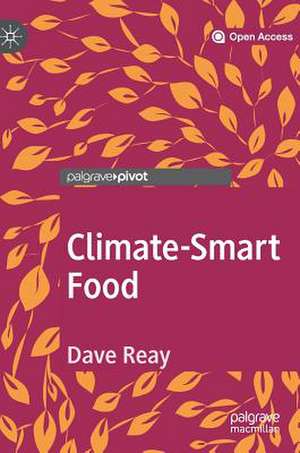
Climate-Smart Food
Autor Dave Reayen Limba Engleză Hardback – 9 iul 2019
This open access book asks just how climate-smart our food really is. It follows an average day's worth of food and drink to see where it comes from, how far it travels, and the carbon price we all pay for it. From our breakfast tea and toast, through breaktime chocolate bar, to take-away supper, Dave Reay explores the weather extremes the world’s farmers are already dealing with, and what new threats climate change will bring. Readers will encounter heat waves and hurricanes, wildfires and deadly toxins, as well as some truly climate-smart solutions. In every case there are responses that could cut emissions while boosting resilience and livelihoods. Ultimately we are all in this together, our decisions on what food we buy and how we consume it send life-changing ripples right through the global web that is our food supply.
As we face a future of 10 billion mouths to feed in a rapidly changing climate, it’s time to get to know our farmers and herders, our vintners and fisherfolk, a whole lot better.
Preț: 104.43 lei
Puncte Express: 157
Carte disponibilă
Livrare economică 27 octombrie-10 noiembrie
Livrare express 10-16 octombrie pentru 32.23 lei
Livrare prin curier în România Termenul estimat este afișat lângă disponibilitate.
Transport gratuit de la 400.00 lei Plată online sau ramburs, în funcție de opțiunile comenzii.
Retur gratuit în 14 zile Comandă securizată și suport în română.
Specificații
ISBN-13: 9783030182052
ISBN-10: 3030182053
Pagini: 207
Ilustrații: XIV, 201 p. 16 illus. in color.
Dimensiuni: 148 x 210 x 20 mm
Greutate: 0.5 kg
Ediția:1st ed. 2019
Editura: Springer
Colecția Palgrave Pivot
Locul publicării:Cham, Switzerland
ISBN-10: 3030182053
Pagini: 207
Ilustrații: XIV, 201 p. 16 illus. in color.
Dimensiuni: 148 x 210 x 20 mm
Greutate: 0.5 kg
Ediția:1st ed. 2019
Editura: Springer
Colecția Palgrave Pivot
Locul publicării:Cham, Switzerland
V-ar putea interesa
-
 Linguistic DisobedienceYuliya KomskaPreț: 134.41 lei
 -
 Johnstown's Flood of 1889Neil M. ColemanPreț: 276.73 lei
 -
 Electrical MeasurementsEdwin J. HoustonPreț: 299.19 lei
 -
 A Treatise on Frictional ElectricityWilliam Snow HarrisPreț: 238.23 lei
 -
 ElectricityRobert M. FergusonPreț: 282.87 lei
 -
 Physical Treatise on Electricity and MagnetismJames E. H. GordonPreț: 295.35 lei
 -
 Electricity in Electro-TherapeuticsA. E. KennellyPreț: 297.17 lei
 -
 ElectrolysisHippolyte FontainePreț: 213.52 lei
 -
 -15%Preț: 574.16 lei675.48 lei
 -
 Preț: 472.56 lei
 -
 Die humanoide HerausforderungE. W. Udo KüppersPreț: 256.11 lei
 -
 Modelle als Denkräume, Beispiele und Ebenbilder: Philosophische DimensionenWolfgang MeisenheimerPreț: 156.88 lei
 -
 Mobilitätswende - autonome Autos erobern unsere StraßenJohannes RitzPreț: 134.99 lei
 -
 Preț: 133.18 lei
 -
 FarbenNorbert WelschPreț: 285.27 lei
 -
 Bis(s) ins Innere des ProtonsBoris LemmerPreț: 238.93 lei
 -
 Preț: 181.30 lei
 -
 Risiko EnergiewendeKonrad KleinknechtPreț: 150.95 lei
 -
 ZeitpfadJörg ResagPreț: 271.84 lei
 -
 Nationalpark Kellerwald-EderseeNorbert PanekPreț: 199.79 lei
Recenzii
Textul de pe ultima copertă
This open access book asks just how climate-smart our food really is. It follows an average day's worth of food and drink to see where it comes from, how far it travels, and the carbon price we all pay for it. From our breakfast tea and toast, through breaktime chocolate bar, to take-away supper, Dave Reay explores the weather extremes the world’s farmers are already dealing with, and what new threats climate change will bring. Readers will encounter heat waves and hurricanes, wildfires and deadly toxins, as well as some truly climate-smart solutions. In every case there are responses that could cut emissions while boosting resilience and livelihoods. Ultimately we are all in this together, our decisions on what food we buy and how we consume it send life-changing ripples right through the global web that is our food supply.
As we face a future of 10 billion mouths to feed in a rapidly changing climate, it’s time to get to know our farmers and herders, our vintners and fisherfolk, a whole lot better.
Dave Reay is Professor of Carbon Management at the University of Edinburgh, UK. He has studied climate change for over 20 years, from warming impacts in the Southern Ocean, through carbon fluxes in forests, to greenhouse gas emissions from wetlands and agriculture. In 2018 he received the Chancellor’s Award for Teaching for his work in climate change education. His latest project involves managing a large area of coastal land in Scotland to regrow native tree species and trap a lifetime’s carbon.
Caracteristici
Discusses the challenges of food security in the 21st century
Compares how climate smart different types of food are
Challenges readers to think about their own food and how they get it
This is an Open Access title
Compares how climate smart different types of food are
Challenges readers to think about their own food and how they get it
This is an Open Access title