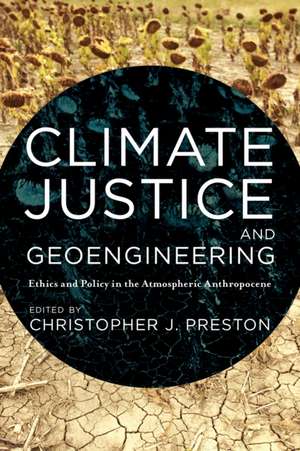
Climate Justice and Geoengineering: Ethics and Policy in the Atmospheric Anthropocene
Editat de Christopher J. Prestonen Limba Engleză Paperback – 21 sep 2016
This volume is the first to put the ethical issues raised by climate engineering into a comprehensive, comparative context so that the key ethical challenges of these technologies can be better measured against those of alternative climate policies . Addressing the topic specifically through the lens of justice, contributors include both advocates of climate intervention research and its sceptics. The volume includes a helpful blend of the theoretical and the practical, with contributions from authors in philosophy, engineering, public policy, social science, geography, sustainable development studies, economics, and climate studies. This cross-disciplinary collection provides the start of an important and more contextualized "second generation" analysis of climate engineering and the difficult public policy decisions that lie ahead.
Preț: 313.24 lei
Preț vechi: 394.23 lei
-21%
Puncte Express: 470
Carte tipărită la comandă
Livrare economică 05-19 iunie
Specificații
ISBN-13: 9781783486373
ISBN-10: 1783486376
Pagini: 224
Ilustrații: 9 b/w illustrations; 5 tables
Dimensiuni: 159 x 234 x 14 mm
Greutate: 0.32 kg
Editura: Bloomsbury Publishing
Colecția Rowman & Littlefield
Locul publicării:New York, United States
ISBN-10: 1783486376
Pagini: 224
Ilustrații: 9 b/w illustrations; 5 tables
Dimensiuni: 159 x 234 x 14 mm
Greutate: 0.32 kg
Editura: Bloomsbury Publishing
Colecția Rowman & Littlefield
Locul publicării:New York, United States
V-ar putea interesa
-
 The Rise and Fall of the Great PowersPaul KennedyPreț: 119.71 lei
 -
 Web Of DeceitMark CurtisPreț: 130.06 lei
 -
 Lions Donkeys And DinosaursLewis PagePreț: 111.44 lei
 -
 Foreign Policy In A Transformed WorldMark Webber-15%Preț: 568.02 lei668.26 lei
 -
 Foreign Affairs in English CourtsF. a. Mann-38%Preț: 823.21 lei1317.55 lei
 -
 -69%Preț: 175.97 lei562.64 lei
 -
 Plantation Silviculture in EuropePeter Savill-31%Preț: 493.22 lei717.68 lei
 -
 The New Energy ParadigmDieter Helm-34%Preț: 653.49 lei984.34 lei
 -
 -15%Preț: 253.55 lei299.42 lei
 -
 Reframing Social CitizenshipPeter Taylor-Gooby-8%Preț: 349.00 lei380.59 lei
 -
 Preț: 238.19 lei
 -
 Health Policy in BritainChristopher Ham-16%Preț: 319.57 lei378.97 lei
 -
 English-Only Europe?: Challenging Language PolicyRobert PhillipsonPreț: 388.87 lei
 -
 The Honest BrokerJr Roger A. PielkePreț: 327.55 lei
 -
 Economic Geography and Public PolicyRichard Baldwin-19%Preț: 499.59 lei616.78 lei
 -
 Welfare States under PressurePeter Taylor-GoobyPreț: 416.78 lei
 -
 The Last Hours of Ancient SunlightThom Hartmann-19%Preț: 83.93 lei103.92 lei
 -
 Preț: 263.68 lei
Cuprins
Introduction: Climate Justice and Geoengineering, Christopher J. Preston / Part I: Geoengineering Justice in Theory / 1.Solar Radiation Management and Comparative Climate Justice, Toby Svoboda / 2. Why Geoengineering is Not 'Plan B', Augustin Fragnière and Stephen M. Gardiner / 3. Justice, Recognition, and Climate Geoengineering, Marion Hourdequin / 4. Do We Have a Residual Obligation to Engineer the Climate, as a Matter of Justice? Patrik Baard and Per Wikman-Svahn / 5. Paying it Forward: Geo-engineering and Compensation for the Further Future, Frank Jankunis and Allen Habib / Part II: Geoengineering Justice in Practice / 6. Solar Geoengineering and Obligations to the Global Poor, Joshua Horton and David Keith / 7. Why Aggressive Mitigation Must be Part of Any Pathway to Climate Justice, Christian Baatz and Konrad Ott / 8. Bringing Geoengineering in the Mix of Climate Change Tools, Jane Long / 9. Food Systems and Climate Engineering: A Plate Full of Risks or Promises?, Teea Kortetmäkiand Markku Oksanen / Part III: Geoengineering Justice in Frames, Scenarios, and Models / 10. Framing out Justice: The Post-politics of Climate Engineering Discourses, Duncan McLaren / 11. Solar Geoengineering: Technology-Based Climate Intervention or Compromising Social Justice in Africa?, Cush Ngozo Luwesi, Dzigbodi Adzo Doke, and David R. Morrow / 12. Geoengineering and Climate Change Mitigation: Trade-offs and Synergies as Foreseen by Integrated Assessment Models, Johannes Emmerling and Massimo Tavoni / 13. Distributional Implications of Geoengineering, Richard S.J. Tol / Index / Notes on Contributors
Recenzii
Christopher Preston has emerged as a leading philosopher of the ethics of climate engineering. In this new collection of essays, he has brought together a diverse group of thinkers and analysts from across three continents who wrestle with the complex question, 'In what ways might it be just to deliberately engineer the world's climate?' Preston's Climate Justice and Geoengineering shows that in the Anthropocene the human ability to transform nature will always likely exceed our confidence in whether it is morally right to do so.
It is likely that we will all have to grapple with the political and ethical implications of climate engineering as calls for an aerosol sunscreen to coat the Earth become louder. Christopher Preston has brought together an impressive group of thinkers to reflect on the knottiest problem of geoengineering: can it be done justly and, if not, must we do it anyway?
Responding to the risks of climate change management requires attention to coupled scientific and ethical concerns. Nowhere is this more obvious than proposals to engineer the climate through measures like cooling the planet through deployment of stratospheric aerosols. Climate Justice and Geoengineering makes an important contribution to this complex and controversial approach to climate risk management, one that promises to responsibly inform both practices and policy.
This important collection situates its thoughtful contributions on climate justice and geoengineering within the context of real-world climate policy choices. It thereby provides a much-needed reflection on the implications of considering geoengineering as a potential policy option amongst others, and is excellent reading for anyone interested in the difficult choices that contemporary climate policy must face.
It is likely that we will all have to grapple with the political and ethical implications of climate engineering as calls for an aerosol sunscreen to coat the Earth become louder. Christopher Preston has brought together an impressive group of thinkers to reflect on the knottiest problem of geoengineering: can it be done justly and, if not, must we do it anyway?
Responding to the risks of climate change management requires attention to coupled scientific and ethical concerns. Nowhere is this more obvious than proposals to engineer the climate through measures like cooling the planet through deployment of stratospheric aerosols. Climate Justice and Geoengineering makes an important contribution to this complex and controversial approach to climate risk management, one that promises to responsibly inform both practices and policy.
This important collection situates its thoughtful contributions on climate justice and geoengineering within the context of real-world climate policy choices. It thereby provides a much-needed reflection on the implications of considering geoengineering as a potential policy option amongst others, and is excellent reading for anyone interested in the difficult choices that contemporary climate policy must face.