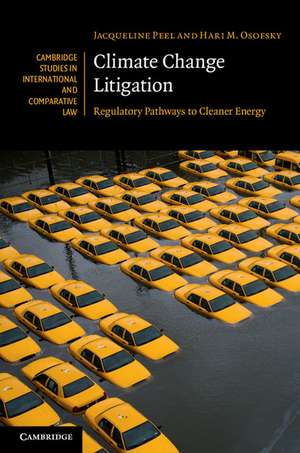
Climate Change Litigation
Autor Jacqueline Peel, Hari M. Osofskyen Limba Engleză Hardback – 17 feb 2015
Preț: 830.67 lei
Preț vechi: 965.89 lei
-14%
Puncte Express: 1246
Carte tipărită la comandă
Livrare economică 19 noiembrie-03 decembrie
Livrare prin curier în România Termenul estimat este afișat lângă disponibilitate.
Transport gratuit pentru acest produs Plată online sau ramburs, în funcție de opțiunile comenzii.
Retur gratuit în 14 zile Comandă securizată și suport în română.
Specificații
ISBN-13: 9781107036062
ISBN-10: 1107036062
Pagini: 376
Ilustrații: 2 b/w illus.
Dimensiuni: 157 x 235 x 25 mm
Greutate: 0.69 kg
Editura: Cambridge University Press
Locul publicării:New York, United States
ISBN-10: 1107036062
Pagini: 376
Ilustrații: 2 b/w illus.
Dimensiuni: 157 x 235 x 25 mm
Greutate: 0.69 kg
Editura: Cambridge University Press
Locul publicării:New York, United States
V-ar putea interesa
-
 Environmental LawLee Godden-23%Preț: 630.91 lei819.37 lei
 -
 Environmental Diplomacy: Negotiating More Effective Global AgreementsLawrence E. Susskind-29%Preț: 443.09 lei620.70 lei
 -
 International Climate Change LawDaniel Bodansky-21%Preț: 468.70 lei593.91 lei
 -
 The Oxford Handbook of International Climate Change LawCinnamon P. Carlarne-32%Preț: 1112.94 lei1637.74 lei
 -
 Introduction to International Environmental LawTimo Koivurova-15%Preț: 430.96 lei507.00 lei
 -
 Protecting the Polar Marine EnvironmentDavor VidasPreț: 303.20 lei
 -
 Transboundary Harm in International LawRebecca M. BratspiesPreț: 424.92 lei
 -
 Australian Climate Law in Global ContextAlexander Zahar-23%Preț: 1063.77 lei1381.52 lei
 -
 Toxic LoopholesCraig CollinsPreț: 312.65 lei
 -
 Preț: 461.89 lei
 -
 International Climate Change RegimeFarhana YaminPreț: 469.85 lei
 -
 Preț: 464.90 lei
 -
 The Human Right to a Green FutureRichard P. HiskesPreț: 239.45 lei
 -
 Environmental Law and Justice in ContextJonas Ebbesson-14%Preț: 965.21 lei1122.34 lei
 -
 Science and Risk Regulation in International LawJacqueline PeelPreț: 345.55 lei
 -
 Adjudicating Climate ChangeWilliam C. G. BurnsPreț: 357.86 lei
 -
 Climate Change, Public Health, and the LawMichael BurgerPreț: 398.89 lei
 -
 Principles of International Environmental LawPhilippe Sands-8%Preț: 462.23 lei502.42 lei
 -
 Indigenous Water Rights in Law and RegulationElizabeth Jane Macpherson-14%Preț: 757.59 lei880.92 lei
 -
 -15%Preț: 462.55 lei544.18 lei
 -
 Enforcement of European Union Environmental Law: Legal Issues and ChallengesMartin Hedemann-Robinson-15%Preț: 473.86 lei557.49 lei
 -
 Clean Power PoliticsJoseph P. TomainPreț: 294.03 lei
 -
 -18%Preț: 1066.13 lei1300.17 lei
 -
 -32%Preț: 850.96 lei1251.94 lei
 -
 Shipbreaking: Hazards and LiabilitiesMichael Galley-15%Preț: 623.59 lei733.63 lei
 -
 -18%Preț: 786.68 lei959.36 lei
 -
 Agricultural LawMariagrazia Alabrese-18%Preț: 1154.80 lei1408.29 lei
Cuprins
1. Why climate change litigation matters; 2. Model for understanding litigation's regulatory impact; 3. Litigation as a mitigation tool; 4. Litigation as an adaptation tool; 5. Corporate responses to litigation; 6. Litigation's role in shaping social norms; 7. Barriers to progress; 8. The future of climate change litigation.
Recenzii
'Peel and Osofsky do an excellent job of providing the necessary factual and legal information needed to understand the various aspects of this complex topic. Whether the reader possesses only a basic knowledge of the subject or is well versed, this book should provide considerable insight. While Climate Change Litigation provides information, theories, and strategies designed to assist those seeking to use the court system as a vehicle for reducing carbon emissions, attorneys, advocacy groups, and other stakeholders positioned on the opposite side of such efforts also will find this book to be a useful resource for generating legal strategies and preparing for potential future legal actions.' Mark Popielarski, Law Library Journal
Descriere
This book examines how litigation over climate change shapes the choices of governments, corporations and the public regarding mitigation and adaptation.