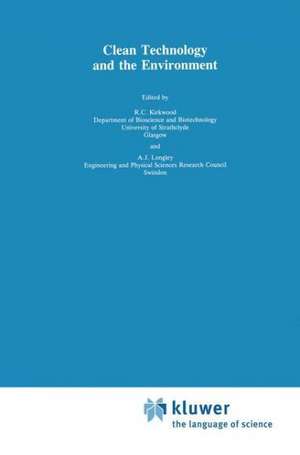
Clean Technology and the Environment
Editat de R. Kirkwood, A. Longleyen Limba Engleză Paperback – 21 sep 2012
Preț: 1329.59 lei
Preț vechi: 1621.45 lei
-18%
Puncte Express: 1994
Carte tipărită la comandă
Livrare economică 26 noiembrie-10 decembrie
Livrare prin curier în România Termenul estimat este afișat lângă disponibilitate.
Transport gratuit pentru acest produs Plată online sau ramburs, în funcție de opțiunile comenzii.
Retur gratuit în 14 zile Comandă securizată și suport în română.
Specificații
ISBN-13: 9789401045728
ISBN-10: 9401045720
Pagini: 368
Ilustrații: XIV, 350 p.
Dimensiuni: 155 x 235 x 19 mm
Greutate: 0.51 kg
Ediția:1995
Editura: SPRINGER NETHERLANDS
Colecția Springer
Locul publicării:Dordrecht, Netherlands
ISBN-10: 9401045720
Pagini: 368
Ilustrații: XIV, 350 p.
Dimensiuni: 155 x 235 x 19 mm
Greutate: 0.51 kg
Ediția:1995
Editura: SPRINGER NETHERLANDS
Colecția Springer
Locul publicării:Dordrecht, Netherlands
V-ar putea interesa
-
 Target Sites for Herbicide ActionR. Kirkwood-18%Preț: 920.28 lei1122.29 lei
 -
 EcogeneticsP. Grandjean-18%Preț: 980.46 lei1195.68 lei
 -
 Industrial Air Pollution MonitoringA. G. Clarke-18%Preț: 981.32 lei1196.72 lei
 -
 Environmental Condition of the Mediterranean SeaF. B. De Walle-18%Preț: 1273.61 lei1553.19 lei
 -
 Hazardous DecisionsD. Huitema-18%Preț: 1278.99 lei1559.74 lei
 -
 The Hadley Circulation: Present, Past and FutureRaymond S. Bradley-18%Preț: 1282.92 lei1564.53 lei
 -
 Strategic Management of Marine EcosystemsEugene Levner-18%Preț: 980.87 lei1196.19 lei
 -
 -18%Preț: 1896.82 lei2313.20 lei
 -
 Combined and Hybrid Adsorbents: Fundamentals and ApplicationsJosé M. Loureiro-18%Preț: 1748.87 lei2132.77 lei
 -
 -23%Preț: 895.07 lei1162.44 lei
 -
 Public CommunicationLinda Blankenship-18%Preț: 1024.23 lei1249.06 lei
 -
 -18%Preț: 1023.29 lei1247.91 lei
 -
 -18%Preț: 1013.90 lei1236.46 lei
 -
 -18%Preț: 1013.20 lei1235.61 lei
 -
 -18%Preț: 1014.41 lei1237.08 lei
 -
 State of the ScienceJohn McCray-18%Preț: 1014.12 lei1236.73 lei
 -
 Trace Organic Chemicals in Biosolids-Amended SoilsHiggins, Christopher P.-18%Preț: 755.36 lei921.17 lei
 -
 -18%Preț: 1013.34 lei1235.79 lei
 -
 -18%Preț: 753.21 lei918.55 lei
 -
 -18%Preț: 1015.16 lei1238.01 lei
 -
 Nutrient ManagementDavid Clark-18%Preț: 753.99 lei919.50 lei
 -
 -18%Preț: 1013.46 lei1235.93 lei
 -
 -18%Preț: 1013.90 lei1236.46 lei
 -
 Peat and WaterC. H. Fuchsman-18%Preț: 1878.49 lei2290.84 lei
 -
 Atmospheric AcidityRoy M. Harrison-18%Preț: 1283.99 lei1565.84 lei
Public țintă
ResearchCuprins
1 Environment and human influence.- 1.1 Introduction.- 1.2 The environmental issue.- 1.3 The environment, abiotic and biotic components.- 1.4 The ecosystem, energy flow, biogeochemical cycling and biodiversity.- 1.5 Human population increase and its influence on the environment.- 1.6 The problem of environmental pollutants.- 1.7 The scope and nature of the problem of toxic chemicals.- 1.8 The strategy of sustainable development.- 1.9 Clean technology in relation to major industrial processes.- 1.10 Concluding remarks.- References.- 2 Atmospheric pollution: components, mechanisms, control and remediation.- 2.1 Introduction.- 2.2 The structure of the atmosphere.- 2.3 Key air pollution species.- 2.4 Air quality standards and guidelines.- 2.5 Emissions of air pollutants.- 2.6 Transport, reaction and deposition of air pollutants.- 2.7 Toxic organic pollutants.- 2.8 Acid deposition.- 2.9 Stratòspheric ozone depletion.- 2.10 The greenhouse effect.- 2.11 Conclusions.- References.- 3 Water pollution.- 3.1 Introduction: water — the essential resource.- 3.2 The present state of the aquatic environment.- 3.3 The impact of pollution on aquatic systems.- 3.4 Legislation and control systems.- 3.5 The way ahead.- References.- 4 Bioremediation: a practical solution to land pollution.- 4.1 Introduction.- 4.2 Microbial nutrition and environmental requirements.- 4.3 Bioremediation options.- 4.4 Composting.- 4.5 Land treatment.- 4.6 In situ bioremediation.- 4.7 The oxygen question.- 4.8 Conclusions.- References.- 5 The economics of pollution.- 5.1 Introduction: environmental economics.- 5.2 The basic analytics.- 5.3 Illustrating the economic approach — ‘energy adders’.- 5.4 An application to recycling and waste disposal.- 5.5 Conclusions.- References.- 6 Introduction to cleantechnology.- 6.1 Clean technology and clean-up technology.- 6.2 How clean is the technology? Environmental life cycle assessment.- 6.3 Services and commodities.- 6.4 Materials reuse: the new industrial ecology.- 6.5 Waste reduction at source.- 6.6 Concluding remarks.- References.- 7 Agricultural and pharmaceutical chemicals.- 7.1 Introduction — agricultural and pharmaceutical chemicals.- 7.2 Why clean technology?.- 7.3 Clean technology is not new.- 7.4 What has caused the move towards clean technology?.- 7.5 The need for an even playing field.- 7.6 Position of agricultural and pharmaceutical chemicals businesses.- 7.7 The future for agrochemicals and pharmaceuticals.- 7.8 Importance of agriculture.- 7.9 Plant nutrition.- 7.10 Animal health and nutrition.- 7.11 Outline of historical development of agrochemicals.- 7.12 Outline of problems with pesticides.- 7.13 The DDT experience.- 7.14 The 2,4,5-T experience.- 7.15 Legislative control relating to pesticides.- 7.16 Agrochemicals — finding new active ingredients.- 7.17 The pharmaceutical chemicals industry.- 7.18 Outline of historical development of pharmaceutical chemicals.- 7.19 Outline of problems with pharmaceutical chemicals.- 7.20 The thalidomide experience.- 7.21 Legislative control relating to pharmaceutical chemicals.- 7.22 Finding new pharmaceutical actives.- 7.23 Pharmaceutical process development.- 7.24 Pharmaceutical formulation development.- 7.25 Conclusion.- References.- 8 Plastics.- 8.1 Plastics today.- 8.2 Source and nature of plastics.- 8.3 Common plastics and their uses.- 8.4 Cleaner technology of plastics production.- 8.5 Life cycle analysis.- 8.6 Processes available for recycling plastics.- 8.7 Biodegradable plastics.- 8.8 Legislation.- 8.9 Conclusions.- 8.10 Information sources.- References.- 9Clean technology in the food industry.- 9.1 Introduction.- 9.2 Ingredients and processing: environmental contamination of foods.- 9.3 Cleaning of food process plant.- 9.4 Liquid and solid wastes.- 9.5 Opportunities for waste minimisation.- 9.6 The environmental impact of food packaging.- 9.7 Clean technology and the food industry.- References.- 10 Clean synthesis.- 10.1 Scope of chapter.- 10.2 Stochiometric reactions.- 10.3 Non-biological catalysts.- 10.4 Biological catalysis.- 10.5 Embryonic ideas in conclusion.- References.- 11 Clean energy supply and use.- 11.1 Introduction.- 11.2 Principles of clean energy.- 11.3 Consequences of the laws of thermodynamics and matter.- 11.4 Case studies.- 11.5 Conclusions.- References.
Recenzii
It would be of value to someone in industry or academia venturing into the subject and wanting an overview of the issues. - Environmental Pollution; This is an excellent book which can be recommended for teachers and students alike, technocrats and all those interested in making the earth a better place to live in. - Chemical Business; ...well recommended to all environmental scientists from advanced undergraduate course level upwards... - Journal of Chemical Technology and Biotechnology; ...a useful read. - Integrated Environmental Management