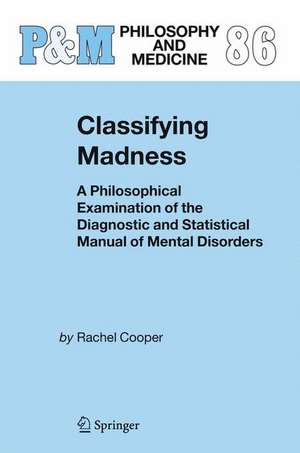
Classifying Madness
Autor Rachel Cooperen Limba Engleză Hardback – 22 apr 2005
În peisajul literaturii de specialitate dedicate taxonomiei psihiatrice, Classifying Madness ocupă o poziție distinctă prin rigoarea analizei conceptuale. Acolo unde lucrarea Making the DSM-5 de Joel Paris se concentrează pe procesul politic și administrativ de revizuire a manualului, volumul semnat de Rachel Cooper aprofundează fundamentele ontologice și epistemologice ale clasificării. Descoperim aici o investigație clinică asupra modului în care entități diverse, de la depresie la „Tulburarea de Matematică”, sunt integrate într-un sistem care tinde spre standardizare absolută. Reținem că, spre deosebire de manualul propriu-zis, care urmează un format arid de coduri numerice și prevalențe, Rachel Cooper propune o structură reflexivă. Cartea progresează de la interogația fundamentală „Ce este o tulburare mentală?” către analize complexe despre tipurile naturale și problema încărcăturii teoretice a observațiilor. Această abordare este o continuare firească a preocupărilor autoarei din Psychiatry and the Philosophy of Science, consolidându-i profilul de cercetător interesat de intersecția dintre istoria științei și practica medicală. Credem că relevanța acestui volum pentru practicieni rezidă în capacitatea de a chestiona validitatea criteriilor de diagnostic. Cooper nu se limitează la a descrie D.S.M.-ul, ci analizează modul în care diagnosticele pot genera bucle de feedback în societate, influențând comportamentul pacienților și, implicit, datele pe care se bazează știința. Este un text esențial pentru înțelegerea limitelor clasificării într-un domeniu unde granița dintre patologie și normalitate este adesea o convenție socială sau teoretică.
Preț: 718.89 lei
Preț vechi: 756.73 lei
-5%
Carte tipărită la comandă
Livrare economică 27 noiembrie-11 decembrie
Specificații
ISBN-10: 1402033443
Pagini: 178
Ilustrații: VIII, 178 p.
Dimensiuni: 164 x 242 x 19 mm
Greutate: 0.43 kg
Ediția:2005 edition
Editura: Springer
Locul publicării:Dordrecht, Netherlands
V-ar putea interesa
-
 Oxford Studies in Experimental Philosophy, Volume 1Tania Lombrozo-13%Preț: 301.42 lei348.31 lei
 -
 The World in the HeadRobert Cummins-12%Preț: 304.52 lei347.89 lei
 -
 -31%Preț: 563.57 lei816.86 lei
 -
 Anti-ExternalismJoseph Mendola-12%Preț: 253.77 lei289.30 lei
 -
 -29%Preț: 392.63 lei549.71 lei
 -
 Making Sense of Freedom and ResponsibilityDana Kay Nelkin-13%Preț: 299.37 lei345.20 lei
 -
 Descartes and the Puzzle of Sensory RepresentationRaffaella De Rosa-13%Preț: 277.40 lei319.95 lei
 -
 -19%Preț: 498.69 lei615.67 lei
 -
 Does Perception Have Content?Berit Brogaard-34%Preț: 664.38 lei1008.50 lei
 -
 -31%Preț: 696.82 lei1009.02 lei
 -
 -15%Preț: 627.62 lei738.37 lei
 -
 Body Wisdom: Interplay of Body and EgoKenneth C. BauschPreț: 158.16 lei
 -
 More Kinds of BeingE. J. LowePreț: 345.31 lei
 -
 The Handbook of Design ManagementProfessor Rachel Cooper-43%Preț: 246.68 lei433.94 lei
 -
 Dependencies, Connections, and Other RelationsWim de Muijnck-18%Preț: 987.97 lei1204.84 lei
 -
 Design for HealthEmmanuel Tsekleves-18%Preț: 1128.77 lei1376.56 lei
 -
 Psychiatry and Philosophy of ScienceRachel CooperPreț: 421.70 lei
 -
 Interdisciplinary Perspectives on Consciousness and the SelfSangeetha Menon-8%Preț: 597.11 lei649.04 lei
 -
 Preț: 377.29 lei
 -
 Body, Mind, and MethodDonald F. Gustafson-18%Preț: 981.71 lei1197.20 lei
 -
 -18%Preț: 980.24 lei1195.41 lei
 -
 Perspectives on MindH R Otto-15%Preț: 679.20 lei799.06 lei
 -
 Analogical ReasoningD H Helman-18%Preț: 1276.73 lei1557.00 lei
 -
 Hegel's Critique of Aristotle's Philosophy of MindFrederick G. WeissPreț: 364.08 lei
Public țintă
Professional/practitionerDe ce să citești această carte
Recomandăm Classifying Madness profesioniștilor din sănătatea mentală care doresc să înțeleagă mecanismele invizibile din spatele D.S.M. Cititorul câștigă o perspectivă critică asupra modului în care sunt „construite” bolile psihice, dincolo de simpla memorare a simptomelor. Este o resursă valoroasă pentru eticieni și psihiatri care vor să navigheze cu discernământ prin clasificările controversate ale manualului.
Despre autor
Rachel Cooper este un cercetător de renume în filosofia psihiatriei, deținând un doctorat în Istoria și Filosofia Științei de la Universitatea Cambridge. În prezent, este Senior Lecturer la Universitatea Lancaster din Marea Britanie. Activitatea sa academică este centrată pe problemele conceptuale ale clasificării bolilor mentale, fiind o voce autoritară în analiza critică a sistemelor de diagnostic. Pe lângă volumul de față, publicat de Springer, opera sa include lucrări de referință care explorează fundamentele științifice ale psihiatriei, demonstrând o capacitate rară de a uni rigoarea filosofică cu realitățile practicii clinice.