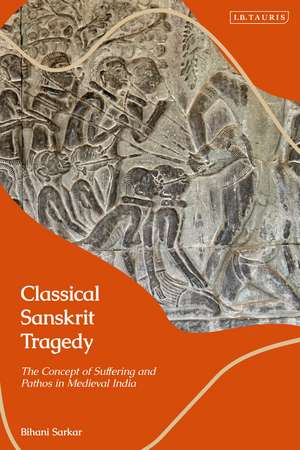
Classical Sanskrit Tragedy: The Concept of Suffering and Pathos in Medieval India
Autor Bihani Sarkaren Limba Engleză Paperback – 25 aug 2022
Looking at Kalidasa, the most celebrated writer of Sanskrit poetry and drama (kavya), this book argues that constructions of absence and grief are central to Kalidasa's compositions and that these 'tragic middles' are much more sophisticated than previously understood. For Kalidasa, tragic middles are modes of thinking, in which he confronts theological and philosophical issues. Through a close literary analysis of the tragic middle in five of his works, the Abhijñanasakuntala, the Raghuva?sa, the Kumarasambhava, the Vikramorvasiya and the Meghaduta, Sarkar demonstrates the importance of tragedy for classical Indian poetry and drama in the early centuries of the common era. These depictions from the Indian literary sphere, by their particular function and interest in the phenomenology of grief, challenge and reshape in a wholly new way our received understanding of tragedy.
Preț: 213.66 lei
Preț vechi: 306.97 lei
-30%
Puncte Express: 320
Carte tipărită la comandă
Livrare economică 01-15 decembrie
Livrare prin curier în România Termenul estimat este afișat lângă disponibilitate.
Transport gratuit de la 400.00 lei Plată online sau ramburs, în funcție de opțiunile comenzii.
Retur gratuit în 14 zile Comandă securizată și suport în română.
Specificații
ISBN-13: 9780755639243
ISBN-10: 0755639243
Pagini: 224
Dimensiuni: 154 x 232 x 14 mm
Greutate: 0.34 kg
Editura: Bloomsbury Publishing
Colecția I.B.Tauris
Locul publicării:London, United Kingdom
ISBN-10: 0755639243
Pagini: 224
Dimensiuni: 154 x 232 x 14 mm
Greutate: 0.34 kg
Editura: Bloomsbury Publishing
Colecția I.B.Tauris
Locul publicării:London, United Kingdom
Cuprins
Acknowledgements
Preamble: A note on the Indian medieval.
Introduction Part I. The Tragic Middle
Introduction Part II. Doubt, Obstacle, Deliberation, Death, Disaster: the Trial in Indian Aesthetics
Chapter 1. Kalidasa and his inheritance of grief
Chapter 2. The Map of Melancholy: Lamentation and the Philosophical Pause
Chapter 3. On losing and finding love: Conflict, Obstacle and drama
Chapter 4. The Altered Heart: Anguish, Entreaty and Lyric
Conclusion
Bibliography
Preamble: A note on the Indian medieval.
Introduction Part I. The Tragic Middle
Introduction Part II. Doubt, Obstacle, Deliberation, Death, Disaster: the Trial in Indian Aesthetics
Chapter 1. Kalidasa and his inheritance of grief
Chapter 2. The Map of Melancholy: Lamentation and the Philosophical Pause
Chapter 3. On losing and finding love: Conflict, Obstacle and drama
Chapter 4. The Altered Heart: Anguish, Entreaty and Lyric
Conclusion
Bibliography
Recenzii
An erudite book with profound insights into the history of emotions in classical India.
Tragedy-the moral imagination it engages and emotional impact it delivers-has long been considered a unique achievement of Western culture. Sarkar confronts this cliché head on, by a subtle rethinking of the tragic itself-as something experiential rather than formal-and a wide-ranging and acute analysis of classical Sanskrit literature. A searching inquiry into the profound reflections of Indian poets and thinkers on the nature of human existence.
Sarkar gives us a fresh and original reading of Kalidasa's works, these great classics of Sanskrit literature-a new reading that is sensitive and intelligent at the same time. She focuses on the "tragic middle" in these works, presents the reader a study of the revolving wheel of human existence and gives us a finely detailed topography of the map of melancholy. This "tragic middle" is also a study of a severe human crisis in knowing, a rupture in clear awareness, and of the unfolding of recognition. On the other hand, it is a second birth, a maturing and transformative test for the characters. Sarkar's sympathetic and insightful analysis enriches our understanding of the many aspects of tragedy in works of classical Sanskrit literature.
Tragedy-the moral imagination it engages and emotional impact it delivers-has long been considered a unique achievement of Western culture. Sarkar confronts this cliché head on, by a subtle rethinking of the tragic itself-as something experiential rather than formal-and a wide-ranging and acute analysis of classical Sanskrit literature. A searching inquiry into the profound reflections of Indian poets and thinkers on the nature of human existence.
Sarkar gives us a fresh and original reading of Kalidasa's works, these great classics of Sanskrit literature-a new reading that is sensitive and intelligent at the same time. She focuses on the "tragic middle" in these works, presents the reader a study of the revolving wheel of human existence and gives us a finely detailed topography of the map of melancholy. This "tragic middle" is also a study of a severe human crisis in knowing, a rupture in clear awareness, and of the unfolding of recognition. On the other hand, it is a second birth, a maturing and transformative test for the characters. Sarkar's sympathetic and insightful analysis enriches our understanding of the many aspects of tragedy in works of classical Sanskrit literature.