
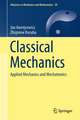
Classical Mechanics: Advances in Mechanics and Mathematics, cartea 28
Autor Jan Awrejcewiczen Limba Engleză Hardback – 26 iul 2012
Remarcăm în acest volum o abordare riguroasă a problemelor de dinamică și mecanică avansată, unde exercițiile și studiile de caz nu sunt simple ilustrații, ci piloni de analiză pentru sisteme complexe. Autorul propune o explorare detaliată a dinamicii punctului material și a sistemelor rigide, culminând cu secțiuni aplicate despre vibrațiile sistemelor mecanice și dinamica planetelor. Structura cărții, organizată în 11 capitole, ghidează cititorul de la fundamentul coordonatelor generalizate și ecuațiile clasice ale dinamicii, până la subiecte de nișă precum teoria impactului sau stabilitatea mișcărilor staționare. Classical Mechanics extinde cadrul propus de Classical and Analytical Mechanics de Alexander S. Poznyak cu date noi din perspectiva ingineriei mecatronice și a stabilității sistemelor multibody. În timp ce lucrarea lui Poznyak pune accent pe interfața dintre sistemele electrice și mecanice, Jan Awrejcewicz se concentrează pe profunzimea analitică a dinamicii geometrice și a sistemelor cu masă variabilă. Această lucrare consolidează temele explorate de autor în Dynamical Systems Theory, dar cu un accent mult mai pronunțat pe fundamentele cinematice și statice necesare în modelarea matematică. Progresia conținutului este logică, facilitând tranziția de la mecanica teoretică la aplicații tehnice de precizie. Considerăm că includerea capitolului de dinamică geometrică reprezintă un element distinctiv, oferind instrumente moderne pentru cercetătorii care depășesc limitele manualelor universitare convenționale. Ediția din 2012, publicată de Springer, rămâne o referință actuală prin rigoarea matematică și claritatea cu care sunt tratate fenomenele de rezonanță și bifurcație, teme recurente în opera autorului.
Din seria Advances in Mechanics and Mathematics
- 24%
 Preț: 934.28 lei
- 18%
 Preț: 981.32 lei
- 18%
 Preț: 1262.88 lei
- 18%
 Preț: 1673.21 lei
- 15%
 Preț: 667.29 lei
- 18%
 Preț: 815.44 lei
- 15%
 Preț: 698.94 lei
- 18%
 Preț: 912.20 lei
- 15%
 Preț: 667.01 lei
- 18%
 Preț: 931.20 lei
- 24%
 Preț: 877.70 lei
- 18%
 Preț: 952.62 lei
- 43%
 Preț: 571.29 lei
- 43%
 Preț: 573.63 lei
- 15%
 Preț: 670.03 lei
- 34%
 Preț: 838.80 lei
- 15%
 Preț: 643.87 lei
- 15%
 Preț: 726.83 lei
-
 Preț: 405.84 lei
- 32%
 Preț: 695.23 lei
- 15%
 Preț: 675.30 lei
- 24%
 Preț: 797.16 lei
- 23%
 Preț: 901.14 lei
- 18%
 Preț: 1050.45 lei
- 15%
 Preț: 674.64 lei
-
 Preț: 507.36 lei
- 18%
 Preț: 987.39 lei
-
 Preț: 398.55 lei
- 18%
 Preț: 940.01 lei
Preț: 993.31 lei
Preț vechi: 1211.35 lei
-18%
Carte tipărită la comandă
Livrare economică 04-18 decembrie
Specificații
ISBN-10: 1461437903
Pagini: 456
Ilustrații: XIII, 440 p.
Dimensiuni: 160 x 241 x 29 mm
Greutate: 0.79 kg
Ediția:2012
Editura: Springer
Colecția Advances in Mechanics and Mathematics
Seria Advances in Mechanics and Mathematics
Locul publicării:New York, NY, United States
V-ar putea interesa
-
 Information, Physics, and ComputationMarc Mézard-30%Preț: 676.71 lei970.50 lei
-
 Essentials of Econophysics ModellingFrantisek Slanina-11%Preț: 469.59 lei527.63 lei
-
 Probabilities in PhysicsClaus Beisbart-31%Preț: 779.16 lei1126.79 lei
-
 Principia: The Authoritative TranslationIsaac NewtonPreț: 145.99 lei
-
 Preț: 252.86 lei
-
 -8%Preț: 512.94 lei557.54 lei
-
 Quantum GravityCarlo Rovelli-11%Preț: 689.32 lei774.51 lei
-
 Self-Organised CriticalityGunnar Pruessner-11%Preț: 706.28 lei793.57 lei
-
 Star Maps for BeginnersTheodore LevittPreț: 89.02 lei
-
 The Little Book of String TheorySteven S. GubserPreț: 127.76 lei
-
 Groups, Representations and PhysicsH.F Jones-15%Preț: 632.97 lei744.67 lei
-
 Geometry, Topology and PhysicsMikio Nakahara-18%Preț: 728.00 lei887.81 lei
-
 A Student's Guide to Dimensional AnalysisDon S. LemonsPreț: 229.15 lei
-
 -15%Preț: 442.16 lei520.18 lei
Public țintă
GraduateDe ce să citești această carte
Această carte este esențială pentru cercetătorii și studenții de la nivel postuniversitar care doresc să stăpânească mecanica avansată dincolo de nivelul introductiv. Cititorul câștigă o înțelegere profundă a dinamicii sistemelor complexe, beneficiind de modele matematice pentru impact, vibrații și sisteme multibody. Este un instrument de lucru indispensabil pentru proiectarea în ingineria mecanică și civilă, oferind soluții teoretice pentru probleme practice dificile.
Despre autor
Jan Awrejcewicz este un reputat specialist în domeniul sistemelor dinamice și al mecanicii, cunoscut pentru contribuțiile sale vaste în modelarea matematică și simularea numerică. Opera sa include lucrări de referință precum Resonance și Nonlinearity, Bifurcation and Chaos, reflectând un interes constant pentru fenomenele fizice complexe. În cadrul seriei Advances in Mechanics and Mathematics, Awrejcewicz își utilizează experiența academică pentru a sintetiza teorii clasice și metode moderne, fiind un autor prolific a cărui activitate face puntea între cercetarea fundamentală și aplicațiile practice în inginerie.
Descriere scurtă
Cuprins
Recenzii
“This book presents classical mechanics including kinematics and statics, and can be recommended as a textbook for undergraduate and graduate students in mechanical and civil engineering and applied physics. … This excellent book unifies different approaches to the subject in the English, Russian, Polish and German literature.” (Vasile Marinca, zbMATH, Vol. 1268, 2013)
Notă biografică
Textul de pe ultima copertă
Classical Mechanics: Kinematics and Statics is addressed to a wide spectrum of undergraduate and graduate students, postgraduate students, researchers, and instructors, from the fields of mechanical and civil engineering. This volume, which includes a wealth of worked examples and applications, is also intended to be used as a self-contained reference for researchers in applied mathematics and physical sciences. It is also recommended as a supplementary textbook at the upper undergraduate and graduate levels.
In Chapter 1 the fundamental principles of mechanics are formulated, illustrated, and discussed. Chapter 2 is devoted to statics and Chapter 3 presents the geometry of masses. Kinematics of a particle, the curvilinear and normal coordinates, and kinematic pairs and chains are the main focus of Chapter 4. Chapter 5 studies the kinematics of a rigid body and a composite motion of a particle. Chapter 6 ends the text with kinematics of a deformable body.