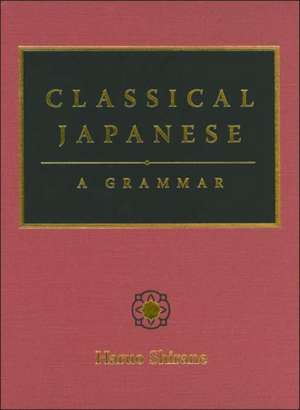
Classical Japanese
Autor Haruo Shiraneen Limba Engleză Hardback – 27 iul 2005
Observăm în lucrarea Classical Japanese de Haruo Shirane o abordare riguroasă care transformă studiul japonezei clasice (bungo) dintr-un demers adesea arid într-un proces structurat și accesibil. Față de manualele axate exclusiv pe memorarea formelor, această ediție publicată de Columbia University Press aduce o perspectivă istorică vitală, explicând evoluția de la formele arhaice la japoneza modernă. Ne-a atras atenția în mod deosebit modul în care autorul integrează tabelele gramaticale cu analizele de text, oferind studenților instrumentele necesare pentru a descifra scrieri ce acoperă peste un mileniu de istorie. Extinde cadrul propus de Japanese: A Comprehensive Grammar de Stefan Kaiser prin mutarea focusului de la limba contemporană vorbită către fundamentele literare și gramaticale ale textelor premoderne. În timp ce volumul lui Kaiser se concentrează pe uzul curent, Haruo Shirane prioritizează morfologia formelor inflectate și sintaxa complexă a textelor clasice. Cartea este organizată progresiv: începe cu bazele ortografiei și foneticii istorice, trece prin analiza detaliată a verbelor (regulate și neregulate) și a adjectivelor, culminând cu secțiuni despre onorifice și tehnici retorice. Această structură, susținută de apendice despre schimbările de sunet și combinațiile de verbe auxiliare, asigură o acoperire completă a curriculumului de studii japoneze avansate. Apreciem includerea fragmentelor adnotate, care permit aplicarea imediată a regulilor învățate pe texte reale, oferind o experiență de lectură echilibrată între teorie și practică. Este o resursă esențială care completează lacunele lăsate de manualele introductive, fiind potrivită atât pentru studenții aflați la începutul studiului bungo, cât și pentru cercetătorii care au nevoie de un volum de referință solid.
Preț: 458.94 lei
Preț vechi: 533.65 lei
-14%
Carte disponibilă
Livrare economică 10-24 august
Livrare express 25-31 iulie pentru 77.97 lei
Specificații
ISBN-10: 0231135246
Pagini: 552
Dimensiuni: 225 x 290 x 35 mm
Greutate: 1.5 kg
Ediția:1
Editura: Columbia University Press
V-ar putea interesa
-
 Oxford Japanese Grammar and VerbsJonathan Bunt-5%Preț: 60.71 lei64.06 lei
 -
 Oxford Grammar of Classical GreekJames MorwoodPreț: 69.20 lei
 -
 Pocket Kenkyusha Japanese DictionaryShigeru TakebayashiPreț: 93.54 lei
 -
 The Chicago Guide to Grammar, Usage, and PunctuationBryan A. GarnerPreț: 307.99 lei
 -
 Preț: 184.24 lei
 -
 Classical Japanese Reader and Essential DictionaryHaruo Shirane-14%Preț: 389.78 lei453.22 lei
 -
 Essential Japanese GrammarEverett F. BleilerPreț: 43.96 lei
 -
 Using JapaneseWilliam McclurePreț: 450.76 lei
 -
 A New Practical Primer of Literary ChinesePaul RouzerPreț: 298.22 lei
 -
 Readers Guide to Intermediate JapaneseYasuko Ito WattPreț: 171.58 lei
 -
 Fundamentals of Japanese GrammarYuki JohnsonPreț: 230.38 lei
 -
 -12%Preț: 102.14 lei115.45 lei
 -
 Japanese Linguistics in Use: An Introduction for Language LearnersDr. Toshiko Yamaguchi-21%Preț: 260.38 lei330.91 lei
 -
![Grammar Dimensions, Book 4: Form, Meaning, and Use [With Access Code]](https://i2.books-express.ro/bt/9781413027525/grammar-dimensions-book-4.jpg) Preț: 225.76 lei
Preț: 225.76 lei -
 The Ultimate Japanese Phrasebook: 1800 Sentences for Everyday Use (free audio download)Kit Pancoast Nagamura-21%Preț: 123.96 lei157.52 lei
 -
 A Dictionary of Basic Japanese Grammar =Seiichi MakinoPreț: 279.07 lei
 -
 Preț: 108.49 lei
 -
 -16%Preț: 91.99 lei109.97 lei
 -
 -18%Preț: 52.99 lei64.68 lei
 -
 -18%Preț: 100.78 lei122.56 lei
De ce să citești această carte
Această lucrare este indispensabilă oricărui student sau cercetător în studii est-asiatice care dorește să acceseze literatura japoneză premodernă în original. Veți câștiga o înțelegere profundă a sistemului bungo, depășind bariera limbii moderne. Este recomandată deoarece îmbină rigoarea academică a lui Haruo Shirane cu o metodologie practică, oferind exerciții și explicații clare pentru forme gramaticale complexe care nu mai sunt utilizate în japoneza de astăzi.
Despre autor
Haruo Shirane este profesor de literatură și cultură japoneză la Universitatea Columbia, fiind considerat unul dintre cei mai importanți specialiști contemporani în domeniu. Opera sa se concentrează pe literatura clasică japoneză, istoria culturală și estetică. Prin contribuțiile sale academice, a facilitat accesul publicului occidental la texte fundamentale, precum „Povestea lui Genji”. Experiența sa vastă în predare este reflectată în claritatea acestui manual, care a devenit un standard în universitățile de profil din întreaga lume pentru studiul gramaticii bungo.
Cuprins
Descriere scurtă
Classical Japanese ( bungo) was used to write Japanese for more thirteen hundred years, until World War II. The volume, which explains how classical Japanese is related to modern Japanese, includes
. Detailed explanations of basic grammar, including helpful, easy-to-use tables of grammatical forms
. Annotated excerpts from classical premodern texts, with accompanying grammar and vocabulary notes
. Exercises and an answer booklet
. Detailed explanations of honorific expressions
. Appendixes on sound changes, prefixes, and suffixes, rhetorical techniques, and auxiliary verb combinations