
Classical and Quantum Information Theory: An Introduction for the Telecom Scientist
Autor Emmanuel Desurvireen Limba Engleză Hardback – 18 feb 2009
Preț: 751.28 lei
Preț vechi: 873.58 lei
-14%
Puncte Express: 1127
Carte tipărită la comandă
Livrare economică 29 iunie-13 iulie
Specificații
ISBN-13: 9780521881715
ISBN-10: 0521881714
Pagini: 714
Ilustrații: 1 b/w illus. 59 tables 139 exercises
Dimensiuni: 179 x 253 x 37 mm
Greutate: 1.55 kg
Editura: Cambridge University Press
Colecția Cambridge University Press
Locul publicării:Cambridge, United Kingdom
ISBN-10: 0521881714
Pagini: 714
Ilustrații: 1 b/w illus. 59 tables 139 exercises
Dimensiuni: 179 x 253 x 37 mm
Greutate: 1.55 kg
Editura: Cambridge University Press
Colecția Cambridge University Press
Locul publicării:Cambridge, United Kingdom
V-ar putea interesa
-
 Quantum Information ScienceRiccardo Manenti-20%Preț: 410.86 lei513.59 lei
 -
 Entropy: A Very Short IntroductionJames Binney-22%Preț: 54.57 lei69.70 lei
 -
 Quantum 2.0Paul DaviesPreț: 142.02 lei
 -
 The Mathematical Theory of CommunicationClaude E ShannonPreț: 153.01 lei
 -
 Quantum Computing for EveryoneChris Bernhardt-20%Preț: 88.66 lei110.82 lei
 -
 Theoretical Foundations of Quantum ComputingDaowen Qiu-34%Preț: 462.28 lei696.66 lei
 -
 Communication Systems, International Student VersionMichael Moher-19%Preț: 395.13 lei487.81 lei
 -
 Quantum InformationAsma Al-QasimiPreț: 438.47 lei
 -
 Probability Theory for Quantitative ScientistsEnzo Marinari-8%Preț: 432.62 lei470.24 lei
 -
 Quantum Mechanics: Volume 3David TongPreț: 317.92 lei
 -
 Systematic Security: A CISO’s PlaybookTimur Qader-20%Preț: 342.82 lei428.53 leiRecomandat
 -
 Quantum Computing For DummiesWhurley-20%Preț: 140.30 lei175.38 lei
 -
 -9%Preț: 648.03 lei712.12 lei
 -
 Becoming Quantum SafeJai Singh ArunPreț: 331.92 lei
 -
 Quantum Computation and Quantum InformationJ. M. Landsberg-9%Preț: 618.24 lei679.39 lei
 -
 Learn Quantum Computing with Python and QChris Granade-20%Preț: 409.72 lei512.15 lei
 -
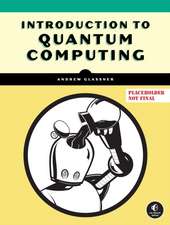 Quantum Computing: From Concepts to CodeAndrew Glassner-36%Preț: 230.04 lei360.86 lei
 -
 Preț: 231.78 lei
 -
 Information Theoretic Principles for Agent LearningJerry D. GibsonPreț: 373.00 lei
 -
 -20%Preț: 552.18 lei690.23 lei
Cuprins
1. Probabilities basics; 2. Probability distributions; 3. Measuring information; 4. Entropy; 5. Mutual information and more entropies; 6. Differential entropy; 7. Algorithmic entropy and Kolmogorov complexity; 8. Information coding; 9. Optimal coding and compression; 10. Integer, arithmetic and adaptive coding; 11. Error correction; 12. Channel entropy; 13. Channel capacity and coding theorem; 14. Gaussian channel and Shannon-Hartley theorem; 15. Reversible computation; 16. Quantum bits and quantum gates; 17. Quantum measurments; 18. Qubit measurements, superdense coding and quantum teleportation; 19. Deutsch/Jozsa alorithms and quantum fourier transform; 20. Shor's factorization algorithm; 21. Quantum information theory; 22. Quantum compression; 23. Quantum channel noise and channel capacity; 24. Quantum error correction; 25. Classical and quantum cryptography; Appendix A. Boltzmann's entropy; Appendix B. Shannon's entropy; Appendix C. Maximum entropy of discrete sources; Appendix D. Markov chains and the second law of thermodynamics; Appendix E. From discrete to continuous entropy; Appendix F. Kraft-McMillan inequality; Appendix G. Overview of data compression standards; Appendix H. Arithmetic coding algorithm; Appendix I. Lempel-Ziv distinct parsing; Appendix J. Error-correction capability of linear block codes; Appendix K. Capacity of binary communication channels; Appendix L. Converse proof of the Channel Coding Theorem; Appendix M. Block sphere representation of the qubit; Appendix N. Pauli matrices, rotations and unitary operators; Appendix O. Heisenberg Uncertainty Principle; Appendix P. Two qubit teleportation; Appendix Q. Quantum Fourier transform circuit; Appendix R. Properties of continued fraction expansion; Appendix S. Computation of inverse Fourier transform in the factoring of N=21 through Shor's algorithm; Appendix T. Modular arithmetic and Euler's Theorem; Appendix U. Klein's inequality; Appendix V. Schmidt decomposition of joint pure states; Appendix W. State purification; Appendix X. Holevo bound; Appendix Y. Polynomial byte representation and modular multiplication.
Recenzii
'The book would make an excellent text for an upper division graduate course in Electrical Engineering that might run one or two semesters. Meaningful problems, with a range of difficulty, are provided (answers are available from the publisher). The format and style of the book also make it a great choice for self-study. I recommend it highly.' Ivan P. Kaminow, University of California, Berkeley
'The most interesting presentation on quantum cryptography I have read. I really enjoyed reading the book and learned a lot. I am confident that readers will discover an original and interesting viewpoint on information theory.' Ivan Favero, Université Paris Diderot - CNRS
'The entire work is well and clearly presented with a mathematical background, and can be a good handbook for those which study the quantum information theory domain.' Zentralblatt MATH
'The most interesting presentation on quantum cryptography I have read. I really enjoyed reading the book and learned a lot. I am confident that readers will discover an original and interesting viewpoint on information theory.' Ivan Favero, Université Paris Diderot - CNRS
'The entire work is well and clearly presented with a mathematical background, and can be a good handbook for those which study the quantum information theory domain.' Zentralblatt MATH
Descriere
This complete overview of classical and quantum information theory employs an informal yet accurate approach, for students, researchers and practitioners.