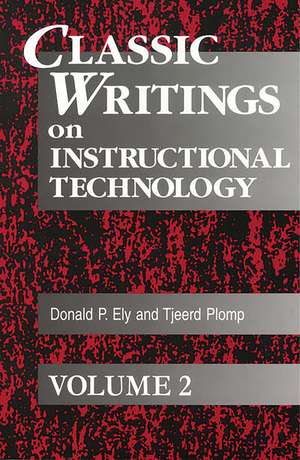
Classic Writings on Instructional Technology: Volume 2
Autor Donald P. Ely, Tjeerd Plompen Limba Engleză Paperback – 15 ian 2001
Preț: 420.04 lei
Preț vechi: 565.92 lei
-26%
Puncte Express: 630
Carte tipărită la comandă
Livrare economică 21 noiembrie-05 decembrie
Livrare prin curier în România Termenul estimat este afișat lângă disponibilitate.
Transport gratuit pentru acest produs Plată online sau ramburs, în funcție de opțiunile comenzii.
Retur gratuit în 14 zile Comandă securizată și suport în română.
Specificații
ISBN-13: 9781563088544
ISBN-10: 1563088541
Pagini: 268
Dimensiuni: 152 x 229 x 19 mm
Greutate: 0.49 kg
Editura: Bloomsbury Publishing
Colecția Libraries Unlimited
Locul publicării:New York, United States
ISBN-10: 1563088541
Pagini: 268
Dimensiuni: 152 x 229 x 19 mm
Greutate: 0.49 kg
Editura: Bloomsbury Publishing
Colecția Libraries Unlimited
Locul publicării:New York, United States
V-ar putea interesa
-
 Design for How People LearnJulie DirksenPreț: 269.01 lei
 -
 Preț: 103.37 lei
 -
 Language and Literacy in Science EducationJerry Wellington-30%Preț: 179.99 lei256.37 lei
 -
 Meaning Making in Secondary Science ClassroomsEduardo Mortimer-27%Preț: 198.43 lei273.49 lei
 -
 -15%Preț: 428.24 lei503.81 lei
 -
 Digital Learning for All, NowJonathan P. Costa Sr.Preț: 283.15 lei
 -
 Apps for LearningHarry J. DickensPreț: 212.03 lei
 -
 Worlds of MakingLaura FlemingPreț: 91.84 lei
 -
 Cloud 9: Learning in the Information AgeLuke Strongman-27%Preț: 1634.51 lei2228.11 lei
 -
 -25%Preț: 179.65 lei240.77 lei
Cuprins
Contents for Volume 1
Introduction
Part 1: Definition and Conceptual Background
Chapter 1: The Proper Study of Instructional Technology
Chapter 2: Situated Congnition and the Culture of Learning
Chapter 3: Objectivism Versus Constructivism: Do We Need a New Philosophical Paradigm?
Part 2: Design and Development Functions
Chapter 4: The Systematic Design of Instruction: Origins of Systematically Designed Instruction
Chapter 5: In Search of a Better Way to Organize Instruction: The Elaboration Theory
Chapter 6: Emerging Technologies, ISD, and Learning Envirnoments: Critical Perspectives
Chapter 7: Levels of Use of the Innovation: A Framework for Analyzing Innovation Adoption
Chapter 8: Course Improvement Through Evaluation
Part 3: Delivery Options
Chapter 9: Reconsidering Research on Learning from Media
Chapter 10: Learning with Media
Chapter 11: Who Needs Computers in Schools, and Why?
Chapter 12: Displays and Communciation
Chapter 13: Development and Use of the ARCS Model of Motivational Design
Chapter 14: Distance Teaching and Industrial Production: A Comparative Interpretation in Outline
Part 4: The Profession
Chapter 15: Educational Technology-Adolescence to Adulthood
Introduction
Part 1: Definition and Conceptual Background
Chapter 1: The Proper Study of Instructional Technology
Chapter 2: Situated Congnition and the Culture of Learning
Chapter 3: Objectivism Versus Constructivism: Do We Need a New Philosophical Paradigm?
Part 2: Design and Development Functions
Chapter 4: The Systematic Design of Instruction: Origins of Systematically Designed Instruction
Chapter 5: In Search of a Better Way to Organize Instruction: The Elaboration Theory
Chapter 6: Emerging Technologies, ISD, and Learning Envirnoments: Critical Perspectives
Chapter 7: Levels of Use of the Innovation: A Framework for Analyzing Innovation Adoption
Chapter 8: Course Improvement Through Evaluation
Part 3: Delivery Options
Chapter 9: Reconsidering Research on Learning from Media
Chapter 10: Learning with Media
Chapter 11: Who Needs Computers in Schools, and Why?
Chapter 12: Displays and Communciation
Chapter 13: Development and Use of the ARCS Model of Motivational Design
Chapter 14: Distance Teaching and Industrial Production: A Comparative Interpretation in Outline
Part 4: The Profession
Chapter 15: Educational Technology-Adolescence to Adulthood