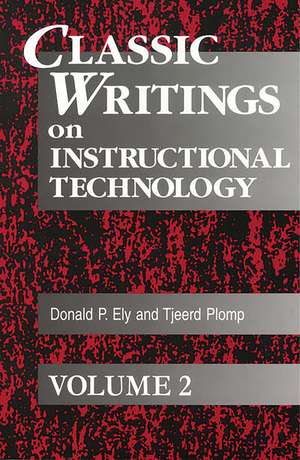
Classic Writings on Instructional Technology: Volume 2
Autor Donald P. Ely, Tjeerd Plompen Limba Engleză Paperback – 15 ian 2001
Preț: 400.04 lei
Preț vechi: 548.13 lei
-27%
Puncte Express: 600
Preț estimativ în valută:
70.75€ • 82.71$ • 61.51£
70.75€ • 82.71$ • 61.51£
Carte tipărită la comandă
Livrare economică 07-21 martie
Specificații
ISBN-13: 9781563088544
ISBN-10: 1563088541
Pagini: 268
Dimensiuni: 152 x 229 x 19 mm
Greutate: 0.49 kg
Editura: Bloomsbury Publishing
Colecția Libraries Unlimited
Locul publicării:New York, United States
ISBN-10: 1563088541
Pagini: 268
Dimensiuni: 152 x 229 x 19 mm
Greutate: 0.49 kg
Editura: Bloomsbury Publishing
Colecția Libraries Unlimited
Locul publicării:New York, United States
V-ar putea interesa
-
 Design for How People LearnJulie DirksenPreț: 249.08 lei
 -
 Preț: 103.37 lei
 -
 Language and Literacy in Science EducationJerry Wellington-31%Preț: 171.31 lei247.32 lei
 -
 Meaning Making in Secondary Science ClassroomsEduardo Mortimer-28%Preț: 188.88 lei263.84 lei
 -
 -8%Preț: 407.87 lei443.33 lei
 -
 Preț: 272.47 lei
 -
 Apps for Learning: 40 Best iPad/iPod Touch/iPhone Apps for High School ClassroomsHarry J. (Jerome) DickensPreț: 203.22 lei
 -
 Preț: 82.64 lei
 -
 Cloud 9: Learning in the Information AgeLuke Strongman-26%Preț: 1591.63 lei2151.19 lei
 -
 -27%Preț: 171.00 lei233.13 lei
Cuprins
Contents for Volume 1
Introduction
Part 1: Definition and Conceptual Background
Chapter 1: The Proper Study of Instructional Technology
Chapter 2: Situated Congnition and the Culture of Learning
Chapter 3: Objectivism Versus Constructivism: Do We Need a New Philosophical Paradigm?
Part 2: Design and Development Functions
Chapter 4: The Systematic Design of Instruction: Origins of Systematically Designed Instruction
Chapter 5: In Search of a Better Way to Organize Instruction: The Elaboration Theory
Chapter 6: Emerging Technologies, ISD, and Learning Envirnoments: Critical Perspectives
Chapter 7: Levels of Use of the Innovation: A Framework for Analyzing Innovation Adoption
Chapter 8: Course Improvement Through Evaluation
Part 3: Delivery Options
Chapter 9: Reconsidering Research on Learning from Media
Chapter 10: Learning with Media
Chapter 11: Who Needs Computers in Schools, and Why?
Chapter 12: Displays and Communciation
Chapter 13: Development and Use of the ARCS Model of Motivational Design
Chapter 14: Distance Teaching and Industrial Production: A Comparative Interpretation in Outline
Part 4: The Profession
Chapter 15: Educational Technology-Adolescence to Adulthood
Introduction
Part 1: Definition and Conceptual Background
Chapter 1: The Proper Study of Instructional Technology
Chapter 2: Situated Congnition and the Culture of Learning
Chapter 3: Objectivism Versus Constructivism: Do We Need a New Philosophical Paradigm?
Part 2: Design and Development Functions
Chapter 4: The Systematic Design of Instruction: Origins of Systematically Designed Instruction
Chapter 5: In Search of a Better Way to Organize Instruction: The Elaboration Theory
Chapter 6: Emerging Technologies, ISD, and Learning Envirnoments: Critical Perspectives
Chapter 7: Levels of Use of the Innovation: A Framework for Analyzing Innovation Adoption
Chapter 8: Course Improvement Through Evaluation
Part 3: Delivery Options
Chapter 9: Reconsidering Research on Learning from Media
Chapter 10: Learning with Media
Chapter 11: Who Needs Computers in Schools, and Why?
Chapter 12: Displays and Communciation
Chapter 13: Development and Use of the ARCS Model of Motivational Design
Chapter 14: Distance Teaching and Industrial Production: A Comparative Interpretation in Outline
Part 4: The Profession
Chapter 15: Educational Technology-Adolescence to Adulthood