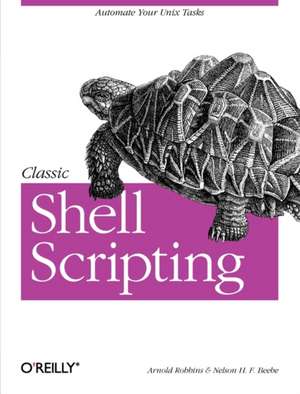
Classic Shell Scripting
Autor Arnold Robbins, Nelson H. F. Beebeen Limba Engleză Paperback – 21 iun 2005
ACTUALIZAREA: În contextul diversificării distribuțiilor moderne, Classic Shell Scripting rămâne ancora necesară pentru orice administrator de sistem care dorește să navigheze prin oceanul de variații ale comenzilor Unix, punând accent pe execuția portabilă și respectarea standardelor POSIX. Observăm că autorii nu se limitează la sintaxa limbajului, ci extind discuția către utilizarea corectă a programelor individuale Unix în combinații complexe. Apreciem structura riguroasă a volumului, care debutează cu o retrospectivă istorică și principiile fundamentale ale uneltelor software, avansând rapid către mecanismele de căutare, expresii regulate și procesarea câmpurilor de date. Subliniem faptul că progresia textului, de la construcții de bază la pipeline-uri complexe, este concepută pentru a transforma sarcini repetitive în fluxuri automatizate fiabile. Pe linia practică a volumului Shell Scripting Recipes, dar cu focus pe fundamentele arhitecturale și rigoarea execuției, această lucrare se distinge prin explicarea detaliată a motivelor pentru care anumite soluții funcționează universal, în timp ce altele eșuează pe sisteme diferite. În contextul operei lui Arnold Robbins, lucrarea completează perfect titluri precum VI and VIM Editors Pocket Reference sau sed & awk Pocket Reference 2e. Dacă referințele de buzunar oferă soluții rapide, Classic Shell Scripting oferă profunzimea necesară pentru a înțelege ecosistemul Unix în ansamblu. Experiența autorului în grupul de standardizare POSIX se reflectă în precizia tehnică a fiecărui capitol, oferind cititorului nu doar fragmente de cod, ci o metodologie de lucru sustenabilă.
Preț: 267.35 lei
Preț vechi: 334.20 lei
-20%
Carte indisponibilă temporar
Specificații
ISBN-10: 0596005954
Pagini: 558
Ilustrații: 1, black & white illustrations
Dimensiuni: 177 x 233 x 35 mm
Greutate: 0.96 kg
Editura: O'Reilly
Locul publicării:United States
V-ar putea interesa
-
 -20%Preț: 340.35 lei425.43 lei
 -
 The AWK Programming LanguageAlfred Aho-20%Preț: 225.70 lei282.12 lei
 -
 UNIX & Shell ProgrammingB. M. Harwani-20%Preț: 265.67 lei332.08 lei
 -
 The Practice of ProgrammingBrian Kernighan-20%Preț: 304.16 lei380.20 lei
 -
 -20%Preț: 226.42 lei283.03 lei
 -
 Practical Computing for BiologistsSteven H. D. Haddock-27%Preț: 797.38 lei1092.30 lei
 -
 Linux Command Line and Shell Scripting BibleRichard Blum-20%Preț: 291.11 lei363.88 lei
 -
 Linux Command Line and Shell Scripting BibleRichard Blum-20%Preț: 410.86 lei513.56 lei
 -
 Effective AWK Programming, 4eArnold Robbins-20%Preț: 241.79 lei302.24 lei
 -
 ScriptingMichael Kofler-20%Preț: 263.13 lei328.90 lei
 -
 Wicked Cool Shell Scripts, 2nd EditionDave Taylor-29%Preț: 188.92 lei267.47 lei
 -
 -34%Preț: 291.41 lei444.24 lei
 -
 -35%Preț: 305.95 lei467.40 lei
 -
 -36%Preț: 187.66 lei295.19 lei
 -
 System Programming in Linux: A Hands-On IntroductionStewart Weiss-35%Preț: 481.65 lei739.15 lei
 -
 -35%Preț: 299.39 lei463.54 lei
 -
 -35%Preț: 243.60 lei372.75 lei
 -
 -37%Preț: 187.47 lei295.65 lei
 -
 The Linux Command Line, 3rd Edition: A Complete IntroductionWilliam Shotts-34%Preț: 247.82 lei374.07 lei
 -
 UNIX in Easy StepsMike Mcgrath-20%Preț: 68.42 lei85.53 lei
De ce să citești această carte
Recomandăm această carte administratorilor de sistem și utilizatorilor Unix/Linux care doresc să depășească stadiul de simpli executanți de comenzi. Veți câștiga abilitatea de a scrie scripturi robuste, portabile și eficiente, evitând ore de depanare cauzate de diferențele între versiunile de shell. Este resursa esențială pentru a stăpâni procesarea de text și automatizarea la nivel profesional.
Despre autor
Arnold Robbins este un programator profesionist și autor tehnic cu o experiență vastă, lucrând cu sisteme Unix din 1980 și utilizând AWK din 1987. Expertiza sa este recunoscută la nivel internațional, fiind membru al grupului de votare POSIX 1003.2, unde a contribuit direct la modelarea standardului pentru AWK. În prezent, este responsabil pentru mentenanța gawk (GNU AWK) și a documentației aferente. Colaborarea sa la ediții fundamentale precum cele despre editorul vi îl poziționează ca pe una dintre cele mai autoritare voci în literatura tehnică dedicată ecosistemului Unix.
Cuprins
Foreword; Preface; Intended Audience; What You Should Already Know; Chapter Summary; Conventions Used in This Book; Code Examples; Unix Tools for Windows Systems; Safari Enabled; We'd Like to Hear from You; Acknowledgments; Chapter 1: Background; 1.1 Unix History; 1.2 Software Tools Principles; 1.3 Summary; Chapter 2: Getting Started; 2.1 Scripting Languages Versus Compiled Languages; 2.2 Why Use a Shell Script?; 2.3 A Simple Script; 2.4 Self-Contained Scripts: The #! First Line; 2.5 Basic Shell Constructs; 2.6 Accessing Shell Script Arguments; 2.7 Simple Execution Tracing; 2.8 Internationalization and Localization; 2.9 Summary; Chapter 3: Searching and Substitutions; 3.1 Searching for Text; 3.2 Regular Expressions; 3.3 Working with Fields; 3.4 Summary; Chapter 4: Text Processing Tools; 4.1 Sorting Text; 4.2 Removing Duplicates; 4.3 Reformatting Paragraphs; 4.4 Counting Lines, Words, and Characters; 4.5 Printing; 4.6 Extracting the First and Last Lines; 4.7 Summary; Chapter 5: Pipelines Can Do Amazing Things; 5.1 Extracting Data from Structured Text Files; 5.2 Structured Data for the Web; 5.3 Cheating at Word Puzzles; 5.4 Word Lists; 5.5 Tag Lists; 5.6 Summary; Chapter 6: Variables, Making Decisions, and Repeating Actions; 6.1 Variables and Arithmetic; 6.2 Exit Statuses; 6.3 The case Statement; 6.4 Looping; 6.5 Functions; 6.6 Summary; Chapter 7: Input and Output, Files, and Command Evaluation; 7.1 Standard Input, Output, and Error; 7.2 Reading Lines with read; 7.3 More About Redirections; 7.4 The Full Story on printf; 7.5 Tilde Expansion and Wildcards; 7.6 Command Substitution; 7.7 Quoting; 7.8 Evaluation Order and eval; 7.9 Built-in Commands; 7.10 Summary; Chapter 8: Production Scripts; 8.1 Path Searching; 8.2 Automating Software Builds; 8.3 Summary; Chapter 9: Enough awk to Be Dangerous; 9.1 The awk Command Line; 9.2 The awk Programming Model; 9.3 Program Elements; 9.4 Records and Fields; 9.5 Patterns and Actions; 9.6 One-Line Programs in awk; 9.7 Statements; 9.8 User-Defined Functions; 9.9 String Functions; 9.10 Numeric Functions; 9.11 Summary; Chapter 10: Working with Files; 10.1 Listing Files; 10.2 Updating Modification Times with touch; 10.3 Creating and Using Temporary Files; 10.4 Finding Files; 10.5 Running Commands: xargs; 10.6 Filesystem Space Information; 10.7 Comparing Files; 10.8 Summary; Chapter 11: Extended Example: Merging User Databases; 11.1 The Problem; 11.2 The Password Files; 11.3 Merging Password Files; 11.4 Changing File Ownership; 11.5 Other Real-World Issues; 11.6 Summary; Chapter 12: Spellchecking; 12.1 The spell Program; 12.2 The Original Unix Spellchecking Prototype; 12.3 Improving ispell and aspell; 12.4 A Spellchecker in awk; 12.5 Summary; Chapter 13: Processes; 13.1 Process Creation; 13.2 Process Listing; 13.3 Process Control and Deletion; 13.4 Process System-Call Tracing; 13.5 Process Accounting; 13.6 Delayed Scheduling of Processes; 13.7 The /proc Filesystem; 13.8 Summary; Chapter 14: Shell Portability Issues and Extensions; 14.1 Gotchas; 14.2 The bash shopt Command; 14.3 Common Extensions; 14.4 Download Information; 14.5 Other Extended Bourne-Style Shells; 14.6 Shell Versions; 14.7 Shell Initialization and Termination; 14.8 Summary; Chapter 15: Secure Shell Scripts: Getting Started; 15.1 Tips for Secure Shell Scripts; 15.2 Restricted Shell; 15.3 Trojan Horses; 15.4 Setuid Shell Scripts: A Bad Idea; 15.5 ksh93 and Privileged Mode; 15.6 Summary; Appendix A: Writing Manual Pages; A.1 Manual Pages for pathfind; A.2 Manual-Page Syntax Checking; A.3 Manual-Page Format Conversion; A.4 Manual-Page Installation; Appendix B: Files and Filesystems; B.1 What Is a File?; B.2 How Are Files Named?; B.3 What's in a Unix File?; B.4 The Unix Hierarchical Filesystem; B.5 How Big Can Unix Files Be?; B.6 Unix File Attributes; B.7 Unix File Ownership and Privacy Issues; B.8 Unix File Extension Conventions; B.9 Summary; Appendix C: Important Unix Commands; C.1 Shells and Built-in Commands; C.2 Text Manipulation; C.3 Files; C.4 Processes; C.5 Miscellaneous Programs; Chapter 16: Bibliography; 16.1 Unix Programmer's Manuals; 16.2 Programming with the Unix Mindset; 16.3 Awk and Shell; 16.4 Standards; 16.5 Security and Cryptography; 16.6 Unix Internals; 16.7 O'Reilly Books; 16.8 Miscellaneous Books; Colophon;
Notă biografică
Arnold Robbins, an Atlanta native, is a professional programmer and technical author. He has worked with Unix systems since 1980, when he was introduced to a PDP-11 running a version of Sixth Edition Unix. He has been a heavy AWK user since 1987, when he became involved with gawk, the GNU project's version of AWK. As a member of the POSIX 1003.2 balloting group, he helped shape the POSIX standard for AWK. He is currently the maintainer of gawk and its documentation. He is also coauthor of the sixth edition of O'Reilly's Learning the vi Editor. Since late 1997, he and his family have been living happily in Israel.
Nelson Beebe is a long time Unix user and system administrator, and has helped for years on Usenet newsgroups.
Descriere scurtă
Shell scripting skills never go out of style. It's the shell that unlocks the real potential of Unix. Shell scripting is essential for Unix users and system administrators-a way to quickly harness and customize the full power of any Unix system. With shell scripts, you can combine the fundamental Unix text and file processing commands to crunch data and automate repetitive tasks. But beneath this simple promise lies a treacherous ocean of variations in Unix commands and standards. Classic Shell Scripting is written to help you reliably navigate these tricky waters.Writing shell scripts requires more than just a knowledge of the shell language, it also requires familiarity with the individual Unix programs: why each one is there, how to use them by themselves, and in combination with the other programs. The authors are intimately familiar with the tips and tricks that can be used to create excellent scripts, as well as the traps that can make your best effort a bad shell script. With Classic Shell Scripting you'll avoid hours of wasted effort. You'll learn not only write useful shell scripts, but how to do it properly and portably.The ability to program and customize the shell quickly, reliably, and portably to get the best out of any individual system is an important skill for anyone operating and maintaining Unix or Linux systems. Classic Shell Scripting gives you everything you need to master these essential skills.
Descriere
For Unix users and system administrators, this book contains shell scripts that help the reader easily crunch data and automate repetitive tasks, offering a way to quickly harness the full power of any Unix system. It provides tips, tricks, and organized knowledge needed to create scripts, as well as warnings of the traps in shell scripts.