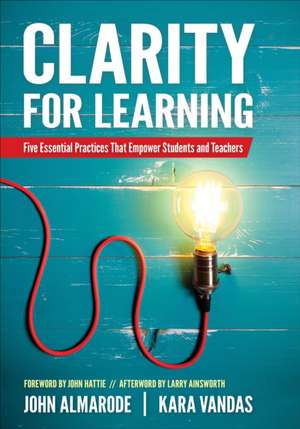
Clarity for Learning
Autor John T Almarode, Kara L Vandasen Limba Engleză Paperback – 16 noi 2018
Notăm cu interes modul în care Clarity for Learning abordează 'Problema Clarității' încă din primul capitol, identificând obstacolele care apar atunci când standardele curriculare nu sunt traduse în obiective transparente pentru elevi. Autorii John Almarode și Kara Vandas propun o metodologie structurată în jurul a cinci piloni, punând un accent deosebit pe procesul de co-construcție a criteriilor de succes. Această abordare transformă elevul dintr-un receptor pasiv într-un partener activ care înțelege nu doar ce învață, ci și cum arată performanța. Subliniem progresia logică a volumului: după stabilirea fundamentelor teoretice, capitolele dedicate acțiunii ('Gaining Clarity in Action') oferă exemple concrete și mărturii ale profesorilor care au navigat prin aceste schimbări. Față de lucrarea anterioară a lui Almarode, Student Learning Communities, care se concentra pe cultura clasei și colaborarea social-emoțională, volumul de față este mult mai aplicat pe mecanismele pedagogice de zi cu zi, precum formularea intențiilor de învățare derivate din standardele de conținut. Considerăm această resursă o alternativă viabilă la Unlocking: Learning Intentions de Shirley Clarke pentru cursurile de metodică și evaluare formativă, având avantajul unei integrări explicite cu cadrul Visible Learning (confirmat de prefața lui John Hattie) și a unei structuri tip 'manual de parcurs'. În timp ce CLARITY de Lyn D. Sharratt vizează adesea leadership-ul de sistem, lucrarea de față rămâne ancorată în realitatea imediată a clasei, oferind instrumente practice pentru feedback eficient și monitorizarea progresului în timp real. Formatul paperback de 242 de pagini facilitează consultarea rapidă a secțiunilor de reflecție și a pașilor următori recomandați la finalul fiecărui capitol.
Preț: 202.09 lei
Carte disponibilă
Livrare economică 10-24 noiembrie
Specificații
ISBN-10: 1506384692
Pagini: 240
Dimensiuni: 178 x 254 x 14 mm
Greutate: 0.5 kg
Ediția:First Edition
Editura: SAGE Publications
Locul publicării:Thousand Oaks, United States
V-ar putea interesa
-
 -21%Preț: 682.10 lei862.53 lei
 -
 -18%Preț: 1118.66 lei1364.21 lei
 -
 -26%Preț: 154.81 lei208.81 lei
 -
 Assessing Open and Distance LearnersChris MorganPreț: 344.28 lei
 -
 Practical Temperature MeasurementPeter Childs-31%Preț: 715.54 lei1043.83 lei
 -
 Measurement and Research in the Accountability EraCarol Anne Dwyer-18%Preț: 1008.82 lei1230.27 lei
 -
 How Feedback Works: A PlaybookDouglas FisherPreț: 280.44 lei
 -
 How Scaffolding WorksNancy FreyPreț: 325.06 lei
 -
 -15%Preț: 496.10 lei583.65 lei
 -
 Differentiated Instructional Strategies: One Size Doesn't Fit AllGayle H. GregoryPreț: 268.26 lei
 -
 Differentiated Instructional Strategies Professional Learning GuideGayle H. GregoryPreț: 283.96 lei
 -
 Partnering With StudentsMary Jane O'ConnellPreț: 239.52 lei
 -
 Preț: 264.89 lei
 -
 Preț: 289.81 lei
 -
 Visible Learning for Science, Grades K-12John AlmarodePreț: 207.50 lei
 -
 The Plc+ Playbook, Grades K-12Douglas FisherPreț: 261.07 lei
 -
 Preț: 328.78 lei
 -
 Preț: 260.17 lei
 -
 Preț: 370.35 lei
De ce să citești această carte
Recomandăm această carte cadrelor didactice din învățământul primar și gimnazial care doresc să elimine ambiguitatea din actul predării. Cititorul câștigă o metodă clară de a transforma standardele abstracte în criterii de succes concrete. Este un instrument esențial pentru implementarea evaluării formative, oferind strategii testate pentru a implica elevii în propria monitorizare a progresului academic.
Despre autor
John T. Almarode este profesor asociat și cercetător axat pe științele învățării, fiind o voce proeminentă în aplicarea principiilor Visible Learning în educația matematică și științifică. Kara L. Vandas este consultant educațional specializat în strategii de instruire care sporesc performanța elevilor. Împreună, autorii combină expertiza în cercetarea cognitivă cu o vastă experiență de teren, publicând numeroase resurse sub egida Corwin/SAGE dedicate eficientizării procesului educațional prin feedback și claritate pedagogică.
Descriere scurtă
Recenzii
"Clarity for Learning provides the scaffolding needed by both novice and experienced educators as they endeavor to make learning more meaningful for students and provide the type of instructional setting that promotes student achievement."
"Clarity for Learning is a valuable book for a wide audience and is on its way to making an impact on the effectiveness of American classrooms."
Cuprins
Acknowledgments
About the Authors
Introduction
WHY CLARITY?
Chapter 1. The Clarity Problem
What Is the Clarity Problem?
Evidence of the Clarity Problem
Categories of Clarity Problems
Conclusion
Reflection and Next Steps
GAINING CLARITY
Chapter 2. Gaining Clarity: Crafting Learning Intentions and Success Criteria
A Personal Account of Clarity From the World of Education
Learning Intentions
Effective Learning Intentions
Common Questions and Misconceptions About Learning Intentions
Generating Learning Intentions From Content Standards
Success Criteria
Effective Success Criteria
Common Questions and Misconceptions About Success Criteria
Generating Success Criteria
Planning as a Next Step
The Litmus Test
Summarizing Gaining Clarity
Reflection, Next Steps, and Evidence
Chapter 3. Gaining Clarity in Action: Voices From the Field
Voices From the Field
Conclusion
Reflection
SHARING CLARITY
Chapter 4. Sharing Clarity: Co-Constructing Success Criteria With Learners
Why Co-Constructing Matters
What Does Co-Constructing Success Criteria Entail?
Steps to Co-Constructing Success Criteria
Goal Setting and Progress
Common Questions and Misconceptions About Co-Constructing
Reflection, Next Steps, and Evidence
Chapter 5. Sharing Clarity in Action: Voices From the Field
Voices From the Field
Reflection
ASSESSING WITH CLARITY
Chapter 6. Assessing With Clarity: Opportunities to Respond
What Are Opportunities to Respond?
More Than Assessment and Evaluation
Timing the Opportunities to Respond
Characteristics of Opportunities to Respond
Making Thinking Visible
Tasks Versus Exercises
Engaging Scenarios
Conclusion
Reflection and Next Steps
Chapter 7. Assessing With Clarity in Action: Voices From the Field
Voices From the Field
Reflection
FEEDBACK WITH CLARITY
Chapter 8. Feedback With Clarity: Giving and Receiving Feedback on and for Learning
What Is Effective Feedback?
Types of Feedback
The Delivery of the Feedback
Effective Feedback With Effective Delivery
Adjust Feedback for Learners
A Balanced Approach
Reflection and Next Steps
Chapter 9. Feedback With Clarity in Action: Voices From the Field
Voices From the Field
Reflection
CLARITY IN COLLABORATION
Chapter 10. Collaborating for Clarity in Learning
Charting Your Clarity Journey
Charting Next Steps
The Journey Toward Clarity in Barren County Public Schools
What It Takes to Make Clarity Happen
In the Classroom
In the School or District: Collective Teacher Efficacy and Intentionality in Professional Learning
Clarity
Put Them Together
Our Clarity Purpose
Chapter 11. Collaborating for Clarity in Learning: Voices in Action
Voices From the Field
Reflection
Appendix A
Clarity
Learning Intentions
Success Criteria
Learning Progressions
Co-Constructing Success Criteria
Assessment-Capable Learners (ACL)
Opportunities to Respond
Feedback
Collective Teacher Efficacy
Appendix B
Afterword by Larry Ainsworth
References
Index
Notă biografică
John Almarode is a professor of education at James Madison University. He was awarded the inaugural Sarah Miller Luck Endowed Professorship in 2015 and received an Outstanding Faculty Award from the State Council for Higher Education in Virginia in 2021. John started as a mathematics and science teacher in Augusta County, Virginia. John has written multiple books, book chapters, papers, and reports. His collaborative work with colleagues on what works best in teaching and learning includes How Tutoring Works, Visible Learning in Early Childhood, and How Learning Works, all with Corwin Press.