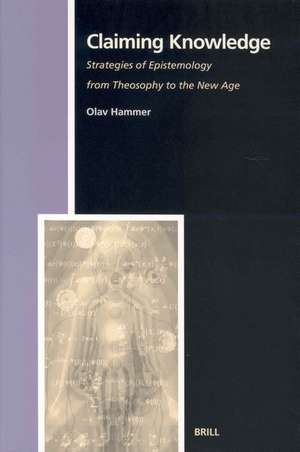
Claiming Knowledge
Autor Olav Hammeren Limba Engleză Paperback – 17 noi 2003
This volume deals with the transformation of religious creativity in the late modern West. Its point of departure is a set of esoteric beliefs, from Theosophy to the New Age. It shows how these traditions have adapted to the cultural givens of each successive epoch.
The claims of each movement have been buttressed by drawing on various structural characteristics of late modernity. The advance of science has resulted in attempts to claim scientific status for religious beliefs. Globalization has given rise to massive loans from other cultures, but also to various strategies to radically reinterpret foreign elements. Individualism has led to an increasing reliance on experience as a source of legitimacy.
The analytical tools applied to understanding religious modernization shed light on changes that are fundamentally reshaping many religious traditions.
This publication has also been published in hardback, please click here for details.
Preț: 815.54 lei
Preț vechi: 948.31 lei
-14%
Carte tipărită la comandă
Livrare economică 07-21 iulie
Specificații
ISBN-10: 900413638X
Pagini: 554
Dimensiuni: 162 x 241 x 37 mm
Greutate: 1.01 kg
Editura: Brill
V-ar putea interesa
-
 HeavenPeter StanfordPreț: 78.80 lei
 -
 Discovering GodRodney StarkPreț: 109.41 lei
 -
 -37%Preț: 4193.65 lei6692.07 lei
 -
 -50%Preț: 542.31 lei1075.59 lei
 -
 -6%Preț: 499.40 lei533.69 lei
 -
 Preț: 272.59 lei
 -
 -7%Preț: 372.70 lei401.71 lei
 -
 -11%Preț: 651.98 lei731.68 lei
 -
 -15%Preț: 680.60 lei800.70 lei
 -
 Introducing Chinese ReligionsMario PoceskiPreț: 420.40 lei
 -
 The Road to EleusisR Gordon WassonPreț: 104.92 lei
 -
 IslamKaren Armstrong-28%Preț: 50.75 lei70.12 lei
 -
 The Great TransformationKaren Armstrong-19%Preț: 87.82 lei108.17 lei
Public țintă
All those interested in modern culture, intellectual history, the history of religions and theology, as well as an educated readership with an interest in esotericism and New Age thought.Notă biografică
Olav Hammer, Ph.D. (2000) in History of Religions, Lund (Sweden), is Researcher and Lecturer at the University of Amsterdam. He has published extensively, mainly in Swedish, on the New Age and on contemporary Western esotericism.
Recenzii
David A. Palmer, Justificatif, 2004.
'Hammer has done a great service with his careful analysis of an understudied phenomenon in contemporary religion: the New Age. This book is a treasure of research into the roots and development of modern esotericism…offers new insight…strong book, which certainly deserves a place in the stacks of academic libraries.'
T.A. Forsthoefel, Choice, 2001.