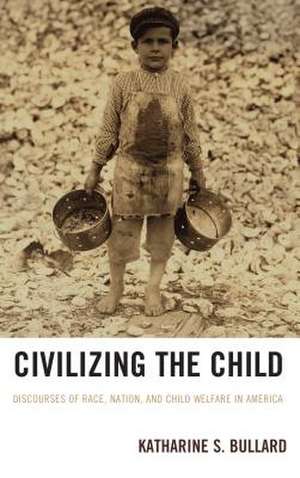
Civilizing the Child: Discourses of Race, Nation, and Child Welfare in America
Autor Katharine S. Bullarden Limba Engleză Paperback – 15 oct 2015
Civilizing the Child tracks the growing social concern with children in the nineteenth and early-twentieth centuries. The author uses seminal figures and institutions to look at the origins of the welfare state. Chapters focus on Charles Loring Brace, Jacob Riis, residents of the Hull House Settlement, and the staff of U.S. Children's Bureau, analyzing their work to unpack the assumptions about American identity that made certain children belong and others remain outsiders. Bullard traces the ways in which child welfare advocates used racialized language and emphasized the "civilizing mission" to argue for support of white native-born children. This language focused on the future citizenship of some children as an argument for their support and protection.
Preț: 318.67 lei
Preț vechi: 421.26 lei
-24%
Puncte Express: 478
Carte tipărită la comandă
Livrare economică 06-20 iunie
Specificații
ISBN-13: 9781498525404
ISBN-10: 1498525407
Pagini: 158
Ilustrații: 3 BW Photos
Dimensiuni: 165 x 234 x 11 mm
Greutate: 0.25 kg
Editura: Bloomsbury Publishing
Colecția Lexington Books
Locul publicării:New York, United States
ISBN-10: 1498525407
Pagini: 158
Ilustrații: 3 BW Photos
Dimensiuni: 165 x 234 x 11 mm
Greutate: 0.25 kg
Editura: Bloomsbury Publishing
Colecția Lexington Books
Locul publicării:New York, United States
Cuprins
Introduction
Chapter One. Settling the Waifs: Charles Loring Brace, the Children's Aid Society and Christian Expansion
Chapter Two. Jacob Riis, Slum Tourism and Citizenship
Chapter Three. Immigrant Neighborhoods, Settlement Houses and the Civilizing
Mission
Chapter Four. The Rights of American Children: Social Science, Citizenship and the Children's Bureau
Epilogue
Chapter One. Settling the Waifs: Charles Loring Brace, the Children's Aid Society and Christian Expansion
Chapter Two. Jacob Riis, Slum Tourism and Citizenship
Chapter Three. Immigrant Neighborhoods, Settlement Houses and the Civilizing
Mission
Chapter Four. The Rights of American Children: Social Science, Citizenship and the Children's Bureau
Epilogue
Recenzii
Bullard's most interesting contribution is her linkage of race, children, and social welfare. Concerned with the nation's racial composition, reformers turned to poor white children and children of immigrants, attempting to civilize and mold them for citizenship.. The final chapter, on the Children's Bureau, is the book's strongest, with compelling sources and a clearer narrative. Bullard brings together the threads of race, nation, and childhood to demonstrate that the Children's Bureau helped to 'establish a nominal social citizenship' for white American children. Here, too, Bullard clearly shows the role of social science in building racial distinctions into the mechanisms of the modern state.. [T]he book [is] approachable. Precisely because reformers like Riis and Addams are likely to be familiar names for students, individual chapters could stand alone in undergraduate courses. Bullard's evenhanded insights enrich our understanding of social reform, particularly reformers' motivations.. Scholars of race, childhood, and welfare will find interesting new insights into child welfare policy's links with developments in social citizenship and the racialization of the modern American state.
This thought-provoking study of child welfare reformers in the early twentieth-century U.S. argues that racial difference, national identity, and imperialist assumptions both inspired reformers' programs to improve the lives of the nation's children and set limits on their notions of deserving childhood. While reformers integrated the children of European immigrants into their vision of the ideal child upon whose welfare the fate of the nation depended, they did so by drawing increasingly rigid boundaries between 'whitened' Americans, who could lay claim to the nation's settler heritage, and racialized Others-African Americans, Asian Americans, Mexican Americans, and Native Americans-who did not fit into the national mythology of newcomers seeking (and finding) success in the New World. Civilizing the Child is a solidly researched and provocatively argued study that will be of interest to historians of social welfare and public policy, children and childhood, race and empire, and nineteenth- and twentieth-century America.
This thought-provoking study of child welfare reformers in the early twentieth-century U.S. argues that racial difference, national identity, and imperialist assumptions both inspired reformers' programs to improve the lives of the nation's children and set limits on their notions of deserving childhood. While reformers integrated the children of European immigrants into their vision of the ideal child upon whose welfare the fate of the nation depended, they did so by drawing increasingly rigid boundaries between 'whitened' Americans, who could lay claim to the nation's settler heritage, and racialized Others-African Americans, Asian Americans, Mexican Americans, and Native Americans-who did not fit into the national mythology of newcomers seeking (and finding) success in the New World. Civilizing the Child is a solidly researched and provocatively argued study that will be of interest to historians of social welfare and public policy, children and childhood, race and empire, and nineteenth- and twentieth-century America.