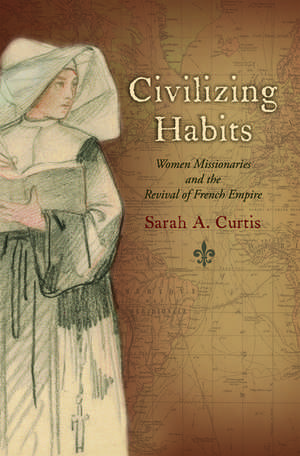
Civilizing Habits: Women Missionaries and the Revival of French Empire
Autor Sarah A. Curtisen Limba Engleză Hardback – 23 sep 2010
Preț: 744.62 lei
Preț vechi: 1078.71 lei
-31%
Puncte Express: 1117
Carte tipărită la comandă
Livrare economică 13-18 noiembrie
Livrare prin curier în România Termenul estimat este afișat lângă disponibilitate.
Transport gratuit pentru acest produs Plată online sau ramburs, în funcție de opțiunile comenzii.
Retur gratuit în 14 zile Comandă securizată și suport în română.
Specificații
ISBN-13: 9780195394184
ISBN-10: 0195394186
Pagini: 384
Ilustrații: 3 black and white halftones
Dimensiuni: 155 x 236 x 25 mm
Greutate: 0.7 kg
Editura: Oxford University Press
Colecția OUP USA
Locul publicării:New York, United States
ISBN-10: 0195394186
Pagini: 384
Ilustrații: 3 black and white halftones
Dimensiuni: 155 x 236 x 25 mm
Greutate: 0.7 kg
Editura: Oxford University Press
Colecția OUP USA
Locul publicării:New York, United States
V-ar putea interesa
-
 A Testament of HopeMartin Luther KingPreț: 218.64 lei
 -
 -31%Preț: 694.17 lei1008.41 lei
 -
 -21%Preț: 428.90 lei545.08 lei
 -
 Sister Churches: American Congregations and Their Partners AbroadJanel Kragt Bakker-13%Preț: 273.68 lei313.44 lei
 -
 -24%Preț: 240.85 lei316.07 lei
 -
 The Provocative ChurchTomlin GrahamPreț: 131.86 lei
 -
 The Gospel in a Pluralist SocietyLesslie NewbiginPreț: 141.79 lei
 -
 Answering Jewish Objections to JesusMichael L BrownPreț: 158.44 lei
 -
 Christian. Muslim. FriendDavid ShenkPreț: 82.65 lei
 -
 Finding Your VoiceJim DantPreț: 96.37 lei
 -
 Encountering the World of IslamKeith E. SwartleyPreț: 243.83 lei
 -
 The Insanity of ObedienceNik RipkenPreț: 104.17 lei
 -
 Billy GrahamW. Terry WhalinPreț: 85.75 lei
Descriere
Civilizing Habits explores the life stories of three French women missionaries - Philippine Duchesne, Emilie de Vialar, and Anne-Marie Javouhey - who transgressed boundaries, both real and imagined, to evangelize far from France's shores. In so doing, this book argues that they helped France reestablish a global empire after the dislocation of the Revolution and the fall of Napoleon. They also pioneered a new missionary era in which the educational, charity, and health care services provided by women became valuable tools for spreading Catholic influence across the globe.Philippine Duchesne, who began her religious life in a cloistered convent before the Revolution, traveled to former French territory in Missouri in 1818 to proselytize among Native American tribes. Thwarted by the American policy of removing tribes even further west, her main legacy became girls' education on the frontier. Emilie de Vialar followed French troops to Algeria after conquest in 1830 and opened missions throughout the Mediterranean basin. Prevented from direct conversion, she developed strategies and subterfuges for working among Muslim populations. Anne-Marie Javouhey made her life's work the evangelization of Africans in the French slave colonies, including a utopian settlement in the wilds of French Guiana. She became a rare Catholic proponent of the abolition of slavery and a woman designated a "great man " by the French king. Freed from physical enclosure, these women were protected from worldly corruption only by their religious habits and their behavior. Paradoxically, however, through embracing religious institutions designed to shield their femininity, these women gained increased authority to travel outside of France, challenge church power, and evangelize among non-Christians, all roles more commonly ascribed to male missionaries. Their stories teach us about the life paths open to religious women in the nineteenth century and how both church and state benefitted from their initiative and energy to expand boundaries of faith and nation.
Recenzii
allows us to see imperialism, womens activism, and religious
Notă biografică
Associate Professor of History at San Francisco State University. Author, Educating the Faithful: Religion, Society, and Schooling in Nineteenth-Century France, DeKalb, Ill.: Northern Illinois University Press, 2000. French edition: L'enseignement au temps des congrégations (Le diocèse de Lyon, 1801-1905), Lyon: Presses Universitaires de Lyon, 2003. Co-editor, Views from the Margins: Creating Identities in Modern France, University of Nebraska Press, 2008.