
Civil War
Autor Lucan Traducere de Brian Walters Introducere de W. R. Johnsonen Limba Engleză Hardback – 21 aug 2015
Written in the reign of Nero—the emperor against whom Lucan was implicated in a conspiracy and by whom he was compelled to commit suicide at the age of 25—the poet's dark, ambiguous, unfinished masterpiece focuses on the disintegration of the Roman body politic and the war between Julius Caesar and Pompey that ultimately lead to the end of the Roman republic.
While aiming for a poem both as rugged as Lucan's—with its mix of history and fantasy, of high and low registers, of common and uncommon turns of phrase, of narrative and declamation—and as reader-friendly as possible, Brian Walters owns that he has "nowhere tried to simplify the rhetorical excesses that are the essence of Lucan's poem, the real meat and bone of the Civil War."
A brilliant Introduction by W. R. Johnson discusses the poem's relationship to Nero and monarchy; its invocations of both the gods and chaos; the real hero of the Civil War; and the poem's end and narrative styles.
Synopses of individual books; suggestions for further reading; a glossary of names, places, and Roman institutions; and a map are also included.
While aiming for a poem both as rugged as Lucan's—with its mix of history and fantasy, of high and low registers, of common and uncommon turns of phrase, of narrative and declamation—and as reader-friendly as possible, Brian Walters owns that he has "nowhere tried to simplify the rhetorical excesses that are the essence of Lucan's poem, the real meat and bone of the Civil War."
A brilliant Introduction by W. R. Johnson discusses the poem's relationship to Nero and monarchy; its invocations of both the gods and chaos; the real hero of the Civil War; and the poem's end and narrative styles.
Synopses of individual books; suggestions for further reading; a glossary of names, places, and Roman institutions; and a map are also included.
Preț: 341.80 lei
Puncte Express: 513
Carte disponibilă
Livrare economică 06-20 noiembrie
Livrare prin curier în România Termenul estimat este afișat lângă disponibilitate.
Transport gratuit de la 400.00 lei Plată online sau ramburs, în funcție de opțiunile comenzii.
Retur gratuit în 14 zile Comandă securizată și suport în română.
Specificații
ISBN-13: 9781603849975
ISBN-10: 1603849971
Pagini: 304
Dimensiuni: 140 x 216 x 139 mm
Greutate: 0.49 kg
Editura: Hackett Publishing Company,Inc
Colecția Hackett Publishing Company, Inc.
Locul publicării:United States
ISBN-10: 1603849971
Pagini: 304
Dimensiuni: 140 x 216 x 139 mm
Greutate: 0.49 kg
Editura: Hackett Publishing Company,Inc
Colecția Hackett Publishing Company, Inc.
Locul publicării:United States
V-ar putea interesa
-
 Essential Bukowski: PoetryCharles BukowskiPreț: 107.28 lei
 -
 The People Look Like Flowers at LastCharles BukowskiPreț: 73.45 lei
 -
 Rumi The Book of LoveColeman BarksPreț: 73.05 lei
 -
 The Essential Rumi - ReissueColeman BarksPreț: 113.94 lei
 -
 Ten Years in an Open Necked ShirtJohn Cooper Clarke-20%Preț: 51.10 lei63.83 lei
 -
 The Canterbury TalesGeoffrey Chaucer-23%Preț: 62.19 lei81.03 lei
 -
 Jason and the Golden Fleece (The Argonautica)Apollonius of Rhodes-19%Preț: 52.19 lei64.47 lei
 -
 The Love PoemsOvid-19%Preț: 69.94 lei86.16 lei
 -
 Poetry by HeartJulie Blake-27%Preț: 80.11 lei109.80 lei
 -
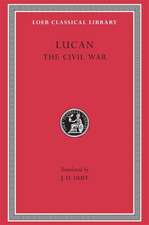 Preț: 234.84 lei
 -
 Love is a Dog from HellCharles BukowskiPreț: 80.50 lei
 -
 You Get So Alone at TimesCharles BukowskiPreț: 73.56 lei
 -
 The Last Night of the Earth PoemsCharles BukowskiPreț: 81.78 lei
 -
 Milk and HoneyRupi Kaur-19%Preț: 75.79 lei93.34 lei
 -
 The Universe of UsLang Leav-20%Preț: 74.97 lei93.34 lei
 -
 Dirty Pretty ThingsMichael Faudet-13%Preț: 75.55 lei86.75 lei
 -
 PharsaliaMarcus Annaeus LucanusPreț: 228.64 lei
 -
 -27%Preț: 66.57 lei91.73 lei
 -
 De bello civili IXLucan-18%Preț: 92.15 lei112.76 lei
 -
 Preț: 226.96 lei
Recenzii
"Brian Walters has given us what too few translators of classical poetry do—an authorial presence. Here is Lucan himself in all his drastic modes—everything from his enraged indignation to his paradoxical aphorisms--recreating the ruptured Neronian world he lived in as he recounts the nefarious civil war that destroyed the Roman Republic."
—Stanley Lombardo, University of Kansas
—Stanley Lombardo, University of Kansas
"Brian Walters, aware that the poem's 'obsessive meditations on tyranny and the corruption of power' fit the times, brings to life in his translation the fractured state of the late Roman Republic as Julius Caesar's compulsive boundary-crossing chips away at the increasingly futile resistance of Pompey and Cato. Lucan's violent content demands an equivalent violence of expression, and here Walter's is especially successful, as during the naval slaughter at Massilia (3.549-803) or Erichtho's reanimation of a young soldier's corpse (6.760-883. He really hits his grisly stride, though, with the infamous snake episode (9.749-854), a scene of herpetological carnage that he renders with Quentin Tarantino-esque intensity and absurdity.
"W.R. Johnson, a critic who has been most willing to find the dark humor in Lucan's poetry, situates the work accordingly as a 'unique fusion of high seriousness with an especially bitter kind of satire fueled by vehement sarcasm' and takes the reader though the greatest its of modern Lucian criticism—anti-heroics, Olympian omissions, the poet's relationship to Nero, the poem's 'ending'—with an eye to this fusion."
—Patrick J. Burns, Institute for the Study of the Ancient World, in Classical World
"W.R. Johnson, a critic who has been most willing to find the dark humor in Lucan's poetry, situates the work accordingly as a 'unique fusion of high seriousness with an especially bitter kind of satire fueled by vehement sarcasm' and takes the reader though the greatest its of modern Lucian criticism—anti-heroics, Olympian omissions, the poet's relationship to Nero, the poem's 'ending'—with an eye to this fusion."
—Patrick J. Burns, Institute for the Study of the Ancient World, in Classical World
"There is much to like about this translation. I commend Walters especially for his excellent ear for 21st century American idiom and diction and the way this helps to create a powerfully simple and clear translation. . . . Walters includes welcome supplementary material, such as a full glossary and a helpful book-by-book structural synopsis. In addition, W.R. Johnson's introduction is provocative and revealing, dealing specifically with the dangerous world of Neronian Rome, Lucan's atypical approach to the gods and the hero, and the Civil War's diverse narrative styles. . . . A welcome option for the classroom [that] may just help hook new fans on Post-Augustan epic."
—Stephen M. Kirshner, Austin Peay State University, in CJ-Online
—Stephen M. Kirshner, Austin Peay State University, in CJ-Online