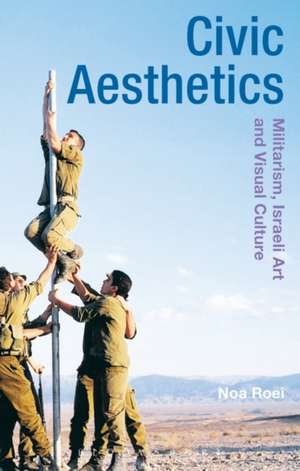
Civic Aesthetics: Militarism, Israeli Art and Visual Culture
Autor Noa Roeien Limba Engleză Paperback – 17 noi 2016
Exploring the politics of the image in the context of Israeli militarized visual culture, Civic Aesthetics examines both the omnipresence of militarism in Israeli culture and society and the way in which this omnipresence is articulated, enhanced, and contested within local contemporary visual art. Looking at a range of contemporary artworks through the lens of "civilian militarism", Roei employs the theory of various fields, including memory studies, gender studies, landscape theory, and aesthetics, to explore the potential of visual art to communicate military excesses to its viewers.
This study builds on the specific sociological concerns of the chosen cases to discuss the complexities of visuality, the visible and non-visible, arguing for art's capacity to expose the scopic regimes that construct their visibility. Images and artworks are often read either out of context, on purely aesthetic or art-historical ground, or as cultural artefacts whose aesthetics play a minor role in their significance. This book breaks with both traditions as it approaches all art, both high and popular art, as part of the surrounding visual culture in which it is created and presented. This approach allows a new theory of the image to come forth, where the relation between the political and the aesthetic is one of exchange, rather than exclusion.
Preț: 196.33 lei
Preț vechi: 235.68 lei
-17%
Puncte Express: 294
Carte tipărită la comandă
Livrare economică 23 noiembrie-07 decembrie
Livrare prin curier în România Termenul estimat este afișat lângă disponibilitate.
Transport gratuit de la 400.00 lei Plată online sau ramburs, în funcție de opțiunile comenzii.
Retur gratuit în 14 zile Comandă securizată și suport în română.
Specificații
ISBN-13: 9781474253154
ISBN-10: 1474253156
Pagini: 240
Ilustrații: 25 bw illus
Dimensiuni: 138 x 216 x 11 mm
Greutate: 0.35 kg
Editura: Bloomsbury Publishing
Colecția Bloomsbury Academic
Locul publicării:London, United Kingdom
ISBN-10: 1474253156
Pagini: 240
Ilustrații: 25 bw illus
Dimensiuni: 138 x 216 x 11 mm
Greutate: 0.35 kg
Editura: Bloomsbury Publishing
Colecția Bloomsbury Academic
Locul publicării:London, United Kingdom
V-ar putea interesa
-
 In Praise of ShadowsJunichiro Tanizaki-37%Preț: 44.41 lei70.11 lei
 -
 Truth, Fiction, and Literature: A Philosophical PerspectivePeter Lamarque-28%Preț: 429.14 lei598.45 lei
 -
 Philosophical Perspectives on ArtStephen Davies-31%Preț: 726.48 lei1054.17 lei
 -
 -28%Preț: 393.50 lei548.20 lei
 -
 Contemplating Art: Essays in AestheticsJerrold Levinson-21%Preț: 377.44 lei476.59 lei
 -
 -21%Preț: 377.87 lei481.03 lei
 -
 Sight and Sensibility: Evaluating PicturesDominic McIver Lopes-21%Preț: 284.90 lei360.44 lei
 -
 Art and EmotionDerek Matravers-19%Preț: 350.44 lei435.16 lei
 -
 -29%Preț: 409.10 lei573.48 lei
 -
 New Essays on Musical UnderstandingPeter Kivy-20%Preț: 364.56 lei453.39 lei
 -
 The Aesthetic Appreciation of NatureMalcolm Budd-29%Preț: 395.22 lei554.62 lei
 -
 Everyday AestheticsYuriko Saito-12%Preț: 301.69 lei344.70 lei
 -
 Scruton's AestheticsA. Hamilton-15%Preț: 647.80 lei762.11 lei
 -
 -15%Preț: 666.12 lei783.67 lei
 -
 Philosophy of the Arts: An Introduction to AestheticsGordon GrahamPreț: 448.58 lei
 -
 -15%Preț: 434.74 lei511.47 lei
 -
 Divine BeautyJohn O'Donohue-26%Preț: 58.79 lei79.03 lei
 -
 Wabi Sabi: The Art of Everyday LifeDiane Durston-25%Preț: 42.97 lei57.20 lei
 -
 Benjamin, Barthes and the Singularity of PhotographyDr. Kathrin Yacavone-26%Preț: 200.71 lei269.56 lei
 -
 Dissensus: On Politics and AestheticsJacques Rancière-44%Preț: 220.93 lei396.57 lei
Cuprins
List of Illustrations
Acknowledgements
Introduction
In Search of a Civic Aesthetics
Between Critique and Complicity
Showing Seeing: The Critical Image
Chapter 1: Can(n)ons of Israeli Society
Frames and Set-Ups
Soldier Figures, Civilian Militarism, and Israeli Art
Taking Sides: Exhibitions as Framing Agents
Visual Performatives
Critical Frictions
Chapter 2: Bodies of the Nation: Eroticized Soldiers
Serial Quotations
National Bodies
Rewriting the Jewish Body, Again
Women Soldiers
Queer Dreams of the Nation
Chapter 3: Looking Through Landscape
The Landscape Way of Seeing
The "Stifling of the Gaze"
Israeli Mindscapes
Chapter 4: Kebab in Theory: Mapping Vision
Zooming in on the Thinking Image
Contesting Mis/interpretations
The Archaeology of the Still Life: Bringing back the Anti-Image
Distortion and Desire: The Mapping Impulse
Seeing Green: Shaping Emplacement
Chapter 5: Greetings to the Soldier-Citizen: Consuming Nostalgia
Peace, Security, and Sparkles
From Guns to Cream Cheese
The Politics of Nostalgia
Preposterous Postcards
The Limits of Critical Discourse
Chapter 6: Fence Art: Re/Framing Politics
Bil'in and Beyond: Aesthetics of Disagreement
Redistributing Visibility
Changing Contexts, Shifting Frames
Conclusion: the Work, the World, and the Critical Image
Works Cited
Index
Acknowledgements
Introduction
In Search of a Civic Aesthetics
Between Critique and Complicity
Showing Seeing: The Critical Image
Chapter 1: Can(n)ons of Israeli Society
Frames and Set-Ups
Soldier Figures, Civilian Militarism, and Israeli Art
Taking Sides: Exhibitions as Framing Agents
Visual Performatives
Critical Frictions
Chapter 2: Bodies of the Nation: Eroticized Soldiers
Serial Quotations
National Bodies
Rewriting the Jewish Body, Again
Women Soldiers
Queer Dreams of the Nation
Chapter 3: Looking Through Landscape
The Landscape Way of Seeing
The "Stifling of the Gaze"
Israeli Mindscapes
Chapter 4: Kebab in Theory: Mapping Vision
Zooming in on the Thinking Image
Contesting Mis/interpretations
The Archaeology of the Still Life: Bringing back the Anti-Image
Distortion and Desire: The Mapping Impulse
Seeing Green: Shaping Emplacement
Chapter 5: Greetings to the Soldier-Citizen: Consuming Nostalgia
Peace, Security, and Sparkles
From Guns to Cream Cheese
The Politics of Nostalgia
Preposterous Postcards
The Limits of Critical Discourse
Chapter 6: Fence Art: Re/Framing Politics
Bil'in and Beyond: Aesthetics of Disagreement
Redistributing Visibility
Changing Contexts, Shifting Frames
Conclusion: the Work, the World, and the Critical Image
Works Cited
Index
Recenzii
Civic Aesthetics is an original contribution to an understanding of the links among culture, art, and militarism. Roei skillfully employs a complex academic and artistic perspective in order to problematize the very basic questions of art and Israeli identity. This book will surely serve as a worthwhile resource for scholars from a diverse range of disciplines.
Noa Roei's Civic Aesthetics traces the evolution and the centrality of militarism in post 1948 Israeli art and visual culture. Engaging closely with and offering nuanced readings of a wide-range of artworks including: paintings, photography, exhibit catalogues and other visual installations, the book exposes the 'open secret' of militarism as the key feature, governing and dictating the constitution of much of Israel's visual artistic production. It is a must-read for anyone who wishes a better understanding of the intricate relationship between politics and aesthetics, the military and the civic, as well as the visible and invisible in the context of today's and yesterday's visual culture in Israel.
Civic Aesthetics is a highly original and profoundly significant publication that enhances our understanding of contemporary Israeli art, culture and society. Roei's rigorous multidisciplinary scholarship is embedded within a nuanced theoretical framework, as she cogently demonstrates how various military 'components' manifest themselves within Israeli visual culture, both explicitly and implicitly. Roei's subtle understanding of how visible or invisible contexts or 'framing devices' shape vision itself -- exposing sights, oversights, and blind spots - and her examination of the simultaneous complicity and criticality inherent in cultural artifacts and practiced by artists and viewers alike - present eye-opening issues vis-à-vis the complexities that bind art and politics. Roei's lucid and fascinating text concerning Israeli culture, goes well beyond its specific locus, and offers a prime example of the poignancy and potency of "visual epistemology" as a mode of knowing and understanding.
Noa Roei's Civic Aesthetics traces the evolution and the centrality of militarism in post 1948 Israeli art and visual culture. Engaging closely with and offering nuanced readings of a wide-range of artworks including: paintings, photography, exhibit catalogues and other visual installations, the book exposes the 'open secret' of militarism as the key feature, governing and dictating the constitution of much of Israel's visual artistic production. It is a must-read for anyone who wishes a better understanding of the intricate relationship between politics and aesthetics, the military and the civic, as well as the visible and invisible in the context of today's and yesterday's visual culture in Israel.
Civic Aesthetics is a highly original and profoundly significant publication that enhances our understanding of contemporary Israeli art, culture and society. Roei's rigorous multidisciplinary scholarship is embedded within a nuanced theoretical framework, as she cogently demonstrates how various military 'components' manifest themselves within Israeli visual culture, both explicitly and implicitly. Roei's subtle understanding of how visible or invisible contexts or 'framing devices' shape vision itself -- exposing sights, oversights, and blind spots - and her examination of the simultaneous complicity and criticality inherent in cultural artifacts and practiced by artists and viewers alike - present eye-opening issues vis-à-vis the complexities that bind art and politics. Roei's lucid and fascinating text concerning Israeli culture, goes well beyond its specific locus, and offers a prime example of the poignancy and potency of "visual epistemology" as a mode of knowing and understanding.