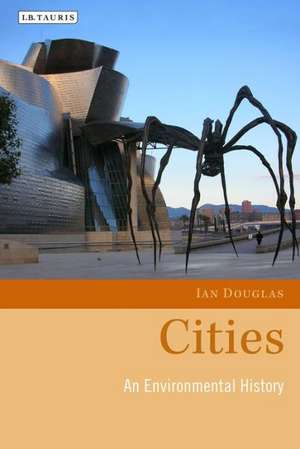
Cities: An Environmental History: Environmental History and Global Change, cartea 05
Autor Ian Douglasen Limba Engleză Hardback – 25 sep 2013
Structura și metodologia lucrării Cities sunt fundamentate pe o abordare sistemică a istoriei mediului, organizată pentru a ghida cititorul de la geneza așezărilor umane până la complexitatea megapolisurilor contemporane. Remarcăm rigoarea cu care Ian Douglas segmentează analiza metabolismului urban, dedicând secțiuni distincte fluxurilor de resurse, calității aerului și managementului integrat al apei. Considerăm că forța acestui volum rezidă în capacitatea de a sintetiza date tehnice — susținute de 67 de figuri și 39 de tabele — într-o narațiune coerentă despre reziliența urbană în fața hazardelor geofizice.
Subliniem că acest volum extinde cadrul propus de Cities and Nature de Lisa Benton-Short, integrând perspective istorice profunde despre modul în care managementul mediului a fost, încă de la începuturi, o componentă intrinsecă a vieții urbane. În timp ce alte lucrări se concentrează pe sociologie urbană, Ian Douglas pune accent pe „metabolismul” orașului — modul în care acesta consumă hrană, energie și materiale, generând în schimb deșeuri și emisii. Progresia capitolelor reflectă o trecere logică de la vulnerabilitatea în fața dezastrelor către soluții de sustenabilitate, precum infrastructura verde și retrofitting-ul orașelor existente.
În contextul operei autorului, Cities reprezintă o sinteză academică ce distilează expertiza prezentată anterior în The Urban Environment (1983) și Routledge Handbook of Urban Ecology. Deși Ian Douglas a explorat anterior geomorfologia și ecologia urbană în lucrări specializate, acest volum publicat de I.B.Tauris funcționează ca o lucrare de referință care conectează planificarea urbană cu limitele ecologice ale planetei, oferind o bază teoretică și practică esențială pentru înțelegerea viitorului urban.


Preț: 537.00 lei
Preț vechi: 583.69 lei
-8%
Carte tipărită la comandă
Livrare economică 27 noiembrie-08 decembrie
Specificații
ISBN-10: 1845117956
Pagini: 369
Dimensiuni: 155 x 234 x 33 mm
Greutate: 0.73 kg
Editura: I. B. Tauris & Company
Seria Environmental History and Global Change
V-ar putea interesa
-
 Wild CitiesChris FitchPreț: 143.05 lei
 -
 The Well-Tempered CityJonathan F. P. RosePreț: 96.56 lei
 -
 The Nature of Our CitiesNadina GallePreț: 162.85 lei
 -
 A New Green History Of The WorldClive Ponting-18%Preț: 77.15 lei94.17 lei
 -
 Sustainability: A Very Short IntroductionSaleem H. Ali-19%Preț: 57.46 lei71.30 lei
 -
 The Great Cities in HistoryJohn Julius Norwich-18%Preț: 75.52 lei92.63 lei
 -
 The City ReaderRichard T. LeGates-8%Preț: 466.10 lei506.63 lei
 -
 Preț: 380.83 lei
 -
 Sink or Swim: How the world needs to adapt to a changing climateSusannah Fisher-26%Preț: 100.23 lei135.49 lei
 -
 Urban JungleBen Wilson-19%Preț: 75.40 lei93.11 lei
 -
 SnoSverker SörlinPreț: 124.75 lei
 -
 Can a City Be Sustainable? (State of the World)The Worldwatch InstitutePreț: 404.10 lei
 -
 Phytopolis: The Living CityStefano Mancuso-20%Preț: 129.43 lei162.00 lei
 -
 How to Save the CityPaul ChattertonPreț: 175.09 lei
 -
 The Earthscan Reader in Sustainable CitiesDavid SatterthwaitePreț: 445.20 lei
 -
 Urban Environment and Smart Cities in Asian CountriesUday Chatterjee-24%Preț: 862.23 lei1134.51 lei
 -
 Urban Metabolism and Climate ChangeRahul Bhadouria-24%Preț: 891.03 lei1172.42 lei
 -
 -5%Preț: 1565.61 lei1648.01 lei
 -
 Flux CitiesGregor H. MewsPreț: 304.76 lei
De ce să citești această carte
Recomandăm această carte specialiștilor și studenților din domeniile geografie, planificare urbană și ecologie. Cititorul câștigă o înțelegere profundă a mecanismelor prin care orașele pot deveni sustenabile în contextul schimbărilor climatice. Este un instrument esențial pentru cei care doresc să analizeze soluții practice, de la reciclarea deșeurilor la conservarea energiei, fundamentate pe date istorice și geografice solide.
Despre autor
Ian Douglas este Profesor Emerit de Geografie în cadrul Școlii de Mediu și Dezvoltare a Universității din Manchester. Cu o carieră academică distinsă, a ocupat funcții de conducere precum Președinte al Societății pentru Ecologie Umană și al Forumului Urban UNESCO MAB din Marea Britanie. Expertiza sa vastă în ecologie urbană și geomorfologie este reflectată în numeroase volume de referință, printre care se numără „The Urban Environment” și „Routledge Handbook of Urban Ecology”. Contribuțiile sale academice sunt dublate de participarea în consiliile editoriale ale unor publicații prestigioase precum „Ecological Processes” și „Geographical Research”.
Notă biografică
Cuprins
Descriere scurtă
Descriere
Cities are amongst our greatest creations. Yet, with cities now home to over half the world's population, there is increasing concern over their unchecked expansion and the detrimental effect this is having on the planet. This unfettered growth is affecting every ecosystem on Earth, from the deepest oceans to the highest mountains, as induced climate change and ever increasing demands upon the world's resources take effect. As the pace of urbanisation quickens, how can we make the world's cities more sustainable? Ian Douglas tells the story of cities. He shows why they exist, how they have evolved and the problems they have encountered, revealing how from the very beginning environmental management played a key role in urban life. He addresses specific problems, such as noise and air pollution, water supply and waste management, as well as the vulnerability of cities to hazards such as earthquakes and flooding. And he considers strategies to make cities more sustainable and help them adapt to climate change, such as waste recycling, energy conservation, dual water systems, sustainable housing, as well as initiatives to retrofit existing cities.
Written by an acknowledged international authority, this unique volume will be welcomed by students and specialists in environment, planning, geography, ecology and the built environment.