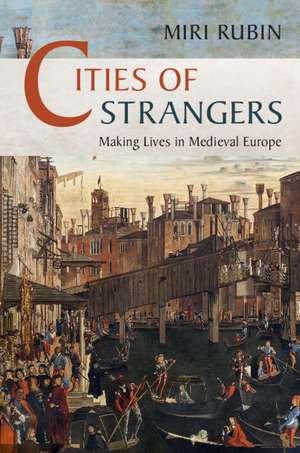
Cities of Strangers
Autor Miri Rubinen Limba Engleză Paperback – 19 mar 2020
În Cities of Strangers, Miri Rubin propune o reevaluare a dinamicii urbane europene între anii 1000 și 1500, concentrându-se pe figura 'străinului'. Remarcăm modul în care autoarea structurează narațiunea istorică: prima parte a intervalului este marcată de o deschidere pragmatică, unde orașele-stat își exercitau autonomia invitând activ bancheri, medici și juriști pentru a consolida 'binele comun'. Totuși, ediția evidențiază un punct de cotitură crucial: anul 1350. Apariția recurentă a ciumei a fracturat acest ciclu benign, transformând toleranța în suspiciune și ducând la politici autoritare de excludere. Structura cărții urmărește această evoluție prin studii de caz specifice, dedicând capitole distincte integrării vecinilor, rolului complex al evreilor — definiți ca 'străini familiari' — și condiției femeilor în spațiul urban. Analiza este susținută de cinci ilustrații alb-negru și două hărți care ajută la vizualizarea fluxurilor migratorii. Ca alternativă la Segregation – Integration – Assimilation pentru cursurile de sociologie istorică sau istorie medievală, lucrarea lui Rubin are avantajul unei perspective integrate, care nu se limitează doar la Europa Centrală, ci caută modele universale de conviețuire și conflict. În contextul operei sale, Cities of Strangers continuă preocuparea pentru viața comunitară și ritualurile puterii explorată în Corpus Christi sau Charity and Community in Medieval Cambridge, mutând însă accentul de pe simbolismul religios pe mecanismele juridice și demografice ale incluziunii sociale. Credem că această abordare oferă o înțelegere nouă asupra modului în care crizele sanitare pot recalibra fundamental atitudinile politice față de minorități.
Preț: 166.99 lei
Carte disponibilă
Livrare economică 31 octombrie-14 noiembrie
Specificații
ISBN-10: 1108740537
Pagini: 204
Ilustrații: 5 b/w illus. 2 maps
Dimensiuni: 149 x 226 x 12 mm
Greutate: 0.3 kg
Editura: Cambridge University Press
Locul publicării:Cambridge, United Kingdom
De ce să citești această carte
Recomandăm această carte studenților la sociologie și istorie, dar și cititorilor interesați de rădăcinile politicilor de migrație europene. Miri Rubin oferă o lecție istorică despre cum prosperitatea și criza modelează toleranța. Veți câștiga o perspectivă documentată asupra modului în care orașele medievale au gestionat diversitatea lingvistică și religioasă cu mult înaintea conceptelor moderne de cetățenie.
Despre autor
Miri Rubin (n. 1956) este o reputată istorică și profesoară de istorie medievală și modernă timpurie la Queen Mary University of London. Formată la Universitatea Ebraică din Ierusalim și la Cambridge, Rubin s-a specializat în istoria socială și religioasă a Europei (1100-1500). Lucrările sale, precum The Middle Ages sau The Life and Passion of William of Norwich, sunt recunoscute pentru capacitatea de a recupera experiențele cotidiene ale oamenilor obișnuiți. Expertiza sa în studiul ritualurilor și al interacțiunilor dintre putere și comunitate o poziționează ca o voce autoritară în mediul academic, fiind invitată să susțină prestigioasele prelegeri Wiles la Queen's University Belfast.
Descriere scurtă
Cuprins
Recenzii
'It is inspiring and troubling to learn from Miri Rubin's engaging book that a twelfth-century Parisian or a thirteenth-century Londoner would find their cities in the twenty-first century more familiar than those whose dreams of purity blinds them to the truth that diverse cities are where history is made.' Engin Isin, Queen Mary University of London
'The great medievalist Miri Rubin reminds us how diverse European cities have always been. This timely, fascinating book traces how a migrant, Jew, bride from another town, or foreign merchant could become less a stranger and more a trusted neighbour, but also how fragile that hard-won trust could be.' Edward Muir, Northwestern University
'A thoughtful and pioneering book.' David Abulafia, Times Literary Supplement
'The narrative portion of this book is, for general readers and undergraduates, a wonderful introduction … Scholars, however, will more deeply appreciate that almost half of the book is bibliography and endnotes, the latter a nice admixture of primary and secondary sources.' R. T. Ingoglia, Choice
'Miri Rubin weaves together stories with an enormous contemporary resonance that recall the unavoidable correlation between everyone's well-being, and the well-being of strangers.' Beatriz E. Salamanca, Journal of Early Modern History
'… Cities of Strangers is a thought-provoking and learned examination of how strangers made the medieval city a place of vibrant difference and opportunity, dependent on trust and a sense of the 'common good.' Tanya Stabler Miller, Medieval Encounters
'Rubin's book provides a method of comparison between European cities based on regulatory frameworks for those deemed different. She draws a common thread through her four chapters that demonstrates how various categories of strangeness change over time. It offers insight into future attempts to define 'strangers' or 'foreigners' across different political and social realities.' Angela Zhang, Renaissance and Reformation / Renaissance et Réforme
'Written with insight and charm, the exposition is attractive in itself and moves beyond the political management of the cities to open up a new understanding of the variety of life in different places and different periods.' Sybil Jack, Parergon