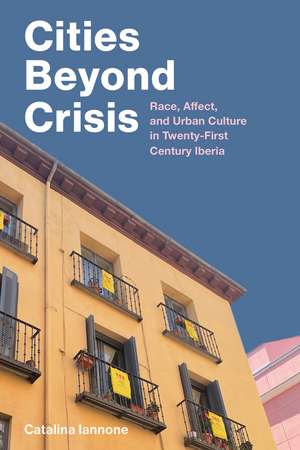
Cities Beyond Crisis: Race, Affect, and Urban Culture in Twenty-First-Century Iberia
Autor Catalina Iannoneen Limba Engleză Paperback – 30 apr 2025
In Cities Beyond Crisis, Catalina Iannone studies the rapid evolution of Iberian urban centers in the years following the 2008 financial crisis, identifying how this event catalyzed a protracted period of unraveling and reorganization in the region. Arguing that the affects and effects of the crisis are best understood when embedded within local environments, Cities Beyond Crisis focuses on how textual, visual, and spatial interventions both drove and contested change in two racially diverse, historically marginalized neighborhoods in the capital cities of Spain and Portugal—Madrid’s Lavapiés and Lisbon’s Mouraria. Through a critical examination of the narratives shaping public perception of these spaces, whether promoting their development and consumption or challenging market-oriented trends, Iannone demonstrates how the stories that stakeholders across the ideological spectrum told about these districts illuminate enduring attachments and aspirations in each nation’s relationship to race. By approaching the study of space as a contested and contingent social product, this book takes an interdisciplinary approach, drawing from both humanistic and social science theories and practices to show how cultural production shapes and is shaped by the built environment.
| Toate formatele și edițiile | Preț | Express |
|---|---|---|
| Paperback (1) | 352.34 lei 39-44 zile | |
| Vanderbilt University Press – 30 apr 2025 | 352.34 lei 39-44 zile | |
| Hardback (1) | 688.72 lei 39-44 zile | |
| Vanderbilt University Press – 30 apr 2025 | 688.72 lei 39-44 zile |
Preț: 352.34 lei
Puncte Express: 529
Preț estimativ în valută:
62.29€ • 74.04$ • 54.05£
62.29€ • 74.04$ • 54.05£
Carte tipărită la comandă
Livrare economică 09-14 martie
Specificații
ISBN-13: 9780826507327
ISBN-10: 0826507328
Pagini: 268
Ilustrații: 32 b&w images
Dimensiuni: 152 x 229 mm
Editura: Vanderbilt University Press
Colecția Vanderbilt University Press
ISBN-10: 0826507328
Pagini: 268
Ilustrații: 32 b&w images
Dimensiuni: 152 x 229 mm
Editura: Vanderbilt University Press
Colecția Vanderbilt University Press
Recenzii
"Who has the right to the city? Iannone’s exemplary contribution to cultural studies sharply illuminates the global processes and local practices that shape Lisbon’s Mouraria and Madrid’s Lavapiés neighborhoods—revealing the urban as a struggle between control, commodification, contestation, resistance, and resilience."
—Benjamin Fraser, author of Obsession, Aesthetics, and the Iberian City: The Partial Madness of Modern Urban Culture
"This innovative study of two neighborhoods makes a significant contribution to the field of urban cultural studies. Starting with an analysis of branding and development in Spain and Portugal in the years following the 2008 financial crisis, Iannone then develops a stimulating account of cultural interventions that sought to contest or provide alternatives to the boom of capital-oriented urban development."
—Ellen W. Sapega, author of Consensus and Debate in Salazar's Portugal
"An innovative, interdisciplinary contribution to scholarship on the relationships between cities, culture, and capital as they play out in iconic neighborhoods in Lisbon and Madrid after the fiscal crisis of 2008. Fundamental reading for those interested in urban transformation on the Iberian Peninsula."
—Malcolm A. Compitello, Founding and Executive Editor Emeritus of the Arizona Journal of Hispanic Cultural Studies
"This book makes an important contribution to the fields of urban and cultural studies and cultural geography as practiced within Luso-Hispanic studies by adding the crucial but often overlooked issues of race and ethnicity to ongoing debates about the role of culture in the production of social spaces in Spain and Portugal."
—Susan Larson, editor of Comfort and Domestic Space in Modern Spain
—Benjamin Fraser, author of Obsession, Aesthetics, and the Iberian City: The Partial Madness of Modern Urban Culture
"This innovative study of two neighborhoods makes a significant contribution to the field of urban cultural studies. Starting with an analysis of branding and development in Spain and Portugal in the years following the 2008 financial crisis, Iannone then develops a stimulating account of cultural interventions that sought to contest or provide alternatives to the boom of capital-oriented urban development."
—Ellen W. Sapega, author of Consensus and Debate in Salazar's Portugal
"An innovative, interdisciplinary contribution to scholarship on the relationships between cities, culture, and capital as they play out in iconic neighborhoods in Lisbon and Madrid after the fiscal crisis of 2008. Fundamental reading for those interested in urban transformation on the Iberian Peninsula."
—Malcolm A. Compitello, Founding and Executive Editor Emeritus of the Arizona Journal of Hispanic Cultural Studies
"This book makes an important contribution to the fields of urban and cultural studies and cultural geography as practiced within Luso-Hispanic studies by adding the crucial but often overlooked issues of race and ethnicity to ongoing debates about the role of culture in the production of social spaces in Spain and Portugal."
—Susan Larson, editor of Comfort and Domestic Space in Modern Spain
Notă biografică
Catalina Iannone is an assistant professor in the Department of Spanish and Portuguese at Ohio State University.
Cuprins
Introduction: Cities in Crisis
Chapter 1: Branding the City
Chapter 2: Taking Shape
Chapter 3: Capturing Community in Lavapiés and Mouraria
Chapter 4: Markets and the Limits of Opposition
Chapter 5: Vision and Opposition
Conclusion: The Continuity of Crisis
Notes
Bibliography
Index
Chapter 1: Branding the City
Chapter 2: Taking Shape
Chapter 3: Capturing Community in Lavapiés and Mouraria
Chapter 4: Markets and the Limits of Opposition
Chapter 5: Vision and Opposition
Conclusion: The Continuity of Crisis
Notes
Bibliography
Index
Descriere
A critical spatial perspective on the narratives that shaped two neighborhoods in Spain and Portugal after the 2008 financial crisis