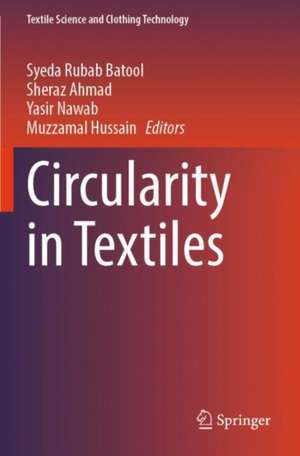
Circularity in Textiles: Textile Science and Clothing Technology
Editat de Syeda Rubab Batool, Sheraz Ahmad, Yasir Nawab, Muzzamal Hussainen Limba Engleză Paperback – 28 dec 2024
Din seria Textile Science and Clothing Technology
- 18%
 Preț: 923.24 lei
 -
 Preț: 365.06 lei
 - 15%
 Preț: 531.61 lei
 - 15%
 Preț: 445.19 lei
 -
 Preț: 364.08 lei
 - 15%
 Preț: 688.16 lei
 - 15%
 Preț: 559.57 lei
 - 15%
 Preț: 613.00 lei
 -
 Preț: 378.40 lei
 - 18%
 Preț: 1080.97 lei
 - 15%
 Preț: 500.22 lei
 - 15%
 Preț: 503.88 lei
 - 18%
 Preț: 863.20 lei
 - 18%
 Preț: 759.74 lei
 - 15%
 Preț: 554.46 lei
 - 15%
 Preț: 554.28 lei
 - 15%
 Preț: 617.72 lei
 -
 Preț: 371.07 lei
 - 15%
 Preț: 670.68 lei
 - 19%
 Preț: 525.72 lei
 - 15%
 Preț: 620.36 lei
 -
 Preț: 365.06 lei
 - 15%
 Preț: 565.25 lei
 - 18%
 Preț: 764.28 lei
 -
 Preț: 363.87 lei
 - 15%
 Preț: 560.58 lei
Preț: 904.47 lei
Preț vechi: 1190.10 lei
-24%
Puncte Express: 1357
Carte tipărită la comandă
Livrare economică 10-16 septembrie
Livrare prin curier în România Termenul estimat este afișat lângă disponibilitate.
Transport gratuit pentru acest produs Plată online sau ramburs, în funcție de opțiunile comenzii.
Retur gratuit în 14 zile Comandă securizată și suport în română.
Specificații
ISBN-13: 9783031494819
ISBN-10: 3031494814
Pagini: 288
Dimensiuni: 155 x 235 x 16 mm
Greutate: 0.44 kg
Editura: Springer
Seria Textile Science and Clothing Technology
ISBN-10: 3031494814
Pagini: 288
Dimensiuni: 155 x 235 x 16 mm
Greutate: 0.44 kg
Editura: Springer
Seria Textile Science and Clothing Technology
Cuprins
Table of content.- 1. Introduction.- 2. Eco- Innovation.- 3. Circular Fashion.- 4. Eco-design of Textiles.- 5. Sustainable Raw Materials.- 6. Sustainable Production Practices.- 7. Life Cycle Assessment of Textile Products.- 8. Recycling of Textiles.- 9. Value Retention Strategies in Circularity.- 10. Circular Textile Business Model.- 11. Generation, Assessment, and Mitigation of Microplastics.- 12. Regulation in Recycling and Circularity: Future prospective.
Textul de pe ultima copertă
This book explains the basic principles of recycling and circularity in textiles. With the emergence of "quick fashion," textile manufacturing has expanded significantly over the past few decades. The importance of textiles to human society goes beyond their practical uses in providing warmth, protection, and comfort. Therefore, the usage and production of textiles are enhanced substantially compared to the past globally. As a result, rates of textile production and trash output have grown drastically. The other side of the story is the drastic rate at which they are dumped into landfills which is almost a garbage truck every second. If this alarming trend continues, there will be serious environmental consequences. It is well known that the textile sector is recognized as the second largest industrial polluter in the world, producing 20% of the global wastewater and accounting for 10% of carbon emissions. Additionally, harmful chemicals are utilized and emitted during the manufacture of textiles, which has an impact on ecosystems and public health The last 150 years of the textile industrial system fundamentally follow the "take-make-dispose" principle, in which resources are continuously taken out of a natural system (take), changed during production (make), and used for various purposes within the human system (use), and then released back into the environment (dispose of). In this way, manufacturing industries produce waste-producing commodities to make money, which eventually has a negative impact leading to the lack of resources resulting in price volatility, uncertainty, and economic crises. This book consists of 11 potential chapters to cover all the aspects of “circularity in textiles.”
Caracteristici
Offers a comprehensive review of circularity in Textiles Presents a comprehensive review of sustainable raw materials used in textile production Covers manufacturing processes that minimize waste and resource consumption