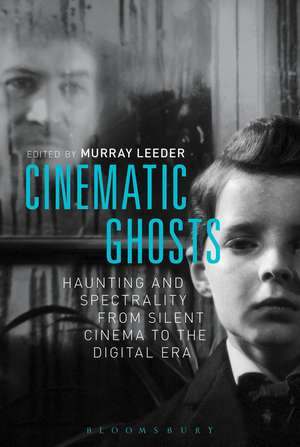
Cinematic Ghosts: Haunting and Spectrality from Silent Cinema to the Digital Era
Editat de Murray Leederen Limba Engleză Paperback – 10 sep 2015
Cinematic Ghosts contains essays revisiting some classic ghost films within the genres of horror (The Haunting, 1963), romance (Portrait of Jennie, 1948), comedy (Beetlejuice, 1988) and the art film (Uncle Boonmee Who Can Recall His Past Lives, 2010), as well as essays dealing with a number of films from around the world, from Sweden to China. Cinematic Ghosts traces the archetype of the cinematic ghost from the silent era until today, offering analyses from a range of historical, aesthetic and theoretical dimensions.
Preț: 209.66 lei
Preț vechi: 250.46 lei
-16%
Puncte Express: 314
Carte tipărită la comandă
Livrare economică 01-15 decembrie
Livrare prin curier în România Termenul estimat este afișat lângă disponibilitate.
Transport gratuit de la 400.00 lei Plată online sau ramburs, în funcție de opțiunile comenzii.
Retur gratuit în 14 zile Comandă securizată și suport în română.
Specificații
ISBN-13: 9781628922134
ISBN-10: 1628922133
Pagini: 320
Ilustrații: 30 bw illus
Dimensiuni: 148 x 228 x 20 mm
Greutate: 0.48 kg
Editura: Bloomsbury Publishing
Colecția Bloomsbury Academic
Locul publicării:New York, United States
ISBN-10: 1628922133
Pagini: 320
Ilustrații: 30 bw illus
Dimensiuni: 148 x 228 x 20 mm
Greutate: 0.48 kg
Editura: Bloomsbury Publishing
Colecția Bloomsbury Academic
Locul publicării:New York, United States
V-ar putea interesa
-
 Searching for Stars: Stardom and Screen Acting in British CinemaGeoffrey Macnab-25%Preț: 641.81 lei851.20 lei
 -
 Close Up: Cinema And ModernismJames Donald-11%Preț: 409.04 lei459.60 lei
 -
 -25%Preț: 241.64 lei321.74 lei
 -
 Stars in Modern French FilmGuy AustinPreț: 289.62 lei
 -
 Preț: 225.29 lei
 -
 Art, Creativity, and the Sacred: An Anthology in Religion and ArtEmerita Professor Diane Apostolos-Cappadona-38%Preț: 398.77 lei643.10 lei
 -
 The Historical Epic and Contemporary Hollywood: From Dances with Wolves to GladiatorProfessor James Russell-16%Preț: 292.10 lei346.90 lei
 -
 Popular Cinemas of Europe: Studies of Texts, Contexts and FrameworksDimitris EleftheriotisPreț: 329.50 lei
 -
 The Charlie Chan Mystery Movie GuideLuke FreemanPreț: 86.21 lei
 -
 Herbert ReadMichael ParaskosPreț: 70.43 lei
 -
 My Lunches with OrsonPeter BiskindPreț: 107.70 lei
 -
 Politics as Form in Lars von Trier: A Post-Brechtian ReadingDr Angelos Koutsourakis-14%Preț: 236.49 lei274.10 lei
 -
 Horror FilmMurray Leeder-29%Preț: 212.11 lei298.51 lei
 -
 Glacial Period: The Louvre CollectionNicolas De CrécyPreț: 138.38 lei
 -
 The Complete Gone With the Wind Trivia BookPauline BartelPreț: 140.10 lei
 -
 UnderminingLucy R. LippardPreț: 210.67 lei
 -
 Beyond the Looking GlassAna Salzberg-23%Preț: 758.62 lei985.21 lei
 -
 Italian CinemaMary Wood-11%Preț: 739.55 lei829.23 lei
 -
 HalloweenMurray LeederPreț: 330.04 lei
Cuprins
Acknowledgements
Introduction
Murray Leeder, University of Calgary, Canada
Ghosts of Pre-Cinema and Silent Cinema
Chapter 1
Phantom Images and Modern Manifestations: Spirit Photography, Magic Theater, Trick Films and Photography's Uncanny
Tom Gunning, University of Chicago, USA
Chapter 2
"Visualizing the Phantoms of the Imagination": Projecting Haunted Minds
Murray Leeder, University of Calgary, Canada
Chapter 3
Specters of the Mind: Ghosts, Illusion, and Exposure in Paul Leni's The Cat and the Canary
Simone Natale, Humboldt University, Germany
Chapter 4
Supernatural Speech: Silent Cinema's Stake in Visualizing the Impossible
Robert Alford, University of California, Berkeley, USA
Cinematic Ghosts from the 1940s through the 1980s
Chapter 5
Bad Sync: Spectral Sound and Retro-effects in Portrait of Jennie
René Thoreau Bruckner, University of Southern California, USA
Chapter 6
"Antique Chiller": Quality, Pretention and History in the Critical Reception of The Innocents and The Haunting
Mark Jancovich, University of East Anglia, UK
Chapter 7
Shadows of Shadows: The Undead in Ingmar Bergman's Cinema
Maurizio Cinquegrani, University of Kent, UK
Chapter 8
Locating the Spectre in Dan Curtis's Burnt Offerings
Dara Downey, University College Dublin, Ireland
Chapter 9
The Bawdy Body in Two Comedy Ghost Films: Topper and Beetlejuice
Katherine A. Fowkes, High Point University, USA
Millennial Ghosts
Chapter 10
"I See Dead People": Visualizing Ghosts in the Horror Film Before the Arrival of CGI
Steffen Hantke, Sogang University, Korea
Chapter 11
Spectral Remainders and Transcultural Hauntings: (Re)iterations of the Onryo in Contemporary
Japanese Horror Cinema
Jay McRoy, University of Wisconsin - Parkside, USA
Chapter 12
Painted Skin: Romance with the Ghostly Femme Fatale in Contemporary Chinese Cinema
Li Zeng, Illinois State University, USA
Chapter 13
"It's Not the House that's Haunted": Demons, Debt and the Family in Peril in Recent Horror Cinema
Bernice M. Murphy, Trinity College, Dublin, Ireland
Chapter 14
Glitch Gothic
Marc Olivier, Brigham Young University, USA
Chapter 15
Showing the Unknown: Uncle Boonmee Who Can Recall His Past Lives
Mitsuyo Wada-Marciano, Carleton University, Canada
Afterword: Haunted Viewers
Jeffrey Sconce, Northwestern University, USA
Introduction
Murray Leeder, University of Calgary, Canada
Ghosts of Pre-Cinema and Silent Cinema
Chapter 1
Phantom Images and Modern Manifestations: Spirit Photography, Magic Theater, Trick Films and Photography's Uncanny
Tom Gunning, University of Chicago, USA
Chapter 2
"Visualizing the Phantoms of the Imagination": Projecting Haunted Minds
Murray Leeder, University of Calgary, Canada
Chapter 3
Specters of the Mind: Ghosts, Illusion, and Exposure in Paul Leni's The Cat and the Canary
Simone Natale, Humboldt University, Germany
Chapter 4
Supernatural Speech: Silent Cinema's Stake in Visualizing the Impossible
Robert Alford, University of California, Berkeley, USA
Cinematic Ghosts from the 1940s through the 1980s
Chapter 5
Bad Sync: Spectral Sound and Retro-effects in Portrait of Jennie
René Thoreau Bruckner, University of Southern California, USA
Chapter 6
"Antique Chiller": Quality, Pretention and History in the Critical Reception of The Innocents and The Haunting
Mark Jancovich, University of East Anglia, UK
Chapter 7
Shadows of Shadows: The Undead in Ingmar Bergman's Cinema
Maurizio Cinquegrani, University of Kent, UK
Chapter 8
Locating the Spectre in Dan Curtis's Burnt Offerings
Dara Downey, University College Dublin, Ireland
Chapter 9
The Bawdy Body in Two Comedy Ghost Films: Topper and Beetlejuice
Katherine A. Fowkes, High Point University, USA
Millennial Ghosts
Chapter 10
"I See Dead People": Visualizing Ghosts in the Horror Film Before the Arrival of CGI
Steffen Hantke, Sogang University, Korea
Chapter 11
Spectral Remainders and Transcultural Hauntings: (Re)iterations of the Onryo in Contemporary
Japanese Horror Cinema
Jay McRoy, University of Wisconsin - Parkside, USA
Chapter 12
Painted Skin: Romance with the Ghostly Femme Fatale in Contemporary Chinese Cinema
Li Zeng, Illinois State University, USA
Chapter 13
"It's Not the House that's Haunted": Demons, Debt and the Family in Peril in Recent Horror Cinema
Bernice M. Murphy, Trinity College, Dublin, Ireland
Chapter 14
Glitch Gothic
Marc Olivier, Brigham Young University, USA
Chapter 15
Showing the Unknown: Uncle Boonmee Who Can Recall His Past Lives
Mitsuyo Wada-Marciano, Carleton University, Canada
Afterword: Haunted Viewers
Jeffrey Sconce, Northwestern University, USA
Recenzii
There is much to interest readers and the book will (dare I say it) leave them in good spirits ... A thoughtful and entertaining addition to any film or religion studies collection, whether for personal or professional purposes, at undergraduate or postgraduate level.
The stand out feature of this collection is the diagnostic links between the content of ghost films and the ghostly techniques through which they are shot, a level of connection that puts Leeder's text a step ahead of other purely thematic approaches to ghosts and haunted cinema. Cinematic Ghosts is just as much about ghostly cinematics, adding appeal to scholars of film production and spectral narratives alike.
Cinema has always been a ghostly medium. Now we finally have a book that explores film's relation to ghosts with the breadth and depth it deserves, moving deftly across historical periods, genre classifications, and national origins. This is a rich and varied collection that will haunt - in all the right ways - a broad range of readers, scholars, and students.
Ghosts have haunted film from its earliest years to the present day, as this volume admirably demonstrates. It is impressive for its chronological and geographical range, and for the consistent quality of the contributions. Breaking new ground in exploring the interlinked theoretical, cultural and national stakes of cinematic haunting, this invaluable collection is certain to be a standard reference point for all future work in the field.
Murray Leeder's strongly focused collection adds another exhilarating twist to the spectral turn by providing a welcome opportunity to reflect on the enduring notion of cinema as a haunted/haunting medium. Asking where non-figurative cinematic ghosts have been and where they might be going, a series of engaging contributions systematically charts the changing narrative, visual and sonic modes of haunting from the silent era to the digital age. Throughout, Cinematic Ghosts shows great sensitivity to the ghost's cultural and historical specificity and, in terms of the films discussed, effectively-and fittingly-combines the expected with the unexpected.
Whether you've accepted a dare to spend one night in a haunted house or just have an interest in ghosts on the silver screen, Murray Leeder's Cinematic Ghosts is essential reading. Ranging from the origins of cinematic ghosts in nineteenth-century phantasmagoria to twenty-first century "glitch gothic," and from classic Western hauntings such as the The Innocents to the Asian onryo, this broad and engaging collection of essays--the first such collection specifically on cinematic ghosts--offers a lively, much-needed analysis of the history and appeal of movie phantoms. International in scope and historicist in approach, Cinematic Ghosts brilliantly showcases the depth and richness of supernatural film and will haunt all subsequent approaches to the topic. Ghostbusters, step aside. Murray Leeder is now the one to call if there's something strange in your neighborhood!
The stand out feature of this collection is the diagnostic links between the content of ghost films and the ghostly techniques through which they are shot, a level of connection that puts Leeder's text a step ahead of other purely thematic approaches to ghosts and haunted cinema. Cinematic Ghosts is just as much about ghostly cinematics, adding appeal to scholars of film production and spectral narratives alike.
Cinema has always been a ghostly medium. Now we finally have a book that explores film's relation to ghosts with the breadth and depth it deserves, moving deftly across historical periods, genre classifications, and national origins. This is a rich and varied collection that will haunt - in all the right ways - a broad range of readers, scholars, and students.
Ghosts have haunted film from its earliest years to the present day, as this volume admirably demonstrates. It is impressive for its chronological and geographical range, and for the consistent quality of the contributions. Breaking new ground in exploring the interlinked theoretical, cultural and national stakes of cinematic haunting, this invaluable collection is certain to be a standard reference point for all future work in the field.
Murray Leeder's strongly focused collection adds another exhilarating twist to the spectral turn by providing a welcome opportunity to reflect on the enduring notion of cinema as a haunted/haunting medium. Asking where non-figurative cinematic ghosts have been and where they might be going, a series of engaging contributions systematically charts the changing narrative, visual and sonic modes of haunting from the silent era to the digital age. Throughout, Cinematic Ghosts shows great sensitivity to the ghost's cultural and historical specificity and, in terms of the films discussed, effectively-and fittingly-combines the expected with the unexpected.
Whether you've accepted a dare to spend one night in a haunted house or just have an interest in ghosts on the silver screen, Murray Leeder's Cinematic Ghosts is essential reading. Ranging from the origins of cinematic ghosts in nineteenth-century phantasmagoria to twenty-first century "glitch gothic," and from classic Western hauntings such as the The Innocents to the Asian onryo, this broad and engaging collection of essays--the first such collection specifically on cinematic ghosts--offers a lively, much-needed analysis of the history and appeal of movie phantoms. International in scope and historicist in approach, Cinematic Ghosts brilliantly showcases the depth and richness of supernatural film and will haunt all subsequent approaches to the topic. Ghostbusters, step aside. Murray Leeder is now the one to call if there's something strange in your neighborhood!