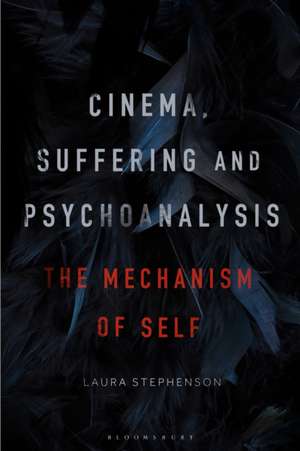
Cinema, Suffering and Psychoanalysis: The Mechanism of Self
Autor Laura Stephensonen Limba Engleză Paperback – 23 ian 2025
Functioning as a culturally reflexive medium, the six feature films analysed, including Black Swan (2010) and The Machinist (2004), represent some of the most common psychological disorders and lived experiences of the contemporary era. This book enters unchartered terrain in cinema scholarship by combining clinical psychology's Diagnostic and Statistical Manual Five (DSM-V) to organise and diagnose each character, and psychoanalysis to track the origin, mechanism and affect of the psychological disorder within the narrative trajectory of each film. Lacan's theories on the infantile mirror phase, the Imaginary, and the Symbolic, Zizek's theories on the Real, the big Other and the Event, and Kristeva's theories on abjection and melancholia work in combination with the DSM's classification of symptoms to interpret six contemporary pieces of cinema.
By taking into consideration that origin, mechanism, affect and symptomatology are part of an interconnected group, this book explores psychological disorder as part of the human condition, something which contributes to and informs personal identity. More specifically, this research refutes the notion that psychological disorder and psychological health exist as a binary, instead recognising that what has traditionally been pathologised, may instead be viewed as variations on human identity.
Preț: 196.80 lei
Preț vechi: 269.73 lei
-27%
Puncte Express: 295
Carte disponibilă
Livrare economică 03-17 septembrie
Livrare prin curier în România Termenul estimat este afișat lângă disponibilitate.
Transport gratuit de la 400.00 lei Plată online sau ramburs, în funcție de opțiunile comenzii.
Retur gratuit în 14 zile Comandă securizată și suport în română.
Specificații
ISBN-13: 9798765105672
Pagini: 232
Dimensiuni: 150 x 228 x 16 mm
Greutate: 0.34 kg
Editura: Bloomsbury Publishing
Colecția Bloomsbury Academic
Locul publicării:New York, United States
Pagini: 232
Dimensiuni: 150 x 228 x 16 mm
Greutate: 0.34 kg
Editura: Bloomsbury Publishing
Colecția Bloomsbury Academic
Locul publicării:New York, United States
V-ar putea interesa
-
 De-Westernizing Film StudiesSaer Maty BaPreț: 397.67 lei
 -
 Don't Stop Believin'Robert K. JohnstonPreț: 126.12 lei
 -
 French and Spanish Queer FilmChris Perriam-25%Preț: 596.55 lei793.33 lei
 -
 The Horror SensoriumAngela NdalianisPreț: 227.38 lei
 -
 They Knew Marilyn MonroeLes HardingPreț: 232.36 lei
 -
 -34%Preț: 630.52 lei961.90 lei
 -
 -36%Preț: 677.13 lei1058.48 lei
 -
 -32%Preț: 426.80 lei626.57 lei
 -
 Cinema of ChoiceNitzan Ben Shaul-23%Preț: 747.65 lei970.97 lei
 -
 Writings on ArtPer KirkebyPreț: 148.45 lei
 -
 Shocked But Connected: Notes on LaughterMichael Roemer-17%Preț: 347.09 lei419.81 lei
 -
 The Complete Guide to Being EvilLaura StephensonPreț: 83.94 lei
 -
 The Wizard of MGMA. Arnold GillespiePreț: 260.79 lei
 -
 Jesus at the MoviesW. Barnes TatumPreț: 205.37 lei
 -
 John Hughes and Eighties Cinema: Teenage Hopes and American DreamsTHOMAS A. CHRISTIEPreț: 151.66 lei
Cuprins
1. Introduction
2. Black Swan (2010) and Psychosis
3. The Machinist (2004) and Insomnia
4. The Girl with the Dragon Tattoo (2009) and PTSD
5. Brodre (2004) and Adjustment Disorder
6. Copycat (1995) and Agoraphobia
7. The Shipping News (2001) and Depression
8. Conclusion
Index
2. Black Swan (2010) and Psychosis
3. The Machinist (2004) and Insomnia
4. The Girl with the Dragon Tattoo (2009) and PTSD
5. Brodre (2004) and Adjustment Disorder
6. Copycat (1995) and Agoraphobia
7. The Shipping News (2001) and Depression
8. Conclusion
Index
Recenzii
Cinema, Suffering and Psychoanalysis is unique and vital addition to the canon of film analysis, bringing together psychoanalysis and psychology in order to explore, in exciting new ways, the manner with which cinema can represent our deepest struggles and darkest experiences. An authoritative, and highly readable, exploration of cinema and suffering.
This is a fascinating and expertly written account of the relationship between clinical psychology, psychoanalysis and cinema. Dr Stephenson's thoroughly engaging writing style, which is both accessible and informed by detailed and thorough research, and her use of appropriate films as case studies, results in a compelling argument for approaching cinema in a novel way.
Focusing on psychological suffering through the lens of film, Laura Stephenson innovatively combines the diagnostic capacity of psychiatry with the subjective insights of psychoanalysis to show that suffering is not abnormal. It affects, and unifies, us all. With equal parts acuity and compassion - for the film protagonists as well as for ourselves, their inevitable companions - Stephenson shows why we are fascinated with psychological disorder in film, and what it may tell us about our own condition. In a world of compounding mental health concerns, this is a book of and for our times.
This is a fascinating and expertly written account of the relationship between clinical psychology, psychoanalysis and cinema. Dr Stephenson's thoroughly engaging writing style, which is both accessible and informed by detailed and thorough research, and her use of appropriate films as case studies, results in a compelling argument for approaching cinema in a novel way.
Focusing on psychological suffering through the lens of film, Laura Stephenson innovatively combines the diagnostic capacity of psychiatry with the subjective insights of psychoanalysis to show that suffering is not abnormal. It affects, and unifies, us all. With equal parts acuity and compassion - for the film protagonists as well as for ourselves, their inevitable companions - Stephenson shows why we are fascinated with psychological disorder in film, and what it may tell us about our own condition. In a world of compounding mental health concerns, this is a book of and for our times.