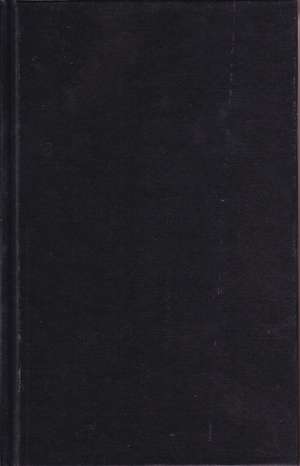
Christianity: An Introduction: I.B.Tauris Introductions to Religion
Autor Philip Kennedyen Limba Engleză Hardback – 21 feb 2011
Preț: 1003.93 lei
Preț vechi: 1375.25 lei
-27%
Puncte Express: 1506
Carte indisponibilă temporar
Livrare prin curier în România Termenul estimat este afișat lângă disponibilitate.
Transport gratuit pentru acest produs Plată online sau ramburs, în funcție de opțiunile comenzii.
Retur gratuit în 14 zile Comandă securizată și suport în română.
Specificații
ISBN-13: 9781848853829
ISBN-10: 1848853823
Pagini: 360
Ilustrații: 5 maps, 30 bw integrated
Dimensiuni: 138 x 216 x 30 mm
Greutate: 0.56 kg
Editura: Bloomsbury Publishing
Colecția I.B.Tauris
Seria I.B.Tauris Introductions to Religion
Locul publicării:London, United Kingdom
ISBN-10: 1848853823
Pagini: 360
Ilustrații: 5 maps, 30 bw integrated
Dimensiuni: 138 x 216 x 30 mm
Greutate: 0.56 kg
Editura: Bloomsbury Publishing
Colecția I.B.Tauris
Seria I.B.Tauris Introductions to Religion
Locul publicării:London, United Kingdom
V-ar putea interesa
-
 The Holy Blood And The Holy GrailHenry Lincoln-18%Preț: 77.26 lei94.44 lei
 -
 -32%Preț: 648.32 lei959.83 lei
 -
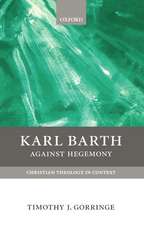 Karl Barth: Against HegemonyTimothy J. Gorringe-28%Preț: 358.96 lei500.80 lei
 -
 -28%Preț: 405.11 lei565.86 lei
 -
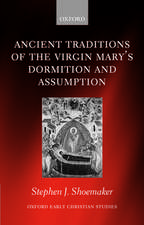 Ancient Traditions of the Virgin Mary's Dormition and AssumptionStephen J. Shoemaker-11%Preț: 540.07 lei606.81 lei
 -
 -28%Preț: 466.14 lei650.49 lei
 -
 Byzantine Philosophy and its Ancient SourcesKaterina Ierodiakonou-28%Preț: 347.49 lei483.21 lei
 -
 Beliefs and the Dead in Reformation EnglandPeter Marshall-28%Preț: 395.20 lei549.21 lei
 -
 A History of the Churches in AustralasiaIan Breward-32%Preț: 644.58 lei951.98 lei
 -
 Reformation in Britain and IrelandFelicity Heal-28%Preț: 512.88 lei710.48 lei
 -
 Living Letters of the LawJeremy CohenPreț: 325.24 lei
 -
 The Institutes of Christian ReligionJohn CalvinPreț: 173.46 lei
 -
 -21%Preț: 451.68 lei570.41 lei
 -
 -20%Preț: 159.81 lei200.42 lei
 -
 Rosslyn and the GrailMark Oxbrow-19%Preț: 64.37 lei79.12 lei
Notă biografică
Philip Kennedy teaches theology in the University of Oxford, where he is a Senior Research Fellow at Mansfield College. He is the author of 'A Modern Introduction to Theology: New Questions for Old Beliefs' (2006) and 'Twentieth Century Theologians: A New Introduction to Modern Christian Thought' (2009), both published by I.B.Tauris.
Cuprins
List of Maps and IllustrationsPrefaceAn X-Ray of ChristianityTime-Frame for ChristianityQuick Guide to Common TermsList of AbbreviationsIntroductionPART IORIGINS AND GROWTHChapter 1Jesus and the Mediterranean WorldChapter 2Ancient ChristianityPART IIMEDIEVAL CHRISTIANITYChapter 3The Early Middle Ages 500-1000Chapter 4The Later Middle Ages 1000-1500PART IIIDISCOVERY AND DIVERSITYChapter 5Renaissance and DiscoveryChapter 6Reformation and RevolutionPART IVENLIGHTENMENT AND MODERNITYChapter 7Christianity TransformedChapter 8Christianity in a Globalized WorldConclusionRecommended ReadingIndex
Descriere
Descriere de la o altă ediție sau format:
The Christian faith has the allegiance of one third of the human race. It has succeeded in influencing civilization to such a degree that we now take its existence almost for granted. Yet it might all have been so different. Christianity began with the words and deeds of an obscure village carpenter's son who died a shameful criminal's death at the hands of the Roman occupiers of his country: itself an insignificant outpost of the powerful ruling Empire. The feverish land of biblical Palestine, awash with apocalyptic expectations of deliverance from its foreign overlords, was hardly short of seers and prophets who claimed to be sent visions from God. Yet the followers of this man thought he was different: so different, in fact, that some years after his death and asserted resurrection they scandalously insisted not only that he was sent by God, but that he 'was' God. How a provincial sect, with its seemingly outrageous ideas, became first the sanctioned religion of the Roman Empire and then, over the course of 2000 years, the creed of billions of people, is the improbable story that this book tells.
It is a story of freethinkers, friars, fanatics and firebrands; and of the lay people (not just the clerical or the powerful) who have made up the great mass of Christians over the centuries. Many introductions to Christianity are written by Christians, for Christians. This elegant textbook, by contrast, shows that the history of the religion, while often glorious, is not one of unimpeded progress, but something still more remarkable, flawed and human.
The Christian faith has the allegiance of one third of the human race. It has succeeded in influencing civilization to such a degree that we now take its existence almost for granted. Yet it might all have been so different. Christianity began with the words and deeds of an obscure village carpenter's son who died a shameful criminal's death at the hands of the Roman occupiers of his country: itself an insignificant outpost of the powerful ruling Empire. The feverish land of biblical Palestine, awash with apocalyptic expectations of deliverance from its foreign overlords, was hardly short of seers and prophets who claimed to be sent visions from God. Yet the followers of this man thought he was different: so different, in fact, that some years after his death and asserted resurrection they scandalously insisted not only that he was sent by God, but that he 'was' God. How a provincial sect, with its seemingly outrageous ideas, became first the sanctioned religion of the Roman Empire and then, over the course of 2000 years, the creed of billions of people, is the improbable story that this book tells.
It is a story of freethinkers, friars, fanatics and firebrands; and of the lay people (not just the clerical or the powerful) who have made up the great mass of Christians over the centuries. Many introductions to Christianity are written by Christians, for Christians. This elegant textbook, by contrast, shows that the history of the religion, while often glorious, is not one of unimpeded progress, but something still more remarkable, flawed and human.