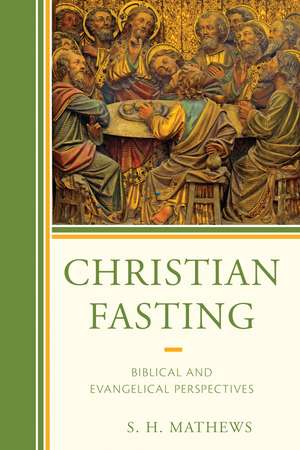
Christian Fasting: Biblical and Evangelical Perspectives: Lexington Books
Autor S.H. Mathewsen Limba Engleză Paperback – 30 apr 2026
The analysis engages closely with key biblical episodes, Moses' and Elijah's forty-day fasts, Esther's intercessory fast, Ezra's and Nehemiah's communal fasts, the critique of exploitative fasting in Isaiah 58, and the ritual fasts in Zechariah 7-8, before turning to the New Testament's reframing of fasting. Mathews offers detailed readings of Jesus' forty-day wilderness fast (Matthew 4), the controversies surrounding Pharisaic fasting, Anna's temple devotion in Luke 2, and the communal discernment fasts in Acts 13-14. Throughout, the study shows how concepts such as honor, limited good, the evil eye, dyadic identity, and Mediterranean social structures shape the rhetorical force and theological function of fasting across the canon.
Bringing this framework into dialogue with contemporary evangelical interpretations, Mathews challenges modern assumptions that cast fasting primarily as a private or devotional practice. Instead, the book presents a compelling and nuanced account of fasting as a socially embedded act-one that both reflected and reshaped early Christian piety, communal life, and interpretive traditions. A valuable resource for scholars, teachers, and advanced students, the volume offers a rich interdisciplinary lens for understanding one of the most overlooked phenomena in biblical interpretation.
Din seria Lexington Books
- 32%
 Preț: 729.63 lei
 - 59%
 Preț: 427.24 lei
 - 35%
 Preț: 574.44 lei
 - 22%
 Preț: 341.76 lei
 - 31%
 Preț: 437.25 lei
 - 28%
 Preț: 352.50 lei
 - 23%
 Preț: 321.53 lei
 - 23%
 Preț: 333.36 lei
 - 23%
 Preț: 327.54 lei
 - 35%
 Preț: 593.04 lei
 - 33%
 Preț: 358.06 lei
 - 26%
 Preț: 363.28 lei
 - 24%
 Preț: 374.46 lei
 - 22%
 Preț: 330.56 lei
 - 28%
 Preț: 346.74 lei
 - 24%
 Preț: 308.07 lei
 - 23%
 Preț: 321.63 lei
 - 27%
 Preț: 263.04 lei
 - 24%
 Preț: 369.89 lei
 - 25%
 Preț: 884.44 lei
 - 36%
 Preț: 730.77 lei
 - 29%
 Preț: 345.71 lei
 - 33%
 Preț: 556.03 lei
 - 33%
 Preț: 428.79 lei
 - 34%
 Preț: 616.07 lei
 - 29%
 Preț: 342.12 lei
 - 26%
 Preț: 362.85 lei
 - 22%
 Preț: 338.89 lei
 - 28%
 Preț: 356.18 lei
 - 23%
 Preț: 321.63 lei
 - 28%
 Preț: 346.74 lei
 - 22%
 Preț: 340.40 lei
 - 29%
 Preț: 345.71 lei
 - 22%
 Preț: 329.89 lei
 - 37%
 Preț: 660.07 lei
 - 27%
 Preț: 355.41 lei
 - 32%
 Preț: 727.58 lei
 - 24%
 Preț: 313.51 lei
 - 28%
 Preț: 614.62 lei
 - 24%
 Preț: 309.62 lei
 - 34%
 Preț: 630.22 lei
 - 34%
 Preț: 575.26 lei
 - 34%
 Preț: 607.70 lei
 - 33%
 Preț: 639.19 lei
 - 33%
 Preț: 642.37 lei
 - 33%
 Preț: 640.95 lei
 - 25%
 Preț: 369.74 lei
Preț: 204.46 lei
Preț vechi: 277.28 lei
-26%
Puncte Express: 307
Carte disponibilă
Livrare economică 17 noiembrie-01 decembrie
Livrare prin curier în România Termenul estimat este afișat lângă disponibilitate.
Transport gratuit de la 400.00 lei Plată online sau ramburs, în funcție de opțiunile comenzii.
Retur gratuit în 14 zile Comandă securizată și suport în română.
Specificații
ISBN-13: 9780567729576
ISBN-10: 0567729575
Pagini: 164
Dimensiuni: 148 x 226 x 14 mm
Greutate: 0.23 kg
Editura: Bloomsbury Publishing
Colecția Lexington Books
Seria Lexington Books
Locul publicării:New York, United States
ISBN-10: 0567729575
Pagini: 164
Dimensiuni: 148 x 226 x 14 mm
Greutate: 0.23 kg
Editura: Bloomsbury Publishing
Colecția Lexington Books
Seria Lexington Books
Locul publicării:New York, United States
Cuprins
Acknowledgements
Introduction
1. An Anthropologist Reads the New Testament
2. Fasting in the Old Testament and Ancient Mediterranean World
3. Fasting in the New Testament: A Social-Scientific View of Fasting in the First-Century Mediterranean World
4. Fasting in Evangelical Christianity
5. Evangelicalism and the New Testament in Dialogue
Bibliography
Index
About the Author
Introduction
1. An Anthropologist Reads the New Testament
2. Fasting in the Old Testament and Ancient Mediterranean World
3. Fasting in the New Testament: A Social-Scientific View of Fasting in the First-Century Mediterranean World
4. Fasting in Evangelical Christianity
5. Evangelicalism and the New Testament in Dialogue
Bibliography
Index
About the Author
Recenzii
The significance of Mathews's work is unquestionable. Besides the misuse of other spiritual
gifts, the nature and practice of Christian fasting is the most misunderstood in some African
church contexts... Mathews has provided the church with a very important tool for addressing the challenges related to the practice of fasting. In short, the book is the outcome of a thorough analysis of a topic that seems neglected by evangelical Christians today. It is relevant and worth reading.
Mathew's book provides reliable information on the meaning and practice of fasting in the first-century world. Before one can decide on what a text means for today, one should first ask what it meant in is original setting. An interpretation of the meaning of texts in their original setting can easily be anachronistic, especially when the cultural scripts evoked by these texts are not taken into consideration. By employing a social-scientific approach, Mathews does not only show what the practice of fasting entailed in the first-century, but also how these texts could and should be applied by Christians today who see the practice of fasting as an essential element of religious devotion. The book also shows that critical scholarship indeed can enhance the faith of believers.
gifts, the nature and practice of Christian fasting is the most misunderstood in some African
church contexts... Mathews has provided the church with a very important tool for addressing the challenges related to the practice of fasting. In short, the book is the outcome of a thorough analysis of a topic that seems neglected by evangelical Christians today. It is relevant and worth reading.
Mathew's book provides reliable information on the meaning and practice of fasting in the first-century world. Before one can decide on what a text means for today, one should first ask what it meant in is original setting. An interpretation of the meaning of texts in their original setting can easily be anachronistic, especially when the cultural scripts evoked by these texts are not taken into consideration. By employing a social-scientific approach, Mathews does not only show what the practice of fasting entailed in the first-century, but also how these texts could and should be applied by Christians today who see the practice of fasting as an essential element of religious devotion. The book also shows that critical scholarship indeed can enhance the faith of believers.