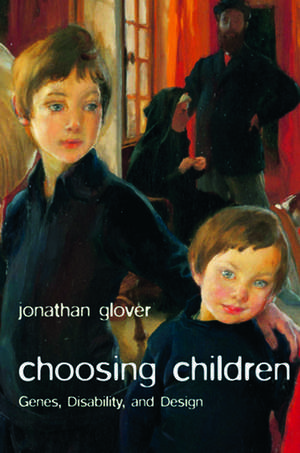
Choosing Children: Genes, Disability, and Design: Uehiro Series in Practical Ethics
Autor Jonathan Gloveren Limba Engleză Paperback – 10 ian 2008






Preț: 255.52 lei
Preț vechi: 315.28 lei
-19%
Puncte Express: 383
Carte tipărită la comandă
Livrare economică 27 noiembrie-08 decembrie
Livrare prin curier în România Termenul estimat este afișat lângă disponibilitate.
Transport gratuit de la 400.00 lei Plată online sau ramburs, în funcție de opțiunile comenzii.
Retur gratuit în 14 zile Comandă securizată și suport în română.
Specificații
ISBN-13: 9780199238491
ISBN-10: 0199238499
Pagini: 128
Dimensiuni: 135 x 203 x 10 mm
Greutate: 0.16 kg
Editura: OUP OXFORD
Colecția OUP Oxford
Seria Uehiro Series in Practical Ethics
Locul publicării:Oxford, United Kingdom
ISBN-10: 0199238499
Pagini: 128
Dimensiuni: 135 x 203 x 10 mm
Greutate: 0.16 kg
Editura: OUP OXFORD
Colecția OUP Oxford
Seria Uehiro Series in Practical Ethics
Locul publicării:Oxford, United Kingdom
V-ar putea interesa
-
 Evolving OurselvesJuan EnriquezPreț: 101.73 lei
 -
 -20%Preț: 149.45 lei186.67 lei
 -
 Preț: 187.89 lei
 -
 Don't Burn Anyone at the Stake TodayNaomi AldermanPreț: 121.20 lei
 -
 Preț: 107.54 lei
 -
 Against the MachinePaul KingsnorthPreț: 193.57 lei
 -
 Case Against PerfectionMichael J Sandel-5%Preț: 134.41 lei141.48 lei
 -
 Catastrophe EthicsTravis RiederPreț: 79.52 lei
 -
 Unfit ParentJessica SlicePreț: 162.60 lei
 -
 What Are Children For?Anastasia BergPreț: 142.22 lei
 -
 Against TechnoableismAshley ShewPreț: 66.20 lei
 -
 The Welfare of Future Children: Reproductive Ethics and Disability ScreeningDr Rebecca Bennett-17%Preț: 143.66 lei172.97 lei
 -
 -39%Preț: 56.37 lei91.93 lei
 -
 Preț: 172.26 lei
 -
 The Future Loves YouAriel Zeleznikow-JohnstonPreț: 93.58 lei
 -
 The ImmortalistsAleks KrotoskiPreț: 123.00 lei
 -
 We've Got ThisEliza HullPreț: 71.57 lei
 -
 The Unnatural Selection of Our SpeciesTorill Kornfeldt-12%Preț: 68.96 lei78.61 lei
Recenzii
Glover's book is informative, argumentative and well structured.
Cuprins
- Introduction
- 1: Disability and Genetic Choice
- Disability and Human Flourishing
- Eugenics?
- 2: Parental Choice and What We Owe to Our Children
- The Boundaries of Parental Choice
- Two Dimensions of Ethics
- What do We Owe to Our Children? A Decent Chance of a Good Life
- What do We Owe to Our Children? Respect for Identity and Autonomy
- 3: Human Values and Genetic Design
- The Genetic Supermarket, Inequality, and Entrapment
- Should We Defend a Central Core of Human Nature?
- The Further Future