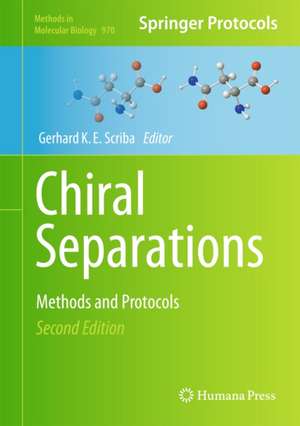
Chiral Separations
Editat de Gerhard K. E. Scribaen Limba Engleză Hardback – 3 ian 2013
Notăm cu interes apariția ediției a doua a lucrării Chiral Separations, un volum esențial pentru chimiștii analiști, biochimiști și cercetătorii din industria farmaceutică sau criminalistică. În contextul unei cereri crescute pentru metode capabile să distingă între enantiomeri, acest manual oferă protocoale de lucru riguroase pentru determinarea purității compușilor din surse naturale sau chimice. Descoperim aici o actualizare necesară a metodologiilor de separare, volumul extinzându-se dincolo de bazele teoretice către aplicații practice imediate. Structura volumului urmărește o progresie logică, începând cu o privire de ansamblu asupra recunoașterii chirale și continuând cu tehnici specifice precum cromatografia în strat subțire, cromatografia de gaze pentru hidrocarburi și utilizarea fazelor staționare bazate pe ciclodextrine sau polizaharide în HPLC. Remarcăm includerea unor capitole noi dedicate tehnicilor electroforetice și cromatografiei în strat mobil simulat (SMB) ca metodă preparativă. Această ediție este o alternativă practică la Chiral Recognition in Separation Methods de Alain Berthod pentru cursurile de chimie analitică, având avantajul integrării formatului specific seriei Methods in Molecular Biology. Spre deosebire de alte lucrări teoretice, fiecare secțiune de aici include liste de reactivi și protocoale de laborator gata pentru a fi reproduse, completate de sfaturi esențiale pentru evitarea erorilor experimentale. Fie că este vorba despre dezvoltarea metodelor de screening în SFC sau utilizarea eterilor coroană chirali, volumul editat de Gerhard K. E. Scriba rămâne un instrument de referință. Ritmul este unul tehnic, axat pe eficiența în laborator, oferind soluții concrete pentru problemele de stereochimie întâlnite în cercetarea academică și industrială.
Preț: 689.18 lei
Preț vechi: 810.80 lei
-15%
Carte tipărită la comandă
Livrare economică 07-21 decembrie
Specificații
ISBN-10: 1627032622
Pagini: 552
Ilustrații: XVII, 531 p.
Dimensiuni: 183 x 260 x 33 mm
Greutate: 1.16 kg
Ediția:2nd edition 2013
Editura: Humana
Locul publicării:Totowa, NJ, United States
V-ar putea interesa
-
 Gas ChromatographyColin Poole-31%Preț: 884.69 lei1277.82 lei
 -
 Essential Elements for a GMP Analytical Chemistry DepartmentThomas Catalano-5%Preț: 1060.44 lei1116.25 lei
 -
 -18%Preț: 1274.46 lei1554.22 lei
 -
 Biosimilarity: The FDA PerspectiveSarfaraz K. Niazi-18%Preț: 1434.69 lei1749.62 lei
 -
 Biotechnology Operations: Principles and Practices, Second EditionJohn M. Centanni-18%Preț: 1312.35 lei1600.43 lei
 -
 -18%Preț: 1037.10 lei1264.76 lei
 -
 Chromatographic Fingerprint Analysis of Herbal Medicines Volume IIIHildebert Wagner-5%Preț: 1654.57 lei1741.65 lei
 -
 -5%Preț: 1690.70 lei1779.69 lei
 -
 Microbial Biomass Process Technologies and ManagementBasanta Kumara Behera-18%Preț: 986.57 lei1203.13 lei
 -
 Nanotechnology Applied To Pharmaceutical TechnologyMahendra Rai-5%Preț: 1474.79 lei1552.41 lei
 -
 Preț: 435.26 lei
 -
 Preț: 394.42 lei
 -
 Preț: 395.32 lei
 -
 Arzneipflanzenkultur und KräuterhandelT. H. Meyer-5%Preț: 554.47 lei583.65 lei
 -
 Handbuch der Deutschen ArzneipflanzenAlois Kosch-5%Preț: 551.31 lei580.33 lei
 -
 -5%Preț: 381.00 lei401.05 lei
 -
 Preț: 398.30 lei
 -
 Die Neuen Arzneidrogen aus dem PflanzenreicheNA HartwichPreț: 414.20 lei
 -
 Engineered Cell Manipulation for Biomedical ApplicationMisturu Akashi-15%Preț: 668.72 lei786.73 lei
 -
 Preț: 368.79 lei
 -
 TRENDS ON THE ROLE OF PET IN DRUG DEVELOElsinga Philip H-5%Preț: 1943.63 lei2045.93 lei
 -
 NANOPHARMACEUTICSLiang Xing-Jie-18%Preț: 1272.49 lei1551.82 lei
Public țintă
Professional/practitionerDe ce să citești această carte
Recomandăm această carte profesioniștilor care au nevoie de metode de lucru validate pentru separarea enantiomerilor. Cititorul câștigă acces la protocoale experimentale detaliate, de la alegerea fazei staționare corecte în HPLC până la tehnici avansate de electroforeză. Este un instrument indispensabil pentru cei care activează în laboratoare de controlul calității, biochimie sau toxicologie, oferind soluții practice pentru provocările complexe de stereochimie.
Descriere scurtă
Authoritative and cutting-edge, Chiral Separations: Methods and Protocols, Second Edition is helpful for analytical chemists working on stereochemical problems in fields or pharmacy, chemistry, biochemistry, food chemistry, molecular biology, forensics, environmental sciences or cosmetics in academia, government or industry.
Cuprins
Recenzii
“The second edition of Chiral Separations: Methods and Protocols discusses almost every kind of chiral separation method, with the emphasis on fundamental research and experimental design. … it is a very useful book for scientists and students involved in the enantioseparation field, and scientists involved in R & D areas such as drug development and environmental monitoring can also benefit from this monograph. It is expected that this book will definitely promote research in chirality-related fields.” (Huwei Liu, Analytical and Bioanalytical Chemistry, Vol. 406, 2014)
“The book provides an overview and practically oriented applications of the most important analytical techniques in chiral separations. … the chapters include introductions, lists of necessary materials and reagents, step-by-step laboratory protocols, and troubleshooting tips. Pharmacists, biochemists, chemists, food chemists, molecular biologists, and forensic and environmental scientists will find this book extremely useful.” (Omer Iqbal, Doody’s Book Reviews, August, 2013)