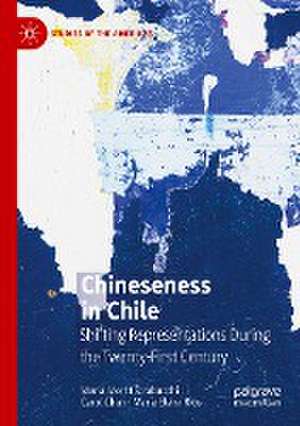
Chineseness in Chile: Studies of the Americas
Autor Maria Montt Strabucchi, Carol Chan, María Elvira Ríosen Limba Engleză Paperback – 17 dec 2022
| Toate formatele și edițiile | Preț | Express |
|---|---|---|
| Paperback (1) | 666.91 lei 6-8 săpt. | |
| Springer – 17 dec 2022 | 666.91 lei 6-8 săpt. | |
| Hardback (1) | 670.80 lei 6-8 săpt. | |
| Springer – 16 dec 2021 | 670.80 lei 6-8 săpt. |
Din seria Studies of the Americas
- 15%
 Preț: 669.59 lei
 - 15%
 Preț: 624.46 lei
 -
 Preț: 214.06 lei
 -
 Preț: 371.00 lei
 - 15%
 Preț: 619.45 lei
 -
 Preț: 371.37 lei
 - 18%
 Preț: 756.50 lei
 - 15%
 Preț: 611.12 lei
 -
 Preț: 368.59 lei
 -
 Preț: 369.16 lei
 -
 Preț: 372.15 lei
 - 18%
 Preț: 699.18 lei
 -
 Preț: 366.95 lei
 -
 Preț: 383.03 lei
 - 18%
 Preț: 708.30 lei
 - 15%
 Preț: 616.45 lei
 -
 Preț: 369.36 lei
 - 15%
 Preț: 479.32 lei
 - 15%
 Preț: 670.68 lei
 - 15%
 Preț: 489.99 lei
 -
 Preț: 368.05 lei
 -
 Preț: 292.10 lei
 - 15%
 Preț: 615.35 lei
 -
 Preț: 287.45 lei
 - 15%
 Preț: 662.65 lei
 -
 Preț: 369.53 lei
 -
 Preț: 369.90 lei
 - 15%
 Preț: 457.22 lei
 - 15%
 Preț: 484.04 lei
 - 15%
 Preț: 455.31 lei
 - 15%
 Preț: 610.33 lei
 - 18%
 Preț: 918.59 lei
 -
 Preț: 375.27 lei
 - 18%
 Preț: 697.98 lei
 - 15%
 Preț: 612.05 lei
 -
 Preț: 371.73 lei
 -
 Preț: 402.52 lei
 -
 Preț: 369.36 lei
 - 18%
 Preț: 865.68 lei
 -
 Preț: 289.54 lei
 - 18%
 Preț: 859.33 lei
 -
 Preț: 372.50 lei
 -
 Preț: 373.98 lei
 -
 Preț: 374.91 lei
 - 15%
 Preț: 617.57 lei
 -
 Preț: 373.40 lei
Preț: 666.91 lei
Preț vechi: 784.60 lei
-15%
Puncte Express: 1000
Preț estimativ în valută:
117.90€ • 137.17$ • 102.56£
117.90€ • 137.17$ • 102.56£
Carte tipărită la comandă
Livrare economică 17 aprilie-01 mai
Specificații
ISBN-13: 9783030839680
ISBN-10: 3030839680
Pagini: 252
Ilustrații: XIII, 236 p. 25 illus., 20 illus. in color.
Dimensiuni: 148 x 210 x 14 mm
Greutate: 0.33 kg
Ediția:1st ed. 2022
Editura: Springer
Seria Studies of the Americas
Locul publicării:Cham, Switzerland
ISBN-10: 3030839680
Pagini: 252
Ilustrații: XIII, 236 p. 25 illus., 20 illus. in color.
Dimensiuni: 148 x 210 x 14 mm
Greutate: 0.33 kg
Ediția:1st ed. 2022
Editura: Springer
Seria Studies of the Americas
Locul publicării:Cham, Switzerland
Cuprins
Chapter 1. Introduction: Chineseness in Chile.- Chapter 2. The Enduring Duality of Chineseness.- Chapter 3 – Dynamics of In/comprehensibility.- Chapter 4. Raialized Femininities and Masculinities, and the Queerness of the Ethnic Chinese.- Chapter 5. Marca Chile, Marca China.- Chapter 6. Many-faced Orientalism: Racism and Xenophobia in a Time of the Novel Coronavirus Covid-19.- Chatper 7. Conclusion.- Chapter 8. Deciphering the Written and Spoken “Chinese:” “Me Estás Hablando en Chino”.
Notă biografică
Maria Montt Strabucchi is Assistant Professor in the Institute of History and Member of the Center for Asian Studies at the Pontificia Universidad Católica de Chile.
Carol Chan is Associate Professor of Sociology at Universidad Academia de Humanismo Cristiano, Chile.
María Elvira Ríos is a researcher in the Institute of Aesthetics at the Pontificia Universidad Católica de Chile.
Carol Chan is Associate Professor of Sociology at Universidad Academia de Humanismo Cristiano, Chile.
María Elvira Ríos is a researcher in the Institute of Aesthetics at the Pontificia Universidad Católica de Chile.
Textul de pe ultima copertă
This book explores the role of Chineseness or lo chino in the production of Chilean national identity. It does so by discussing the many voices, images, and intentions of diverse actors who contribute to stereotyping or problematizing Chineseness in Chile. The authors argue that in general, representing and perceiving China or Chineseness as the Other is part of a broader cultural and political strategy for various stakeholders to articulate Chile as either a Western country or one that is becoming-Western. The authors trace the evolution of the symbolic role that China and Chineseness play in defining racial, gendered, and class aspects of Chilean national social imaginary. In doing so, they challenge a common idea that Chineseness is a stable signifier and the simplistic perception of the ethnic Chinese as the unassimilable foreigner within the nation. In response, the authors call for a postmigrant approach to understanding identities and Chilean society beyond stubborn Orient-Occident and us-them dichotomies.
Maria Montt Strabucchi is Assistant Professor in the Institute of History and Member of the Center for Asian Studies at the Pontificia Universidad Católica de Chile.
Carol Chan is Associate Professor of Sociology at Universidad Academia de Humanismo Cristiano, Chile.
María Elvira Ríos is a researcher in the Institute of Aesthetics at the Pontificia Universidad Católica de Chile.
Maria Montt Strabucchi is Assistant Professor in the Institute of History and Member of the Center for Asian Studies at the Pontificia Universidad Católica de Chile.
Carol Chan is Associate Professor of Sociology at Universidad Academia de Humanismo Cristiano, Chile.
María Elvira Ríos is a researcher in the Institute of Aesthetics at the Pontificia Universidad Católica de Chile.
Caracteristici
Argues that the figure of the Chinese person has been essential to the production of Chilean national identity Describes that the identity of the Chilean nation has historically excluded the Chinese, blacks, and indigenous Traces the evolution of the role Chineseness plays in defining racial and class aspects of Chilean national identity