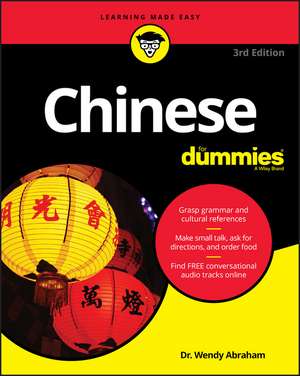
Chinese for Dummies
Autor Wendy Abrahamen Limba Engleză Paperback – 19 sep 2018
Recomandăm Chinese for Dummies, ediția a 3-a, ca resursă fundamentală pentru studenții începători, autodidacți și profesioniștii din mediul de business care doresc să capitalizeze pe creșterea economiei chineze. Notăm cu interes modul în care această ediție revizuită reușește să transforme complexitatea limbii mandarin într-un parcurs accesibil, punând un accent deosebit pe utilitatea practică în tranzacțiile internaționale. Structura volumului este riguros organizată în patru părți: începe cu bazele fonetice și gramaticale, trece prin situații cotidiene de interacțiune socială și cumpărături, culminând cu secțiuni dedicate logisticii călătoriilor și situațiilor de urgență. Găsim în acest manual o progresie logică, de la descifrarea caracterelor la utilizarea tehnologiei și a telecomunicațiilor în China contemporană. Lucrarea extinde cadrul propus de Practice Makes Perfect: Basic Chinese prin integrarea unor scenarii de viață mai diversificate și o abordare mai puțin formală, orientată spre conversație. În contextul operei autoarei Wendy Abraham, acest titlu reprezintă pilonul central care sintetizează tehnicile de scriere explorate în Chinese Character Writing for Dummies și vocabularul funcțional din Chinese Phrases For Dummies. Ediția actuală rafinează explicațiile gramaticale și actualizează terminologia pentru a reflecta realitățile digitale și economice actuale, oferind un suport de curs complet pentru primii ani de studiu.
Preț: 159.09 lei
Carte disponibilă
Livrare economică 11-25 noiembrie
Livrare express 28 octombrie-03 noiembrie pentru 33.34 lei
Specificații
ISBN-10: 1119475449
Pagini: 400
Dimensiuni: 189 x 233 x 22 mm
Greutate: 0.5 kg
Ediția:3rd edition
Editura: Wiley
Locul publicării:Hoboken, United States
V-ar putea interesa
-
 -14%Preț: 71.43 lei83.32 leiRecomandat
 -
 Spanish For DummiesPedro Vazquez BermejoPreț: 122.02 lei
 -
 German Phrases for DummiesPaulina ChristensenPreț: 64.34 lei
 -
 Preț: 42.20 lei
 -
 -17%Preț: 48.25 lei58.40 lei
 -
 Italian All-in-One For DummiesAntonietta Di PietroPreț: 144.74 lei
 -
 Japanese For Dummies, 3rd EditionHiroko M. ChibaPreț: 122.16 lei
 -
 Hebrew For Dummies, 2nd EditionJill Suzanne JacobsPreț: 166.60 lei
 -
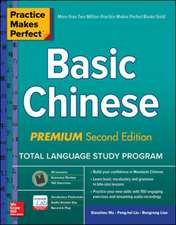 -10%Preț: 126.14 lei139.43 lei
 -
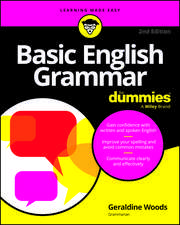 Basic English Grammar For Dummies, 2nd Edition (USA Edition)Geraldine WoodsPreț: 138.84 lei
 -
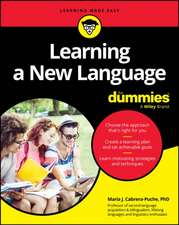 Learning A New Language For DummiesMaria J. Cabrera-PuchePreț: 96.65 lei
 -
 Polish for DummiesDaria GabryanczykPreț: 116.63 lei
 -
 German For DummiesWendy FosterPreț: 141.37 lei
 -
 French for DummiesZoe ErotopoulosPreț: 138.55 lei
 -
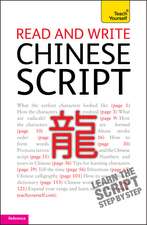 Read and write Chinese script: Teach YourselfSong Lianyi-28%Preț: 87.09 lei120.40 lei
 -
 -19%Preț: 579.91 lei715.94 lei
 -
 Lonely Planet Cantonese Phrasebook & DictionaryChiu-Yee Cheung-11%Preț: 38.75 lei43.31 lei
 -
 -10%Preț: 39.72 lei43.92 lei
 -
 Chinese Made EasyKwoklyn WanPreț: 160.56 lei
Public țintă
Chinese For Dummies, 3rd Edition not only helps beginners, but also those looking to expand their knowledge and vocabulary of Chinese words and phrases. As the Chinese economy continues to grow, the importance of Chinese as a trade language will also increase. Those business professionals who have a basic understanding of the language will be poised to surpass their peers when it comes to dealing with international markets.De ce să citești această carte
Această carte este ideală pentru oricine are nevoie de o bază solidă în limba mandarin, de la zero. Cititorul câștigă nu doar noțiuni de gramatică și vocabular, ci și încrederea de a naviga situații reale de afaceri și călătorie. Este un instrument pragmatic care prioritizează comunicarea eficientă în fața teoriei lingvistice aride, fiind esențial pentru cei care vizează piețele asiatice.
Despre autor
Wendy Abraham este o autoritate în domeniul studiilor asiatice, ocupând funcția de director asociat la Centrul Stanford pentru Studii Budiste. Cu o carieră didactică impresionantă la instituții de prestigiu precum Georgetown University și New York University, ea deține o expertiză profundă în literatura și cultura chineză. Cercetările sale asupra oaselor oracol din dinastia Shang îi conferă o perspectivă unică asupra evoluției scrierii chineze, element care îmbogățește explicațiile etimologice din manualele sale. Experiența sa în coordonarea programelor de limbi străine pentru studenții americani în China se reflectă în abordarea pedagogică eficientă din seria Dummies.
Cuprins
About This Book 1
Foolish Assumptions 3
Icons Used in This Book 4
Beyond the Book 4
Where to Go from Here 5
Part 1: Getting Started with Chinese 7
Chapter 1: Chinese in a Nutshell: The Spoken Word 9
Grasping Chinese Dialects 10
P¿ny¿n Spelling: Beijing, Not Peking 11
Sounding Off: Basic Chinese Sounds 12
Starting off with initials 13
Ending with finals 14
Perfect pitch: Presenting . . . the four tones! 15
Adding Idioms and Popular Expressions to Your Repertoire 17
Chapter 2: The Written Word: Checking Out Chinese Characters 21
Perusing Pictographs, Ideographs, and the Six Scripts 22
The Chinese Radical: A Few Clues to a Character's Meaning 24
Following the Rules of Stroke Order 25
Rule 1 25
Rules 2 through 9 25
Up, Down, or Sideways? Deciphering the Direction of Characters 26
Traditional versus Simplified Characters: When to Use Which 28
Using a Chinese Dictionary . . . without an Alphabet! 29
Chapter 3: Warming Up with the Basics: Chinese Grammar 31
The Basics of Chinese Nouns, Articles, and Adjectives 32
Nouns 33
Definite versus indefinite articles 36
Adjectives 38
Getting into Verbs, Adverbs, Negation, and Possession 39
Verbs 39
Adverbs 44
Bù and méiy¿u: Total negation 44
Getting possessive with the particle de 47
Asking Questions 47
The question particle ma 47
Yes/no choice questions using bù between repeating verbs 47
Interrogative pronouns 48
Chapter 4: Getting Started with Basic Expressions: N¿ H¿o! 51
Making Introductions 52
Acquainting yourself 52
Introducing your friends and family 52
Asking people for their names 53
Greeting and Chatting 55
Addressing new friends and strangers 55
Conversing around the clock 56
Talking about the weather 59
Finding out where people are from 61
Taking (that is, rejecting) compliments 63
Saying goodbye 63
Chapter 5: Getting Your Numbers, Times, and Measurements Straight 65
Counting in Chinese 66
Numbers from 1 to 10 66
Numbers from 11 to 99 67
Numbers from 100 to 9,999 68
Numbers from 10,000 to 100,000 and beyond 69
How 'bout those halves? 69
Ordinal numbers 70
Asking how many or how much 70
Telling Time 71
Asking and stating the time 71
Specifying the time of the day 71
Save the Date: Using the Calendar and Stating Dates 75
Dealing with days of the week 76
Naming the months 77
Specifying dates 77
Celebrating Chinese holidays 80
Sizing Up Weights and Measures 81
Chapter 6: Speaking Chinese at Home 85
Hanging Out at Home 85
Hunting for an Apartment 86
Decorating Your New Digs 89
Appointing Your Rooms, F¿ngshü Style 89
The bedroom 91
The bathroom 92
The kitchen 92
The living room 93
The basement 94
The attic 95
Part 2: Chinese in Action 97
Chapter 7: Getting to Know You: Making Small Talk 99
Establishing a Connection 99
Posing simple introductory questions 102
Chatting about family 103
Making small talk on the job 105
Talking about where you live 108
Chapter 8: Dining Out and Shopping for Food 111
All about Meals 112
Satisfying your hunger 112
Sitting down to eat and practicing proper table manners 114
Getting to Know Chinese Cuisines 115
Dining Out 116
Understanding what's on the menu 118
Placing an order and chatting with the waitstaff 125
Dipping into some dim sum 127
Finding the restrooms 128
Finishing your meal and paying the bill 129
All the Tea in China 130
Taking Your Chinese to Go 131
Making comparisons 131
How much is that thousand-year-old egg? 132
Chapter 9: Shopping Made Easy 137
Going to Stores 137
Getting What You Want at a Department Store 140
Just browsing 141
Asking for help 141
Shopping for Clothes 143
What's your size? 143
Comparing quality: Good, better, best 145
Comparing two items 146
What are you wearing? Chün versus dài 149
Asking about the color and material 150
Shopping for Other Items 151
Hunting for antiques 152
Getting a Good Price and Paying 153
Negotiating prices at the night market 153
Paying for your purchase (or demanding a refund) 154
Chapter 10: Exploring the Town 157
Attending a Performance 157
Exploring different types of music 158
Buying a ticket 160
Asking whether someone has done something 160
Exploring Museums and Galleries 161
Visiting Historical Sites 163
Going to the Movies 165
Hopping Around Bars and Clubs 167
Chapter 11: Taking Care of Telecommunications 169
Getting Familiar with Telephone Terms 169
Going Mobile with a Cellphone 171
Making a Phone Call 172
Calling your friends 173
Ringing hotels and places of business 174
Phoning a client 175
Sorry, I Can't Take Your Call Right Now 177
Listening to messages that people leave you 177
Recording and understanding greeting messages 177
Leaving messages 178
Checking Your Email 180
Going Online 182
The Great Wall Firewall, That Is 183
Chapter 12: Chinese at School and Work 187
Going to School 188
Schools and supplies 188
Teachers and subjects 189
Exams and semesters 190
Degrees and diplomas 191
Settling into Your Office Digs 192
Conducting a Meeting 195
Scheduling and planning a meeting 195
Making the initial greeting 196
Starting the meeting 198
Making a presentation 198
Ending the meeting 199
Discussing Business and Industry 201
Chapter 13: Recreation and Outdoor Activities 207
Naming Your Hobbies 208
Exploring Nature 210
Tapping into Your Artistic Side 213
Striking Up the Band 213
Playing on a Team 215
Part 3: Chinese on the Go 219
Chapter 14: Planning a Trip 221
Talking about When You Want to Travel 221
Celebrating the Chinese Holidays 222
Where To? Deciding on a Destination 223
Passports and Visas: Don't Leave Home without 'Em 227
Packing for Your Trip 228
Enlisting the Help of a Travel Agency 229
Chapter 15: Making Cents of Money 233
Staying Current with Chinese Currency 234
Rénmínbì (RMB) in the PRC 234
X¿n Táibì in the ROC 235
Hong Kong dollars 236
Singapore dollars 236
Exchanging Money 236
Spending Money 239
Using cash 240
Paying with plastic 241
Doing Your Banking 242
Making withdrawals and deposits 243
Accessing an ATM 244
Tips on Tipping 244
Chapter 16: Getting Around 249
Flying Around the Airport 249
Making it past the check-in counter 250
Boarding your flight 253
Going through customs 254
Navigating Around Town 257
Hailing a cab 257
Hopping on the bus 260
Riding the rails 262
Chapter 17: Asking for Directions 267
Avoiding 20 Questions: Just Ask "Where?" 267
Different strokes for different folks: Saying n¿r versus saying n¿l¿ 269
Getting direction about directions 270
Understanding the answers to "where" questions 271
Expressing Distances (Time and Space) with Lí 274
Using Ordinal Numbers to Clarify Points of Reference 276
Specifying Cardinal Points 276
Chapter 18: Finding a Place to Stay 281
Making a Room Reservation 282
Checking In Before You Hit the Pool 285
Taking Advantage of Hotel Service 287
Counting on convenience 287
Getting problems fixed 288
Checking Out Before Heading Out 292
Chapter 19: Handling Emergencies 297
Calling for Help in Times of Need 297
Receiving Medical Care 298
Deciding whether to see a doctor 299
Describing what ails you 300
Discussing your medical history 305
Making a diagnosis 306
Treating yourself to better health 308
Calling the Police 308
Acquiring Legal Help 309
Part 4: The Part of Tens 311
Chapter 20: Ten Ways to Learn Chinese Quickly 313
Listen to Chinese Being Spoken 313
Check Out a Peking Opera Performance 314
Cook with a Wok 314
Shop for Food in Chinatown 314
Search Online 315
Watch Kung-Fu Flicks 315
Exchange Language Lessons 315
Make Chinese Friends 316
Study Chinese Calligraphy 316
Be Curious and Creative 316
Chapter 21: Ten Things Never to Do in China 317
Never Accept a Compliment Graciously 317
Never Make Someone Lose Face 318
Never Get Angry in Public 318
Never Address People by Their First Names First 318
Never Take Food with the Wrong End of Your Chopsticks 319
Never Drink Alcohol Without First Offering a Toast 319
Never Let Someone Else Pay the Bill Without Fighting for It 319
Never Show Up Empty-Handed 320
Never Accept Food, Drinks, or Gifts Without First Refusing a Few Times 320
Never Take the First "No, Thank You" Literally 320
Part 5: Appendixes 321
Appendix A: Chinese-English Mini-Dictionary 323
Appendix B: Chinese Verbs 355
Appendix C: Fun & Games Answer Key 359
Index 365
Notă biografică
Descriere scurtă
With more than 1.2 billion speakers across the globe - and with nearly 3 million in the U.S. alone - Mandarin Chinese claims the top spot as the world's most common language. If you want to learn this language to get ahead at school or work, or to make your travel to China easier, this is the handy reference you'll want by your side.
Chinese For Dummies teaches basic grammar, as well as the necessary vocabulary to make introductions and greetings, use proper etiquette, make small talk, make transportation arrangements, order food and beverages, ask directions, deal with money, shop, access recreation, and handle an emergency.
- Concentrates on Mandarin Chinese and features new and revised content
- Includes major updates to all the necessary foundational information needed to speak Chinese
- Covers grammar, verb conjugations, and pronunciations
- Offers a refreshed mini-dictionary complete with even more vocabulary
- Find free conversational audio tracks online