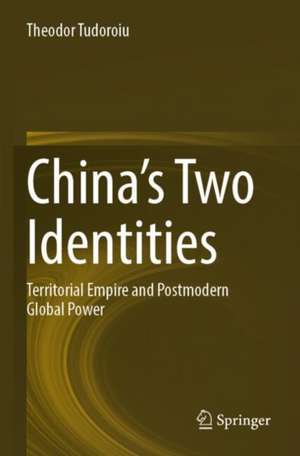
China's Two Identities
Autor Theodor Tudoroiuen Limba Engleză Paperback – 9 iun 2025
Preț: 820.98 lei
Preț vechi: 1080.24 lei
-24%
Puncte Express: 1231
Carte disponibilă
Livrare economică 13-19 noiembrie
Livrare express 03-07 noiembrie pentru 80.57 lei
Livrare prin curier în România Termenul estimat este afișat lângă disponibilitate.
Transport gratuit pentru acest produs Plată online sau ramburs, în funcție de opțiunile comenzii.
Retur gratuit în 14 zile Comandă securizată și suport în română.
Specificații
ISBN-13: 9789819728855
ISBN-10: 9819728851
Pagini: 284
Dimensiuni: 155 x 235 x 16 mm
Greutate: 0.44 kg
Editura: Springer
ISBN-10: 9819728851
Pagini: 284
Dimensiuni: 155 x 235 x 16 mm
Greutate: 0.44 kg
Editura: Springer
Cuprins
.- Chapter 1 Introduction.
.- Chapter 2 Constructivist Theoretical Framework.
.- Chapter 3 China as Territorial Empire.
.- Chapter 2 Constructivist Theoretical Framework.
.- Chapter 3 China as Territorial Empire.
Notă biografică
Theodor Tudoroiu is Senior Lecturer at the Department of Political Science of the University of the West Indies, St. Augustine campus. He earned his Ph.D. in Political Science from the Université de Montréal and an M.A. from the College of Europe in Bruges, Belgium. His China-related books include The Myth of China’s No Strings Attached Development Assistance: A Caribbean Case Study (Lexington Books, 2020), China’s International Socialization of Political Elites in the Belt and Road Initiative (Routledge, 2021), China’s Globalization from Below: Chinese Entrepreneurial Migrants and the Belt and Road Initiative (Routledge, 2022), China in The Global South: Impact and Perceptions (co-edited with Anna Kuteleva, Springer, 2022), and The Geopolitics of the Belt and Road Initiative (Routledge, 2024).
Textul de pe ultima copertă
This book presents an original explanation of the stark contrast between two very different Chinese foreign policy patterns. On the one hand, there is Beijing’s hard power actorness related, among others, to territorial disputes and ‘wolf warrior’ intimidating maneuvers. On the other hand, there are China’s peaceful and cooperative actions, well-illustrated by the Belt and Road Initiative. This book shows that this situation is best understood as a consequence of the coexistence of two different Chinese identities respectively associated with the concepts of nineteenth-century-style territorial empire, and twenty-first-century-style postmodern global power. The book contends that in China’s case, they form a virtuous circle—characterized by a specific division of labor—as both identities are instrumental to the construction of a new, Chinese-led international order. The book provides a detailed analysis of the genesis, development, features, and interplay of these identities. It is relevant to scholars in China studies, political history, contemporary politics, and foreign policy.
Caracteristici
Conducts in-depth analysis of present China’s dual identity as a territorial empire and a postmodern global power Presents an original explanation of China’s aggressive and win-win foreign policy patterns Studies the link between China’s identities and the construction of a new, Chinese-led international order