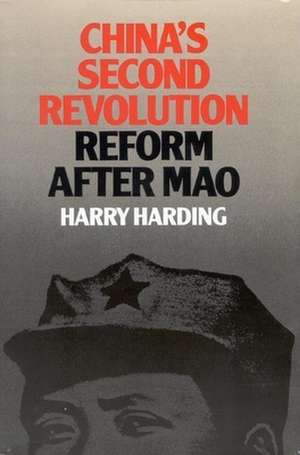
China's Second Revolution
Autor Harry Hardingen Limba Engleză Paperback – dec 1987
China has, since 1976, been enmeshed in an extraordinary program of renewal and reform. The obvious changes—the T-shirts, blue jeans, makeup and jewelry worn by Chinese youth; the disco music blaring from radios and loudspeakers on Chinese streets; the television antennas mushrooming from both urban apartment complexes and suburban peasant housing; the bustling free markets selling meat, vegetables and clothing in China's major cities—reflect a fundamental shift in the government's policy toward the economy and political life.
Although doubts about the long-term commitment to reform arose after the student protests in December 1986 and the dismissal of Party General Secretary Hu Yaobang in January 1987, the scope of reform has been so broad and the pace of change so rapid, that the post-Mao era fully warrants Den Xiaoping's description of it as the "second revolution" undertaken by the Chinese Communist Party.
Although doubts about the long-term commitment to reform arose after the student protests in December 1986 and the dismissal of Party General Secretary Hu Yaobang in January 1987, the scope of reform has been so broad and the pace of change so rapid, that the post-Mao era fully warrants Den Xiaoping's description of it as the "second revolution" undertaken by the Chinese Communist Party.
Preț: 209.66 lei
Puncte Express: 314
Carte tipărită la comandă
Livrare economică 05-19 decembrie
Livrare prin curier în România Termenul estimat este afișat lângă disponibilitate.
Transport gratuit de la 400.00 lei Plată online sau ramburs, în funcție de opțiunile comenzii.
Retur gratuit în 14 zile Comandă securizată și suport în română.
Specificații
ISBN-13: 9780815734611
ISBN-10: 0815734611
Pagini: 392
Dimensiuni: 152 x 229 x 23 mm
Greutate: 0.55 kg
Editura: Brookings Institution Press
ISBN-10: 0815734611
Pagini: 392
Dimensiuni: 152 x 229 x 23 mm
Greutate: 0.55 kg
Editura: Brookings Institution Press
V-ar putea interesa
-
 Edmund BurkeJesse NormanPreț: 94.21 lei
 -
 ArgoAntonio MendezPreț: 101.09 lei
 -
 -34%Preț: 583.85 lei879.20 lei
 -
 Biohackers: The Politics of Open ScienceAlessandro DelfantiPreț: 261.62 lei
 -
 Human Rights in Our Own Backyard – Injustice and Resistance in the United StatesWilliam T. ArmalinePreț: 284.63 lei
 -
 Power Play: The Bush Presidency and the ConstitutionJames P. Pfiffner-23%Preț: 146.73 lei191.40 lei
 -
 Preț: 144.51 lei
Notă biografică
Harry Harding, a senior fellow in the Foreign Policy Studies program at Brookings since 1983, has written several books on China, including Organizing China, the 1986 recipient of the Masayoshi Ohira Memorial Prize. He is coeditor with B
Descriere
China has, since 1976, been enmeshed in an extraordinary program of renewal and reform. The obvious changes—the T-shirts, blue jeans, makeup and jewelry worn by Chinese youth; the disco music blaring from radios and loudspeakers on Chinese streets; the television antennas mushrooming from both urban apartment complexes and suburban peasant housing; the bustling free markets selling meat, vegetables and clothing in China's major cities—reflect a fundamental shift in the government's policy toward the economy and political life.
Although doubts about the long-term commitment to reform arose after the student protests in December 1986 and the dismissal of Party General Secretary Hu Yaobang in January 1987, the scope of reform has been so broad and the pace of change so rapid, that the post-Mao era fully warrants Den Xiaoping's description of it as the "second revolution" undertaken by the Chinese Communist Party.
Although doubts about the long-term commitment to reform arose after the student protests in December 1986 and the dismissal of Party General Secretary Hu Yaobang in January 1987, the scope of reform has been so broad and the pace of change so rapid, that the post-Mao era fully warrants Den Xiaoping's description of it as the "second revolution" undertaken by the Chinese Communist Party.